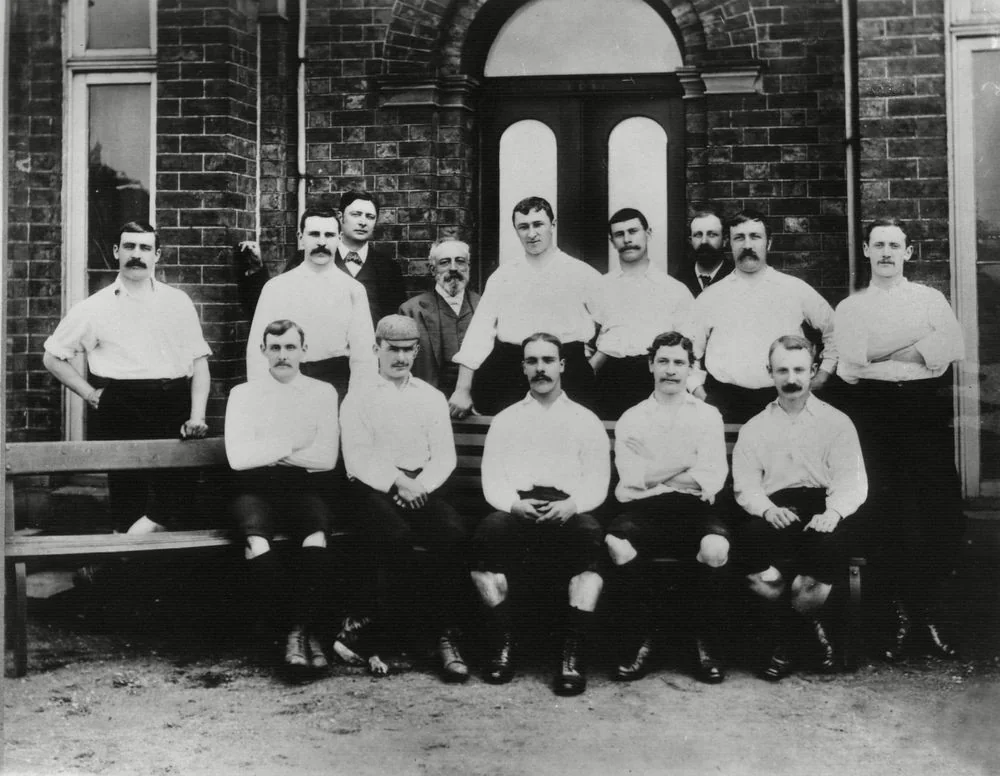
Preston North End won the 1888/89 Football League, finishing with 40 points from 22 matches: 18 wins, four draws and no defeats. Aston Villa were runners-up on 29 points, leaving Preston eleven points clear under the two-points-for-a-win system. The champions also won the FA Cup, giving the original Invincibles a place in football history beyond their position at the top of the table.
This was England's first Football League season, rather than an 1888 Premier League campaign. Some modern databases place old top-flight records under a Premier League heading, but the competition's name and rules must stay attached to their own period. Below are all twelve clubs in their final order, followed by an explanation of the scoring, tied places and Preston's achievement. For the longer chronology, the English top-flight winners list connects this first championship with later eras.
What was the final 1888/89 Football League table?
The final standings below use the historical points system and final order. P means league matches played; W, D and L mean wins, draws and defeats. The points total is two times wins plus draws. Every club completed 22 league matches, so these are completed-season records, rather than a table from the first few months. FA Cup results and friendlies do not contribute to any row. Keeping those boundaries clear is particularly useful when reading about Preston's league-and-cup Double.
| Pos | Club | P | W | D | L | Pts |
|---|---|---|---|---|---|---|
| 1 | Preston North End | 22 | 18 | 4 | 0 | 40 |
| 2 | Aston Villa | 22 | 12 | 5 | 5 | 29 |
| 3 | Wolverhampton Wanderers | 22 | 12 | 4 | 6 | 28 |
| 4 | Blackburn Rovers | 22 | 10 | 6 | 6 | 26 |
| 5 | Bolton Wanderers | 22 | 10 | 2 | 10 | 22 |
| 6 | West Bromwich Albion | 22 | 10 | 2 | 10 | 22 |
| 7 | Accrington | 22 | 6 | 8 | 8 | 20 |
| 8 | Everton | 22 | 9 | 2 | 11 | 20 |
| 9 | Burnley | 22 | 7 | 3 | 12 | 17 |
| 10 | Derby County | 22 | 7 | 2 | 13 | 16 |
| 11 | Notts County | 22 | 5 | 2 | 15 | 12 |
| 12 | Stoke | 22 | 4 | 4 | 14 | 12 |
The smaller field explains the match count. With twelve members, each club had eleven opponents, played once at home and once away: 22 fixtures per team. Multiply twelve clubs by 22 and divide by two, because each game belongs to two club records, and the competition contains 132 fixtures. This was a complete league programme for its membership, rather than an incomplete version of today's 38-game campaign. Comparing only the totals without the number of opponents misses what each side had to complete.
Preston's zero in the defeats column is the obvious landmark, but the lower rows also reward a closer look. Accrington finished above Everton despite winning fewer games, because both reached 20 points and the contemporary ranking rules then applied. Notts County and Stoke also finished level on points. Their order cannot be settled by simply sorting whichever modern-looking column a database happens to display. Nor should today's relegation conventions be attached automatically to those bottom positions: the league's membership arrangements were different.
How were points and tied places decided?
The table belongs to a competition that was still establishing its procedures. The league's historical accounts record that the two-points-for-a-win system was settled after the first campaign had already begun. The final totals should therefore be read using that adopted system, rather than assuming today's conventions were all fixed before the opening day. It is a small administrative detail with a large effect on how impressive, or otherwise, a points total looks.
Scoring and separating tied clubs are different operations. First, calculate the points each side earned. Only when clubs finish level does the next ranking rule become relevant. A modern Premier League table provides a familiar-looking set of columns, but a familiar layout does not establish the rules for a Victorian season. Read the scoring convention and the tiebreak before comparing positions; otherwise an apparently tidy numerical sort can produce a historically wrong order.
Why did Preston finish with 40 points rather than 58?
Preston earned two points for each of their 18 wins and one for each of their four draws: 36 plus four equals 40. With 22 matches, the maximum under that system was 44 points. Their total therefore describes an exceptionally successful campaign, rather than a modern-looking struggle to reach a survival target. The four matches they did not win were draws, not defeats; the unbeaten record and the four dropped points are fully consistent with one another.
Applying today's three-point win value to the same results would produce 58: 18 times three, plus four draws. That is a hypothetical conversion, not Preston's official 1889 total. It can help explain a scale, but it does not recreate a competition played with different incentives, nor turn a 22-game programme into a 38-match modern season. When comparing eras, keep the original points alongside the number of games and any clearly labelled calculation. A converted number should add context, rather than quietly replace the historical record.
What did goal average mean?
Goal average meant goals scored divided by goals conceded. It was a ratio, rather than the subtraction used for goal difference. Notts County and Stoke provide a useful example: both ended on twelve points, but County's 40 divided by 73 gives about 0.548, while Stoke's 26 divided by 51 gives about 0.510. County's higher ratio put them eleventh, with Stoke twelfth. The decimal is not a points total or the average number of goals scored per match; it compares scoring with conceding.
If you instead subtracted goals against from goals for, County would have minus 33 and Stoke minus 25. That different calculation would favour Stoke, which shows why importing a modern goal-difference sort changes the historical order. Goal average still came after points: a better ratio did not allow a club to leapfrog another side that had earned more points. For an old table, understanding which arithmetic belongs to which stage is more valuable than assuming the club with the most attractive goals column must rank higher.
Why were Preston North End called the Invincibles?
Preston completed their entire league programme without losing. Their 18 victories and four draws covered home and away meetings with every other member, so the unbeaten record was not simply a run against a selected group of opponents. “Invincibles” captures that absence of defeat. It does not mean the side won all 22 matches, and it should not be used to erase the draws that formed part of the achievement. The final row of results tells the story more precisely than the nickname alone.
The accomplishment also shows why a league championship is more than a memorable final afternoon. A club must collect results across its programme; one spectacular victory does not replace the rest of those encounters. Preston combined that repeated success with the distinction of never allowing an opponent to beat them in the league. The record establishes their dominance within the inaugural competition. Claims about every friendly, exhibition or other match require their own evidence, because those games do not appear in the league table.
How did the FA Cup make it an unbeaten Double?
The Double means winning the league championship and the FA Cup in the same season. Preston added the cup by beating Wolverhampton Wanderers 3–0 in the final. That match was a separate knockout final, rather than a play-off to decide the Football League champion. Its goals did not add points to the table, and Wolves' defeat did not alter their third-place league finish. The two trophies belonged to different competitive routes, even though familiar opponents appeared in both.
An important detail is often blurred in retelling: Preston conceded no goals during their FA Cup run, but they did concede in the league. Their league figures were 74 scored and 15 conceded. The accurate distinction is therefore an unbeaten league season alongside a cup campaign completed without conceding. Saying that the Invincibles never let in a goal across the whole season would turn a remarkable achievement into a different, incorrect one. Keep the competition label beside any goals figure you quote.
Together, those records demonstrate two forms of success. The league rewarded results over repeated home-and-away meetings; the cup required progress through successive knockout ties. Winning both gave Preston's year a broader significance than the points margin alone. It also offers a better basis for historical discussion than an argument over which era's players would win an imagined match. The difference between league and FA Cup football remains useful today, even though the size, rules and surroundings of the competitions have changed considerably since 1889.
Who were the twelve founder clubs?
All twelve names appear in the standings above, but their shared setting matters as much as the list. The first membership came from the Midlands and the North of England. This was the membership of a newly organised league, rather than a list of every club already playing football in England. A famous club missing from the table was not necessarily yet to exist; it simply did not belong to this particular twelve-member competition.
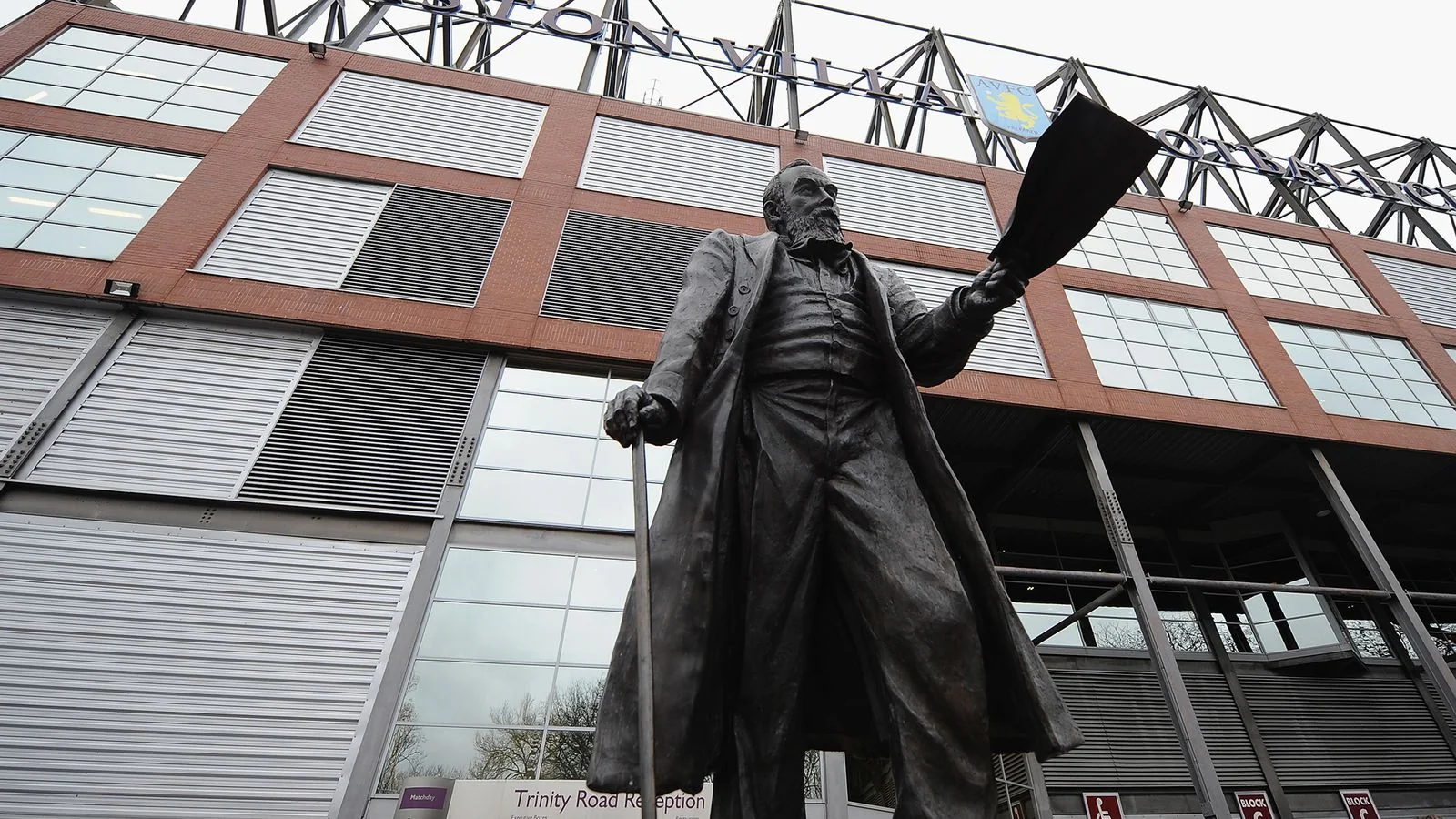
William McGregor, associated with Aston Villa, proposed a regular home-and-away programme because arranging dependable fixtures had become a problem. Clubs employing professional players needed matches and income, while cup progress and cancelled friendly arrangements could disrupt their plans. A league offered a shared programme against agreed opponents. That background helps explain why the table was such an important innovation: the clubs were measuring success within a continuing set of commitments, rather than relying only on isolated cup ties and individually arranged games.
Read the names in their historical form. The Accrington in the inaugural table was Accrington FC, not Accrington Stanley; a shared town name should not be used to merge distinct club histories. Stoke is also retained as the name used for the original member, rather than automatically applying a later form everywhere. Modern badges, abbreviations and database categories can make an old table easier to navigate, but they do not always preserve these distinctions. The name is part of the record, rather than decorative text beside the numbers.
Membership was different from the modern promotion-and-relegation system, too. Stoke finished last but were re-elected at the annual meeting in 1889. Being bottom therefore did not produce the same automatic consequence that a supporter might expect from today's Premier League. The table records a sporting order; the period's membership process explains what happened next. If you want to connect these original arrangements with the later divisions, the guide to English football's league structure provides the broader context without treating 1888 as a ready-made version of the current pyramid.
How does 1888/89 relate to the first Premier League season?
The Premier League began in 1992, when the leading clubs broke away from the Football League and established a separately organised competition. Its first season was 1992/93, with Manchester United as champions. That was a new era for the English top flight, rather than the start of English football itself. The history before it remains part of the country's league championship story, but those earlier seasons did not take place under the Premier League name.
| Comparison | 1888/89 | 1992/93 |
|---|---|---|
| First season of | The Football League | The Premier League |
| Member clubs | 12 | 22 |
| League matches per club | 22 | 42 |
| Champion | Preston North End | Manchester United |
This gives two accurate answers to a question that otherwise sounds contradictory. Preston were the first Football League champions; Manchester United were the first Premier League champions. If someone asks for “the first Premier League table” and means 1992/93, the complete inaugural Premier League standings are the relevant record. If they mean the beginning of organised English league football, the twelve-club table on this page answers that different question. Supplying the competition and season alongside the word “first” resolves the ambiguity without diminishing either achievement.
The boundary matters for cumulative records as well. An all-time Premier League table begins with the competition's 1992 starting point; an all-era top-flight history reaches further back and needs its own scope. Adding old results to a since-1992 table without changing the label would answer neither question cleanly. Likewise, the Football League's later position below the Premier League should not be projected backwards onto its original championship. In 1888/89, this was the leading league competition itself. Use the period's structure when describing its status, rather than reading today's hierarchy into every earlier season.
How can you read an old league table without mixing the records?
Start with the date and the played column. Preston completed their own 22-match league programme on 9 February 1889, but the competition's last fixture was not until 20 April, when Accrington beat Stoke 2–0. A table from February can therefore show Preston's final record beside other clubs' unfinished records. The champion's last league match, the day a title is secured and the league's final fixture are different milestones. Choosing the wrong one can make an apparently authoritative season table answer the wrong question.
- Identify the season and competition. Distinguish the 1888/89 Football League from the Premier League's later history.
- Read the table date. Confirm whether it is final standings or a snapshot after a particular day's games.
- Check matches played. A completed record for one club does not establish that every opponent has finished.
- Keep the original rules. Separate historical points and goal average from modern conversions or sorting options.
- Preserve club identities. Treat historical names and current database labels with care.
- Separate competitions. League points, cup scores and all-competition totals belong to different records.
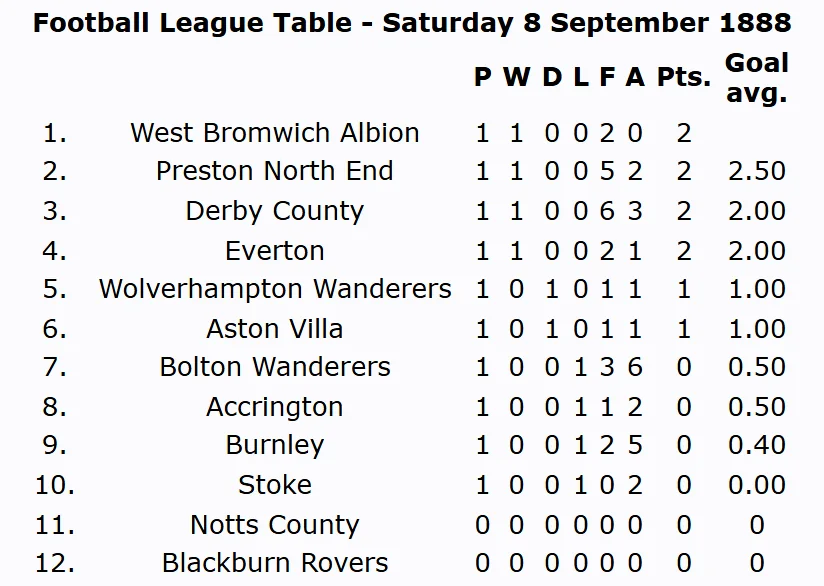
The opening-day snapshot below is another example of why the heading matters: some clubs have played once and others not at all. It is useful evidence of how the programme began, but cannot replace the final 22-game table. Similarly, a modern site's category headed “Premier League” can be a convenient route through its database rather than an accurate name for the 1888 competition. Read the dated record underneath the navigation, and keep the historical identities intact when using it elsewhere.
Choose the record that matches the question you are asking. Use this final table for the first Football League standings, a club-season account for its separate league and cup campaigns, and the all-time Premier League table for results within the since-1992 competition. The connection between those histories is worth understanding, but combining their totals without their labels loses the very distinctions that make Preston's first championship meaningful. Correct dates, competition names and scoring rules let the numbers describe the football that was actually played.
Comments
Ask a useful question or share a helpful tip. Comments are reviewed before publication.
Loading comments…