
The English men's football leagues run from the Premier League at Level 1, through the EFL Championship, League One and League Two at Levels 2-4, then into non-league with the National League at Level 5. From there, the National League System branches into northern, southern and more local divisions. Its Step 1 equals overall Level 5, so the two numbering systems do not start at the same point.
This guide covers the connected adult men's pyramid down to National League System Step 6, which is commonly shown as overall Level 10. The women's pyramid is a separate competition structure and the FA uses “Tier” terminology for it; youth, reserve and Sunday football also sit outside the table below. That scope matters because combining those systems would create an order that no club can actually follow through ordinary promotion and relegation.
Use the chart as a map, not as a permanent list of every division. The top four Levels are single nationwide divisions, but parallel regional leagues multiply below them. The non-league detail here reflects the FA's initial 2026/27 allocations, which can still be adjusted after appeals or other amendments. For the live top-flight match list, start with the Premier League schedule; use this page to understand where that competition sits in the wider game.
English men's football pyramid in order
The simplest complete answer is a ten-Level map: four nationwide Premier League/EFL divisions, followed by six National League System Steps. The table uses the FA's initial 2026/27 allocations for the non-league rows. Those allocations are operational rather than eternal; appeals, club movements and later amendments can alter an individual club's destination.
| Overall Level | NLS Step | Division or division group | 2026/27 shape |
|---|---|---|---|
| 1 | — | Premier League | 1 national division |
| 2 | — | EFL Championship | 1 national division |
| 3 | — | EFL League One | 1 national division |
| 4 | — | EFL League Two | 1 national division |
| 5 | Step 1 | National League | 1 national division |
| 6 | Step 2 | National League North and National League South | 2 regional divisions |
| 7 | Step 3 | Premier divisions of the Isthmian, Northern Premier and Southern league families | 4 regional divisions |
| 8 | Step 4 | Regional divisions in those three league families | 8 regional divisions |
| 9 | Step 5 | Regional National League System divisions | 16 regional divisions |
| 10 | Step 6 | More local National League System divisions | 17 regional divisions |
Read each lower row horizontally. A Level 7 club plays in one of four Step 3 divisions, not in a single 88-club competition and not in all four. The branching helps contain travel while keeping promotion routes pointed upward. Across Steps 1-6, the FA's May 2026 announcement allocated 996 clubs to 48 divisions run by 19 leagues; “48 divisions” and “19 leagues” therefore describe different things.
“Non-league” starts below the EFL block, not below organised competition. National League and regional clubs play scheduled leagues with tables, champions, relegation places and playoffs. The label also does not reliably mean amateur: it identifies a place outside the Premier League and EFL, while clubs' employment and operating models vary. For the changing Level 1 order, use the live Premier League table rather than this structural map.
Premier League and EFL: the top 92 clubs
The phrase “top 92” means the 20 Premier League members plus the 72 clubs of the English Football League. The EFL's 72 are divided evenly among the 24-club Championship, League One and League Two. This is a useful administrative and historical block, but it is not a safe line between professional and amateur football: clubs below League Two can also operate professionally.
The Premier League and EFL are separate competition organisers, yet their divisions form one sporting ladder. A Premier League club can fall into the EFL Championship, while a Championship club can rise into the Premier League. Promotion and relegation therefore change which organisations a club plays under without placing it outside the connected pyramid.

The cleanest mental model is one Level 1 division followed by three EFL Levels. Do not memorize the 92 as permanent club names, because the membership changes at both ends of the block. The number stays stable in the normal format while promoted and relegated clubs trade places across its boundaries.
Level 1: Premier League
The Premier League is the single nationwide division at the pyramid's summit. Its 20 clubs play one another home and away, producing 38 league matches per club. That familiar format explains why a supporter following the Premier League schedule sees only one competition table at Level 1 rather than regional sections.
The bottom is open to movement. Clubs finishing 18th, 19th and 20th are relegated to the Championship, and three Championship clubs replace them for the next season. That exchange is why “Premier League club” describes current membership, not a permanent status. One of the three incoming places is normally won through the Championship playoffs, so “three promoted” should not be read as three automatic places.
Levels 2-4: Championship, League One and League Two
The EFL begins immediately below the Premier League. The Championship is Level 2, League One is Level 3 and League Two is Level 4. Under the normal constitution, each has 24 clubs, making 72 EFL members in all. The qualification matters because regulations can address vacancies or exceptional adjustments; 24 is the standard structure, not a law of nature.
A 24-club double round robin gives each side 46 league matches, eight more than a Premier League club plays. “EFL” is the umbrella organisation for all three divisions, while “the Championship” means only its highest division. That distinction prevents a common ordering error in which League One and League Two are mistakenly treated as being outside the Football League.
Levels and Steps are not the same numbering system
A Level counts position from the top of the entire pyramid: Premier League Level 1, Championship Level 2 and so on. A Step counts position only inside the FA's National League System. When that lower-system counter starts at Step 1, four overall Levels have already passed. The National League can therefore be Level 5 and Step 1 simultaneously, just as one address can include both a building floor and a room number.
This guide deliberately does not use “Tier” as a casual substitute. In current FA stadium-accreditation language, men's National League System positions are Steps while the separate women's football pyramid uses Tiers. “Overall Level” remains a useful explanatory convention for connecting the Premier League, EFL and NLS on one page, but official lower-system rules and allocations are written by Step.
How NLS Steps map to overall Levels
For the six NLS rows in this guide, the translation is simple: add four to the Step number to get the overall Level. Step 1 is Level 5, Step 2 is Level 6, Step 3 is Level 7, Step 4 is Level 8, Step 5 is Level 9 and Step 6 is Level 10. The shortcut applies to this men's National League System range only.
Test it with club descriptions. A National League side at Step 1 sits on overall Level 5; a club in an Isthmian, Northern Premier or Southern Step 4 division sits on Level 8. The arithmetic is safer than treating “Step 1” as the top of all English football. It should not be extended to the women's Tier system or used to invent a uniform Step number for every local league below Step 6.
Why the pyramid becomes regional
Regionalisation makes a broad lower pyramid workable. Step 1 has one nationwide National League; Step 2 splits into North and South; the initial 2026/27 map then has four Step 3 divisions and eight at Step 4 before widening again. Shorter journeys can support economic viability, while geography and suitable facilities help the FA place clubs in an appropriate competition.
A regional assignment is not itself a ranking change. A club may be moved laterally into another division at the same Step to balance geography after promotions, relegations, resignations or appeals. Its division name can change while its overall Level stays the same. That is why the FA labels its May lists as allocations and warns they remain subject to amendment; readers should verify a club's current league instead of treating last season's regional label as permanent.
How promotion and relegation connect the pyramid
The pyramid is connected because clubs move between adjacent Levels at season's end. Some places are automatic, others are won through playoffs, and relegated clubs move the opposite way. More than one rulebook is involved: Premier League and EFL provisions govern the top gateways, while FA National League System regulations govern most movement within Steps 1-6.
League position is central, but lower-pyramid movement is not an unconditional elevator. Entry rules, stadium accreditation, vacancies, appeals and geographic allocation can affect the destination or eligibility of a club. A promoted regional side may also enter the geographically appropriate division rather than a permanently paired league. Match volume changes with divisional size too, a distinction explained in our guide to how many league matches a team plays.
Premier League and EFL movement
Between Levels 1 and 2, three clubs change places in each direction. The Premier League's 18th-, 19th- and 20th-placed sides go down. The Championship's top two rise automatically, while one more club is promoted by winning the playoffs. Check the live Premier League table for positions, but remember that the final table—not a mid-season snapshot—determines relegation.
The Championship-League One gateway also moves three clubs each way. The bottom three Championship teams are relegated; the top two in League One go up automatically, and clubs placed third through sixth contest playoffs that produce one additional promoted side. Four playoff entrants do not mean four promotion places.
Between League One and League Two, the flow expands to four. League One's bottom four are relegated. League Two sends up its top three automatically and one playoff winner, with the playoff field drawn from fourth through seventh. These are the current handbook mechanics; future competition rule changes should be checked before applying the same numbers to a later season.
The League Two-National League gateway
The gateway from non-league into the EFL exchanges two clubs under the current format. League Two's bottom two go down to the National League. The National League champion takes one route upward, while another promoted club emerges through the competition's playoff process. EFL admission remains subject to the handbook's eligibility and other conditions, so “finished high enough” should not be rewritten as unconditional entry.
This boundary also shows why sources matter. FA National League System regulations govern movements within Steps 1-6 but explicitly leave Step 1-to-EFL promotion outside their scope; the EFL handbook controls that upward doorway. The separate jurisdictions do not break the pyramid. They explain why a complete movement answer sometimes needs both documents instead of one simplified chart.
Non-league Steps 1-6 explained
The National League System is a managed network rather than one competition with six divisions. For its initial 2026/27 allocation, the FA placed 996 clubs in 48 divisions run by 19 leagues across Steps 1-6. Those numbers show both scale and branching, but they are date-stamped: appeals and amendments can change an allocation after the first list is released.
| NLS Step | Overall Level | Initial 2026/27 structure | How to read it |
|---|---|---|---|
| 1 | 5 | National League; 1 national division | Top of non-league and the EFL gateway |
| 2 | 6 | National League North and South; 2 divisions | Champions and playoff routes point to Step 1 |
| 3 | 7 | 4 premier divisions across Isthmian, Northern Premier and Southern league families | Regional champions and playoff routes point to Step 2 |
| 4 | 8 | 8 regional divisions in the same three league families | Promotion feeds geographically appropriate Step 3 divisions |
| 5 | 9 | 16 regional divisions | Local geography becomes more prominent |
| 6 | 10 | 17 regional divisions | Connects upward and receives clubs from feeder football |
FA knockout competitions offer a useful memory aid, although they do not determine league movement. For eligible 2026/27 entrants, the FA Trophy covers NLS Steps 1-4, while the FA Vase covers Steps 5-6. Stadium and other entry criteria still apply, and winning either cup does not promote a club.
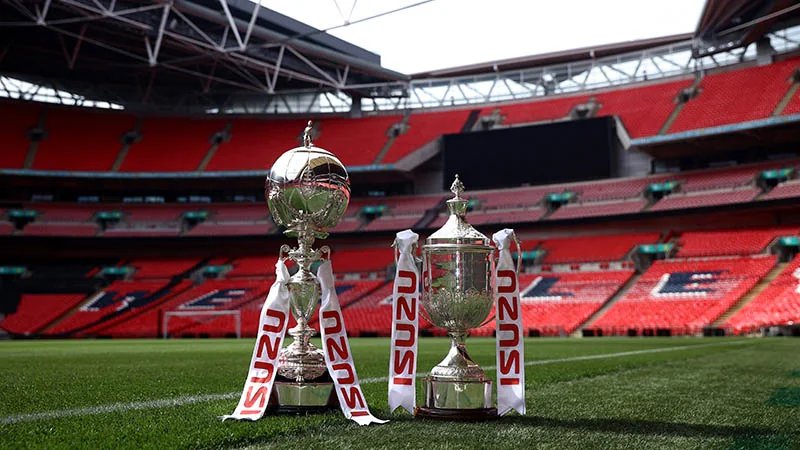
For an individual club, the reliable route is season-specific: find its current Step, read that competition's promotion places, then check FA eligibility and allocation decisions. A finishing position can earn promotion consideration, but the destination may be the geographically appropriate division rather than the league a fan expected from last season's map. This is why official allocations are more dependable than a timeless pyramid graphic.
What sits below Step 6?
English football does not stop at Level 10. Regional feeder leagues sit beneath Step 6, and the FA's 2026/27 allocation announcement counted clubs promoted from that feeder level into the National League System. Level 10 is therefore the bottom of this guide's standardized NLS table, not the bottom of all competitive men's football in England.
Below that boundary, a single national row becomes misleading. Local league names, division structures and geographic relationships vary, and entry into Step 6 can depend on sporting results, vacancies, eligibility and facilities. A local club may have a connected upward opportunity without every league supplying one automatic promotion place in every season. For a specific team, its county FA and current competition documents are better than a generic “Level 11” graphic.
The table also excludes systems that are separate rather than simply lower. The women's football pyramid has its own competitions and FA Tier language; youth and reserve leagues classify teams by different purposes; Sunday and other grassroots structures are not inserted into the adult men's NLS order here. Keeping those boundaries visible prevents an easy-looking chart from inventing promotion links that do not exist.
How to use the pyramid as a supporter
Use the pyramid to orient yourself, then switch to the source that matches the live question. A structural chart tells you that League Two is Level 4; it cannot tell you whether one club has clinched promotion tonight. Likewise, a current match list answers “when do they play?” but does not explain why the next opponent comes from a different regional division next season.
- Identify the current competition. For a top-flight side, check the Premier League schedule; for National League clubs, use the competition's official club directory.
- Translate its coordinate. Premier League/EFL use overall Levels 1-4; within the NLS, add four to a Step number to obtain Levels 5-10.
- Check live position separately. The Premier League table shows the current race, while the relevant league's table controls lower divisions.
- Confirm seasonal movement. Wait for final outcomes and consult official FA allocations for regional placement; distinguish a debut from a return with the all-time Premier League teams guide.
Time labels are essential. A table before the final whistle shows risk or possibility, not confirmed next-season membership. An FA initial allocation is stronger evidence of a lower club's destination, but it can still change after appeals or amendments. Recording the season and access date keeps a correct pyramid explanation from becoming a false current-club claim.
Frequently asked questions
These answers use the connected adult men's English pyramid and the initial 2026/27 National League System structure. Other football pyramids and later seasonal reallocations need their own current documents, because a short answer is only useful when its competition and date boundaries remain visible.
The questions below clarify the main chart's Level count, the National League's two coordinates, the historical meaning of non-league and the possible route upward. Each answer keeps the same eligibility, geography and multi-season qualifications explained above.
How many levels are in the English football pyramid?
A standard national guide usually shows ten Levels, ending with National League System Step 6 at Level 10. That is not the absolute bottom of English football. Regional feeder leagues continue below and can send eligible clubs into Step 6, but the local structure is too varied to describe as one permanent nationwide Level 11 row.
What level is the National League?
The National League division is overall Level 5 and National League System Step 1. National League North and National League South are one row lower at Level 6/Step 2. Naming the division matters: “National League” can also be used more broadly for the organisation and its competitions, but the singular top division occupies Level 5.
Why is it called non-league if the clubs play in leagues?
“Non-league” historically means outside the Premier League/EFL block, not outside all leagues. Its clubs still compete in organised divisions with fixtures, tables, promotion and relegation. The term is also not a dependable synonym for amateur: employment arrangements vary, while the label identifies a club's place below the Football League boundary.
Can a non-league club reach the Premier League?
Yes—in principle, a club can climb the connected pyramid over multiple seasons. It must progress through the appropriate NLS Steps, satisfy the conditions for EFL entry, and then win promotion from League Two, League One and the Championship. There is no direct jump and no guarantee: results, playoffs, eligibility, stadium requirements and regional allocations can all affect the journey.
Comments
Ask a useful question or share a helpful tip. Comments are reviewed before publication.
Loading comments…