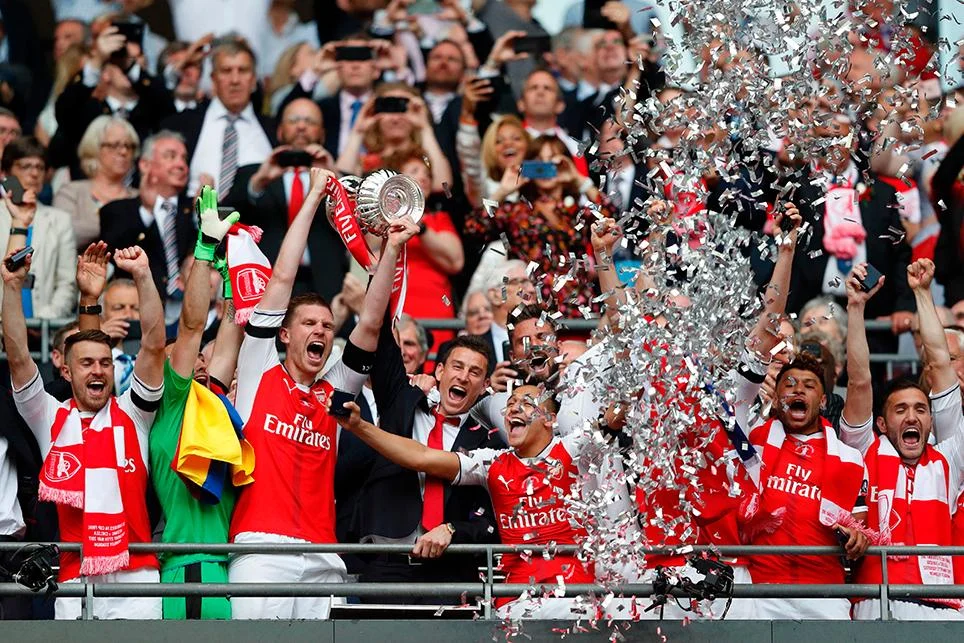
The Premier League is a points-based league; the FA Cup is a knockout competition. In the league, 20 clubs play a season-long home-and-away programme and the top-ranked club becomes champion. In the FA Cup, eligible clubs from different levels of English football progress through cup ties until one wins the final. The same club can play in both during the same season, and winning one does not automatically mean winning the other.
That distinction explains why a team's Saturday fixture might affect the league table while its next match sends it through a cup round. It also changes what a draw means, how many opponents the club must face and where supporters should look for broadcast information. This guide compares the men's senior competitions, including the current rules relevant to Premier League clubs, and shows how to avoid confusing a league fixture with a cup tie when planning your next match.
Two competitions, two ways to become champions
The Premier League tests performance across a shared programme. Each club faces the other 19 twice, once at home and once away, producing 38 league matches per club and 380 across the competition. Points accumulate throughout the season, with the competition's ranking rules separating tied totals. There is no routine championship final between the top two. A team can lose a match and still become champion because the overall campaign determines its finishing position.
The FA Cup instead narrows the field through knockout rounds. A club progresses by winning its cup tie, and the competition culminates in a final. Losing a tie ends that cup campaign; it does not remove the club from the Premier League or cancel its next league fixture. A club's cup run can therefore be brief even while its league campaign continues for months. The two formats reward different achievements: finishing highest across the league programme and surviving a sequence of knockout encounters.
| Feature | Premier League | FA Cup |
|---|---|---|
| Basic format | Home-and-away points league | Knockout rounds |
| Who competes | 20 top-flight clubs each season | Eligible accepted clubs across several levels |
| How the winner is decided | Highest final league ranking | Winning the final after progressing through ties |
| Effect on league points | Win, draw and loss award 3, 1 and 0 | Cup results award no Premier League points |
| Normal season endpoint | Final league match round | A separate cup final |
The same two clubs can meet in both competitions, but those are separate fixtures with separate consequences. A cup victory over a rival does not add three points to the league table, and a league win does not advance the winner into the next FA Cup round. When comparing form, check whether a statistic covers league matches only or all competitions. Otherwise, a run of cup wins can be mistaken for progress up the league table, or a cup defeat can be confused with lost league points.
Who enters, and when Premier League clubs join
Premier League membership identifies the clubs playing in England's top division for that season. FA Cup entry is much broader. For 2026/27, the FA announced 743 accepted clubs, along with exemptions showing the stages at which different clubs enter. That number belongs to the announced 2026/27 entry list; it is not a fixed total that should be copied into every future season guide.
“Open to smaller clubs” does not mean any local team can appear without conditions. The FA sets entry requirements covering league level and ground standards, and publishes the accepted clubs. Some enter early while others are exempt until a later round. For a supporter, the practical distinction is between being eligible and accepted into the competition, being drawn in a particular round and reaching the next stage. Those are different events, and a club's league name alone does not tell you how far its cup run has progressed.
Why lower-league clubs can face top-flight teams
Premier League and Championship clubs enter at the third round proper. Lower-level clubs can start earlier and must survive their own path through the qualifying or earlier proper rounds. By the time the top-flight clubs join, successful smaller clubs can be in the same draw. That creates the possibility of an opponent that would never appear on a Premier League club's ordinary league programme. “Proper” distinguishes the main competition rounds from the qualifying rounds; third round qualifying and third round proper are different stages.
From the third round proper, the usual successful Premier League path runs through the fourth round, fifth round, quarter-final, semi-final and final: six successful ties in total. A smaller club that began earlier has had to win additional rounds to reach the same destination. That makes a headline about “six wins to the trophy” specific to a club's entry point, rather than a statement about every entrant's workload. Compare this with the league, where all members have the same scheduled 38-match programme.
Facing a top-flight team in the FA Cup does not make the lower-division side a Premier League member. It still plays its own league fixtures and competes for promotion through that league's arrangements. Likewise, a Premier League club does not leave the division by losing to a non-league opponent in the cup. The result can be a major sporting upset while the clubs' league status remains governed by their separate league campaigns. Always read the competition label before deciding what a result changes.
How matches and draws are decided
“Draw” has two meanings in cup coverage. A drawn match is one in which the teams finish level on goals. A cup draw is the process that pairs opponents for a round. A headline saying the third-round draw is taking place does not mean a match has finished without a winner; it means the next set of ties is being selected.
Once a match is played, its competition rules determine whether an equal score is an acceptable final result or whether a winner must be found. Ordinary Premier League matches can end level. An FA Cup tie must ultimately produce a club that progresses. Read the specific stage and current season rules, rather than applying one remembered procedure to every English competition.
A Premier League draw earns one point
If an ordinary Premier League match finishes 1-1, both clubs receive one point. There is no routine extra-time period or penalty shoot-out to turn that drawn league match into a win. The fixture is completed, its score contributes to the clubs' league records and their next scheduled matches follow. The three-point reward applies to a win, while a defeat earns no points. A league-table tiebreak question at the end of the season is a different issue from deciding whether this individual match can finish drawn.
The scoring system means unbeaten and successful are not always the same description. As simple arithmetic, five draws give a team five points, while two wins give six. Whether a draw is a useful result depends on the opponent, the remaining fixtures and the table objective; it is not automatically a failure because no one advanced. Use the Premier League standings to assess that cumulative effect instead of reading the match as a knockout encounter.
FA Cup replays, extra time and penalties
For the FA Cup proper rounds in which Premier League clubs participate, a level match is ordinarily settled that day. There are no routine drawn-match replays from the first round proper onwards. Under the 2026/27 rules, a proper-round match level at full time goes to extra time, followed by penalties if the scores remain equal. Old reports about a Premier League club earning a third-round replay may describe a previous format; they are not instructions for a current third-round tie.
Extra time adds 30 minutes, divided into two 15-minute periods. This is different from the referee's allowance for time lost at the end of a half. A penalty shoot-out, if needed, then determines who progresses. For a viewing or travel plan, leave room for the tie to run longer than a standard league match and check the final status before assuming a level score means the evening is over. A score service may distinguish the score after normal time from the eventual extra-time or shoot-out outcome.
The qualifying rounds retain a different procedure. The 2026/27 FA Cup rules require a replay when an initial match through the fourth round qualifying is drawn; a qualifying replay still level at full time then goes to extra time and, if needed, penalties. Saying “the FA Cup has no replays” without the proper-round boundary hides that exception. These are the ordinary drawn-match procedures, separate from an organiser ordering a match to be replayed for some other reason.
What winning changes: trophies, Europe and league status
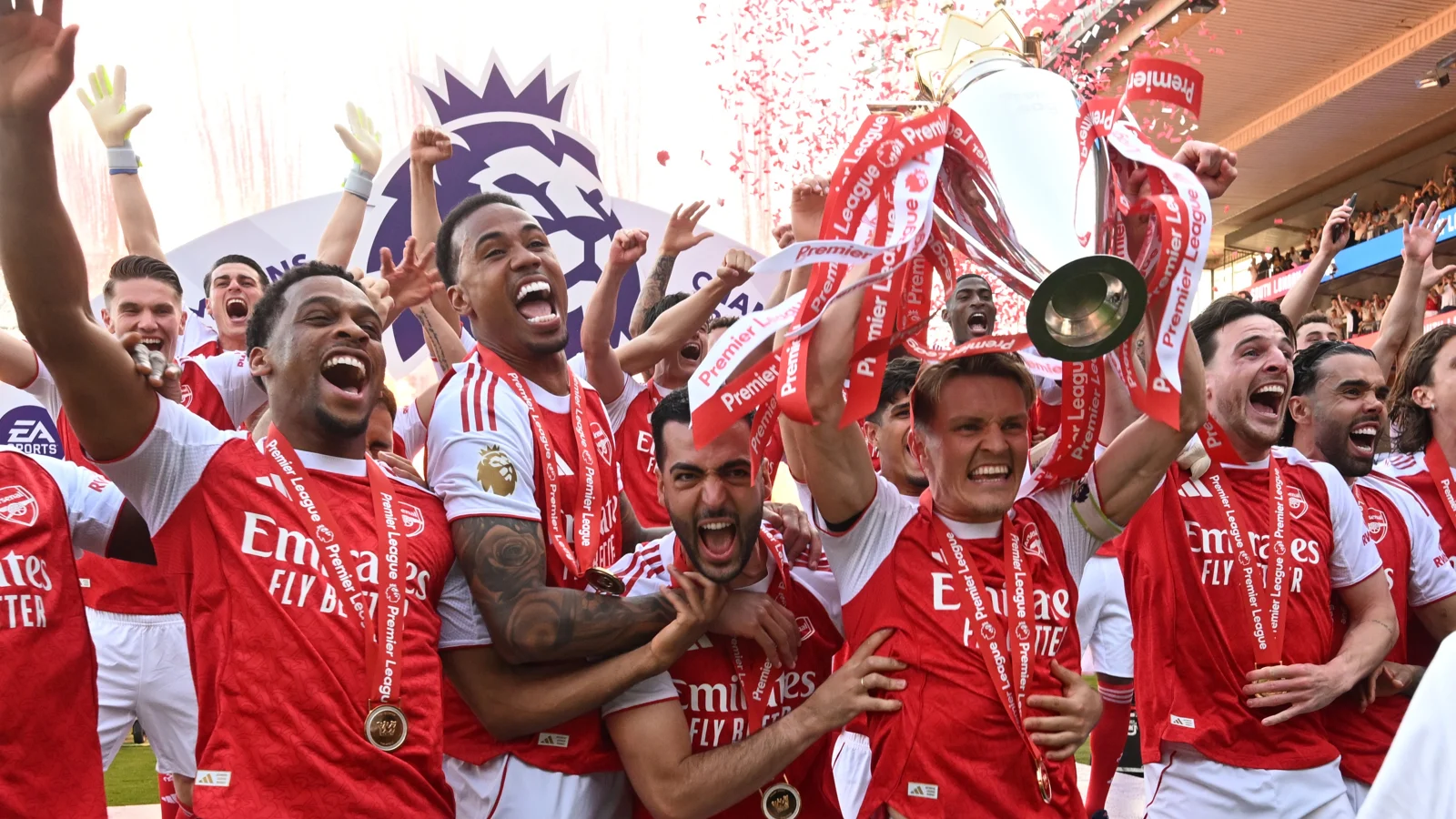
The winners receive different honours. Becoming Premier League champion establishes the club as the highest-ranked side in that league season. Winning the FA Cup establishes it as that season's cup winner. One club can win both, but it must succeed in both competitions; neither trophy is awarded as a consequence of lifting the other. When reading a list of club achievements, keep league titles and FA Cup wins in separate columns rather than adding them together as if they were the same contest.
League status is separate too. An FA Cup win does not erase a bottom-three Premier League finish, and a lower-division cup winner does not gain Premier League membership through that trophy. Promotion and relegation follow the relevant league arrangements. This matters when a club has contrasting campaigns: it can progress deep into the cup while struggling in its league. A cup match can change its silverware prospects without changing a single point in the league survival calculation.
The European routes also differ. The league champions qualify for the Champions League, while the FA Cup provides a Europa League route under the current access framework. An FA Cup win alone is not a Champions League qualification. If a club already holds a stronger route through its league position or another competition, apply the relevant season's overlap and reallocation rules. Do not assume that a club receives two European entries, or that every duplicate route creates another English Champions League berth.
Money is another comparison that needs the correct basis. The FA publishes a cup prize fund with payments attached to stages, while the Premier League distributes central payments that include a finishing-position component. A headline prize and a club's full season revenue are not equivalent figures. You do not need to rank the trophies financially to understand their sporting difference: one is won across a league programme and one through knockout progress. Supporters may value those achievements differently, and that preference should not be presented as a competition rule.
Why cup weekends can change the Premier League schedule
The competitions are separate, but they share clubs and calendar space. A team that reaches a later FA Cup round still has to complete its league programme. If its cup involvement conflicts with a league date, the league fixture can need rearranging. That is one reason clubs temporarily have different numbers of league matches played. The outstanding league game has not turned into a cup match or disappeared from the season's obligations; it awaits the appropriate date.
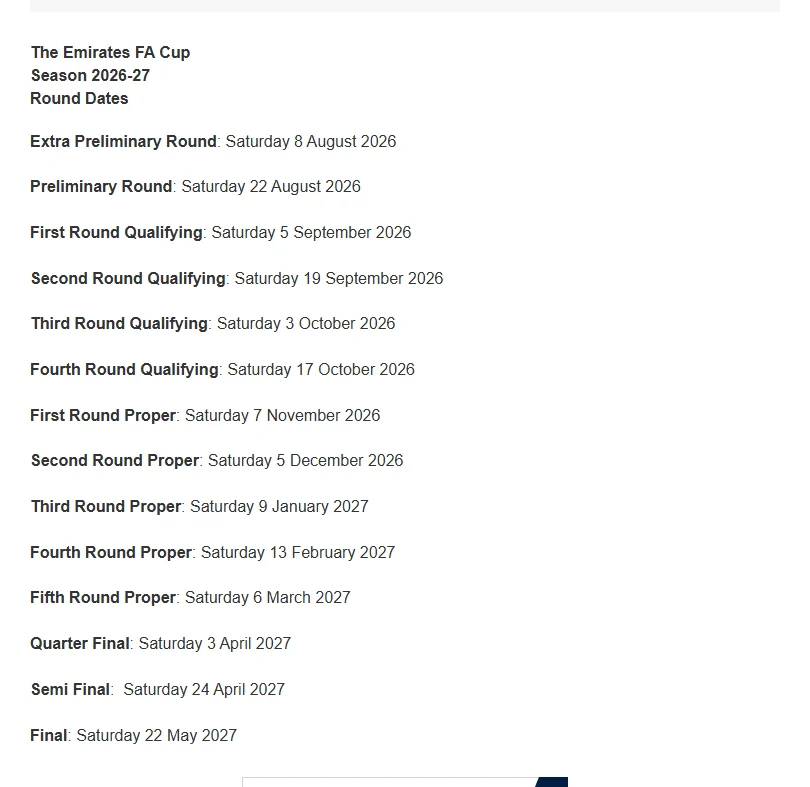
For 2026/27, the third round proper is scheduled around the weekend of 9 January 2027, and the FA Cup final is scheduled for 22 May 2027 at Wembley. The Premier League's final match round is scheduled for 30 May 2027. These are different endpoints. A cup round's calendar date identifies its round window, rather than proving that every tie kicks off at the same time on the printed Saturday. The particular match still needs its own confirmed date and kickoff.
Avoid assuming that every cup weekend affects every league club in the same way. Some dates are planned around cup rounds, while later progression can create a specific clash requiring a change. Television selection and European participation can also move league games. A date listed months ahead can therefore be provisional or explicitly conditional on cup involvement. Read the latest announcement and status rather than predicting a replacement date from the nearest apparently empty midweek.
For attending supporters, verify the club's latest fixture notice before committing to travel. For viewers, refresh the listing after cup progress is confirmed. A subscribed Premier League calendar can receive updated league dates when the provider refreshes it, while a one-time imported file normally preserves the earlier snapshot. Remember the tool's competition scope: a league-only calendar does not become a complete all-competitions club calendar merely because its dates react to FA Cup involvement.
Find the right fixture and broadcast listing
Start with the competition label, not just the team names. A club's Premier League schedule contains its league fixtures; it need not include its FA Cup ties, European matches or friendlies. If a game you have heard about is missing, identify the competition and round before concluding that the fixture feed is wrong. The FA's official cup fixture list is the appropriate starting point for a cup tie.
Next, check the broadcast information for that competition, season and country. A service showing a club's Premier League games does not automatically show its FA Cup matches. Broadcast pages can also remain online with an earlier season's label, including official pages, so inspect the heading and the individual match notice before relying on the channel name. If a future tie has not received an assignment, wait for confirmation rather than inferring coverage from a previous round or a league rights deal.
Finally, record the actual date, kickoff, timezone, venue and status together. A round scheduled around a Saturday can include ties on other days, and an overseas viewer may see the kickoff on a different local calendar date. TBA means a detail is still unconfirmed; it is not a promise of free coverage or proof that the match will be unavailable everywhere. Verify important arrangements with the club or broadcaster, especially after a date change or when a cup tie could require extra time.
For a league fixture, use the Premier League TV schedule and the site's league fixture tools. For a cup tie, follow the FA's competition-specific listing and the latest match announcement. Keeping those two paths clear solves most newcomer confusion: the same club can pursue both trophies, but each match belongs to a particular competition with its own consequence, resolution and viewing information. Once that label is established, the rest of the match plan becomes much easier to verify.
Comments
Ask a useful question or share a helpful tip. Comments are reviewed before publication.
Loading comments…