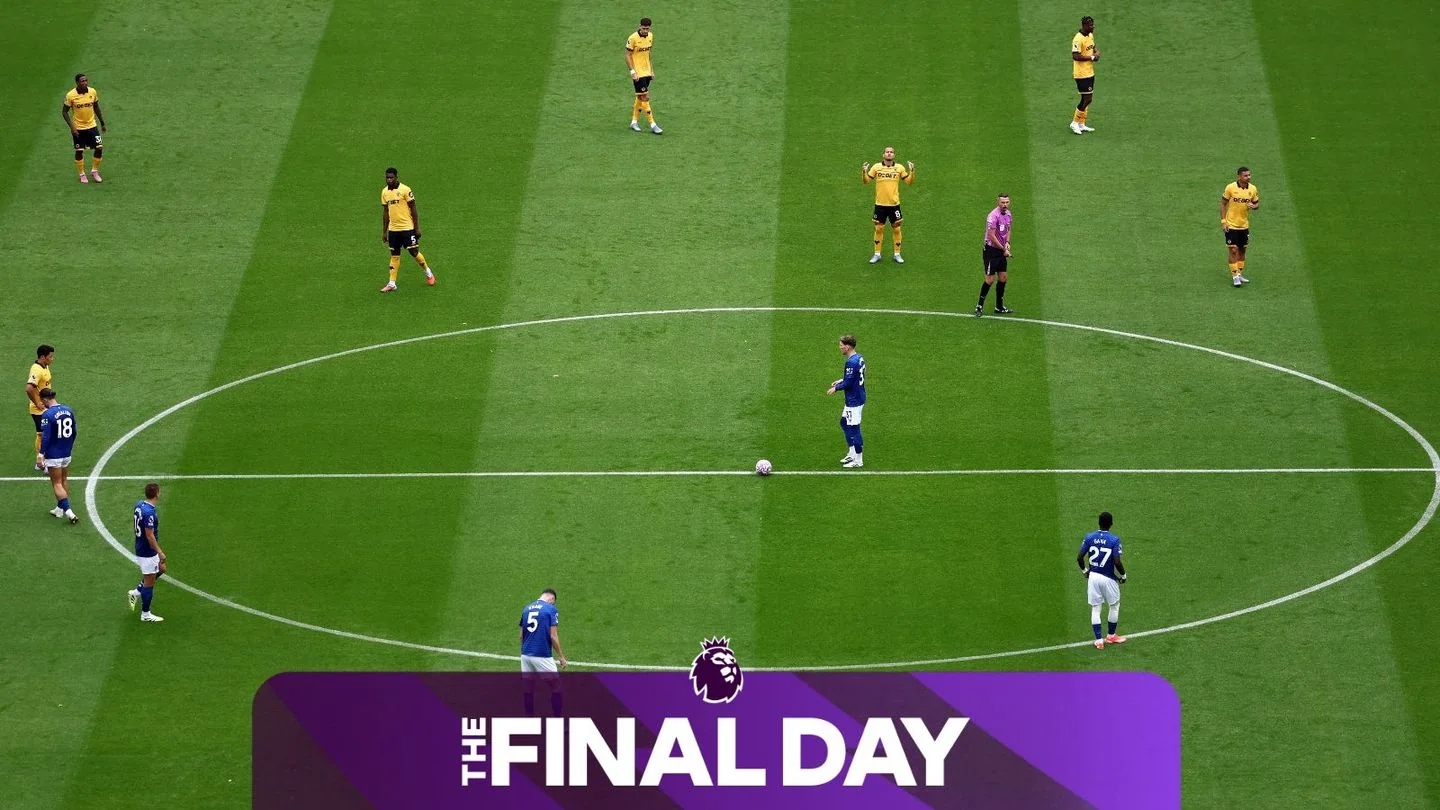
All Premier League final-day matches are scheduled to kick off together to protect competitive fairness. A club playing later would otherwise know its rivals' completed results before deciding how aggressively to chase a win, a draw or a particular score. A common starting time removes that advance certainty, even though scores can still reach players while other matches are in progress.
For the 2026/27 season, the final round is scheduled for Sunday 30 May 2027. The principle is straightforward; the details need more care. A shared kick-off does not guarantee identical finishing times, television coverage or an unchanged plan in an emergency. Our 2026/27 season-date guide covers the wider calendar; this guide explains why the final round is different and how to follow it.
Fairness: why a common starting time matters
The useful distinction is between knowing a rival's score during your match and knowing its final result before your match begins. In the second situation, a manager can prepare for a settled target. A team that expected to need victory might discover a draw is enough, or learn that only a large winning margin will help. The final round offers no later league fixture in which another club can respond to that advantage.
Consider a deliberately simplified example. Club A has 60 points and Club B has 59 before their last matches. The league awards three points for a win and one for a draw. If A plays first, B can choose its approach knowing exactly what A has finished with. The table below illustrates the changing target; it is a hypothetical comparison, not a forecast for any actual club.
| Club A's completed result | A's final points | What Club B knows before playing later |
|---|---|---|
| Defeat | 60 | A draw reaches 60; victory goes above A. |
| Draw | 61 | Victory reaches 62 and goes above A. |
| Victory | 63 | B can reach only 62 and cannot catch A. |
A common start leaves those possibilities unresolved when both games begin. It does not make the fixtures identical: the opponents, venues, squads and points already earned can still differ. Nor does it forbid a team from protecting a draw. It avoids designing the final round around one contender having a completed answer while another must play without it. When equal points are possible, goal difference and further criteria also matter; our guide to final-table scenarios explains how to separate a sufficient result from one that merely keeps a possibility alive.
How the final-day tradition developed
The Premier League began in 1992, but its current ending was not part of every early season. The established pattern dates from 1995/96, when the final fixtures began together on Sunday 5 May 1996. That distinction matters when an archive appears to show a league match after the supposed final weekend: it may accurately describe an earlier scheduling arrangement rather than contain a mistake.
It also helps to separate the intended programme from what can happen on the day. A competition can arrange a common start and still face a situation in which a ground cannot safely stage its match. The early seasons explain how the pattern developed; the 2016 case shows why calling it an arrangement is more precise than promising that exceptions are impossible.
Why the first Premier League seasons were different
The inaugural 1992/93 campaign finished with two matches on Tuesday 11 May: Arsenal against Tottenham Hotspur and Queens Park Rangers against Sheffield Wednesday. Those clubs had also played during the preceding weekend. In 1994/95, the final programme was still not completely aligned: Wimbledon played Nottingham Forest on the Saturday, before the other ten fixtures on Sunday 14 May. A reference to the “last day” in those seasons therefore needs more context than the modern idea of ten games beginning together.
From 1995/96, the newly reduced 20-team division used a shared final-round start. That leaves two separate changes to understand: the size of the competition and the way its concluding fixtures were scheduled. Neither justifies rewriting an old season as though every club followed today's programme. If you are comparing eras, check the actual fixture dates and the number of participating clubs, rather than assuming a modern Matchweek 38 existed in exactly the same form. Our explanation of matches per team covers the numerical difference, while the first Premier League season guide keeps the 1992/93 context separate.
The postponed Manchester United match in 2016
Manchester United's home fixture against Bournemouth did not proceed with the rest of the final-day programme on Sunday 15 May 2016. A security alert at Old Trafford led to the ground being evacuated and the match being postponed. It was rearranged for Tuesday 17 May, two days later. The Premier League identifies this as the exceptional break in its established simultaneous-final-day pattern. It was an emergency response, rather than a deliberate decision to let one club choose its target after rivals had finished.
For supporters, the practical lesson is to keep a route to current club and league announcements even when a date looks settled. If an exceptional notice appears, read what it says about the match, travel and admission instead of assuming a television guide or old calendar entry has already caught up. Historical arrangements for refunds or reused tickets belong to that particular incident; they should not be treated as a standing guarantee. Our fixture-announcement guide explains the ordinary confirmation process, which is distinct from an emergency postponement.
Why simultaneous kick-offs do not mean simultaneous finishes
Each referee keeps time for the match in front of them. Under Law 7, time is allowed for interruptions such as injuries, substitutions, goal celebrations and video-assistant-referee checks. Those interruptions will not be identical at ten grounds. The number displayed by the fourth official is a minimum amount of additional time, and the referee can add more if necessary. The final-day schedule does not replace those responsibilities with one league-wide final whistle.
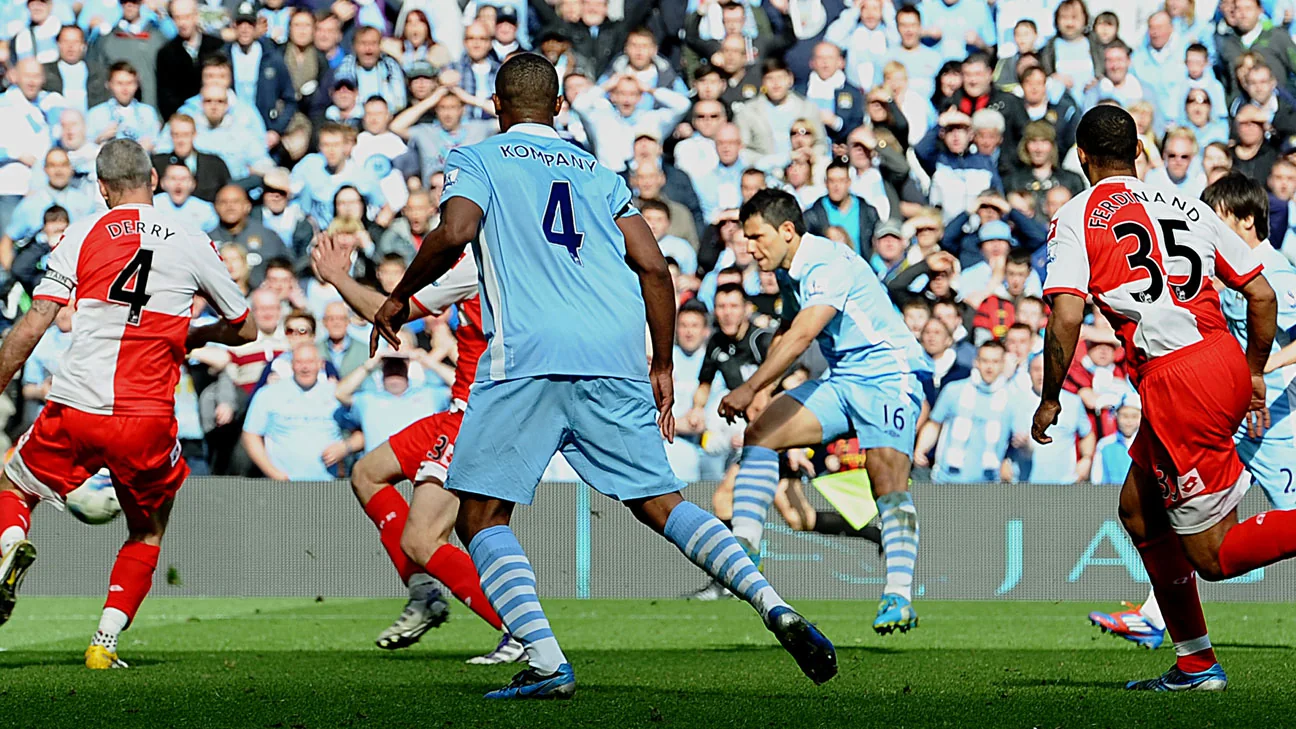
The clearest illustration came on 13 May 2012. Manchester United had completed a 1-0 win at Sunderland while Manchester City were still drawing 2-2 with Queens Park Rangers. Time remained at the Etihad Stadium, where Sergio Agüero scored to make it 3-2. City finished level with United on points and took the title on goal difference. A completed result at one ground and a changing result at another were both genuine, despite the intended shared starting time.
That is a limit of the arrangement, rather than proof that it has failed. Requiring every referee to stop together could deny a team playing time it was entitled to receive. The sensible comparison is with ten fixtures deliberately spread across the afternoon: a common start removes a large, planned information gap, while the remaining differences arise from the individual matches. A supporter should therefore keep following a relevant rival until its own final whistle, even after their club has finished.
There is another clock to consider when watching remotely: the one on your screen. A television feed, an online stream and a score notification can reach you at different moments. If one device reports a goal before another shows it, check which match is live and whether the result has been confirmed. Avoid combining a delayed picture with an apparently final table calculation. The results page helps distinguish completed matches from those still in progress; it cannot make separate broadcasts finish together.
What final-day results can change
The shared start applies to the whole round, even if the champions have already been decided. The unresolved question might instead concern relegation, a European place or the order of clubs in the middle of the table. Start by identifying the position that matters to your team and which rival results can still alter it. Watching all ten scores without that context can make a busy afternoon more confusing than informative.
Be especially careful with European qualification. Domestic cup winners and UEFA's allocation of places can affect which league positions lead to which competitions. European Performance Spots add another season-specific condition. An old article's coloured top-four or top-five band is therefore a poor substitute for the current rules and completed cup outcomes. Use the title, relegation and European scenarios guide for the wider framework, then apply the confirmed conditions for the season you are watching.
Read points and tie-breakers before reacting
Keep three things separate: the score at this moment, the points that score would produce if it stayed unchanged, and the final position once relevant games are complete. A goal can change all three projections, but only a completed match settles its own result. If your club has finished while a rival is still playing, avoid treating a projected position as secure. When using the Premier League table, read its update time and the matches-played column as well as the large position number.
Equal points do not automatically mean equal final positions. Goal difference comes next, followed by goals scored. Where a decisive place still cannot be separated, head-to-head points and then away goals in those head-to-head matches are relevant; a remaining decisive tie can require a neutral-venue play-off. That exceptional mechanism is different from an ordinary post-season tournament. For everyday viewing, first ask whether a new goal changes points, goal difference or both. That small piece of arithmetic often explains why a seemingly unrelated late goal matters to the table.
Planning for the 2026/27 final day
A workable final-day plan has three parts: when the round starts, how you can watch your chosen fixture, and which other matches still affect your club. Confirm those separately. An official season date settles the first question only in broad terms; it does not tell you which subscription you need or whether a particular rival's result will matter by May. Keep the distinction clear when sharing plans with friends.
If you use the fixture calendar, a subscription is more useful for later changes than importing a one-time file and forgetting it. Your calendar provider controls when a subscribed feed refreshes, so it should still be checked against current announcements before an important journey. Treat reminders as a way to organise the day, with the latest official fixture notice available when a detail is in doubt.
Confirm the date, local time and any match changes
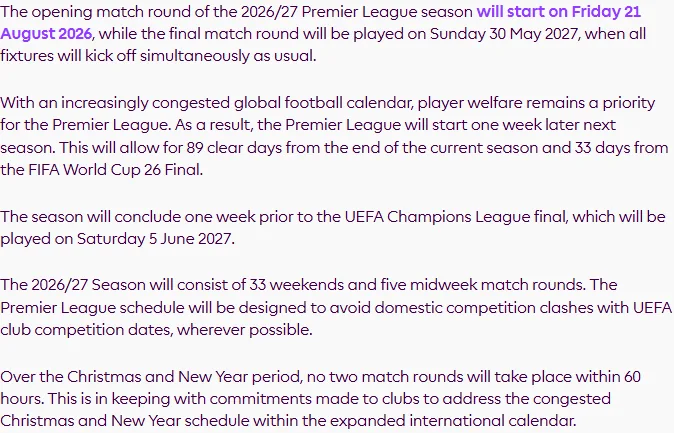
The Premier League's 2026/27 announcements place the final round on Sunday 30 May 2027, with the fixture release scheduling all matches for 16:00 BST. That is the announced plan for this season, rather than a time copied from an old “games today” article. Previous final days have used different common starting times. The season-date guide puts the finale alongside the rest of the league calendar without treating every future detail as immune to change.
Use a timezone setting that applies to the match date. Britain is on British Summer Time in late May, so a winter GMT conversion will be wrong by an hour. Supporters overseas should also check whether their local date falls on Sunday or the following day. Before booking travel, compare the latest league fixture with the club's match information and allow time to reach the ground. A shared starting time is a reason to arrive promptly, not a guarantee that transport, admission and the final whistle will all follow one fixed clock.
Choose a main match and follow the others
Open the TV schedule for the country where you will actually watch, then check the exact fixture and service. A broadcaster holding league rights does not establish the channel for every individual match. If a listing remains TBA, leave it unresolved until an assignment is announced. Commentary, highlights and full live pictures are also different offerings: an available radio programme or later video does not necessarily provide the live match you wanted.
Choose one main match and a small set of consequential scores. If you support a club fighting relegation, the nearest rivals may matter more than the title race; if its position is settled, simply watching its last fixture may be enough. Decide whether alerts would help or spoil a delayed stream before enabling them. Following ten games is optional. Understanding why one other result matters is usually more useful than switching constantly between pictures without knowing the table calculation.
- Check the country, fixture, start time and confirmed broadcast listing together.
- Confirm that you can access the selected service on the device you intend to use.
- Keep only the relevant rival scores and the table close at hand.
- Wait for all consequential matches to finish before treating the final position as settled.
Frequently asked questions
The remaining questions usually mix together three different subjects: how fixtures are arranged, what players know during them and how the final league position is calculated. Keeping those subjects separate makes the closing afternoon much easier to follow.
These short answers explain the principle. For a particular fixture, use its current listing and your own country’s broadcast information rather than assuming the answer names a channel or confirms an unchanged kick-off.
Why are ordinary Premier League weekends spread across different times?
Ordinary rounds accommodate broadcast selections and other competition commitments, so matches occupy different days and slots. The final round has a particular fairness concern: it is each club’s last chance to change its league total. A later-playing contender could otherwise begin with its rival’s completed outcome already known. The common final-day start addresses that situation; it does not mean all the practical scheduling constraints throughout the season disappear.
Can players still hear the scores from other grounds?
Yes. Scores can reach players through the bench or the crowd. The arrangement does not create an information blackout; it prevents a club from deliberately starting its last match after a rival has finished. News of a live score remains conditional because that other game may still change. That is why a team can react to an update yet still need to play on and confirm its own result.
Does winning on the final day guarantee the title?
No. The title depends on the full season’s points and, where necessary, tie-breakers. A win adds three points but may still leave a team behind a rival or level on points with an inferior goal difference. Manchester United’s victory at Sunderland in 2012 did not prevent City taking the title. In other seasons the champions are already confirmed before the final round begins. Check the whole table, not one result.
Comments
Ask a useful question or share a helpful tip. Comments are reviewed before publication.
Loading comments…