A Premier League scenario is an if-then statement: if particular matches finish with specified results, a club will win the title, secure a position, survive or be relegated. It is different from a probability or prediction. “A win guarantees survival” is a claim about every remaining route through the table; “they are likely to survive” is an assessment of how events might unfold.
The calculations begin with a dated league-table snapshot, the fixtures still to play and the rules governing the position at stake. This guide uses imaginary clubs and clearly stated assumptions, with no points deductions or later administrative changes, to show how to build those conditions. The examples are methods rather than current 2026/27 forecasts. For European places, a final league rank and the competition that rank earns must also be checked separately, because cup results and access rules can change the destination.
Start with a snapshot, a target and the remaining points
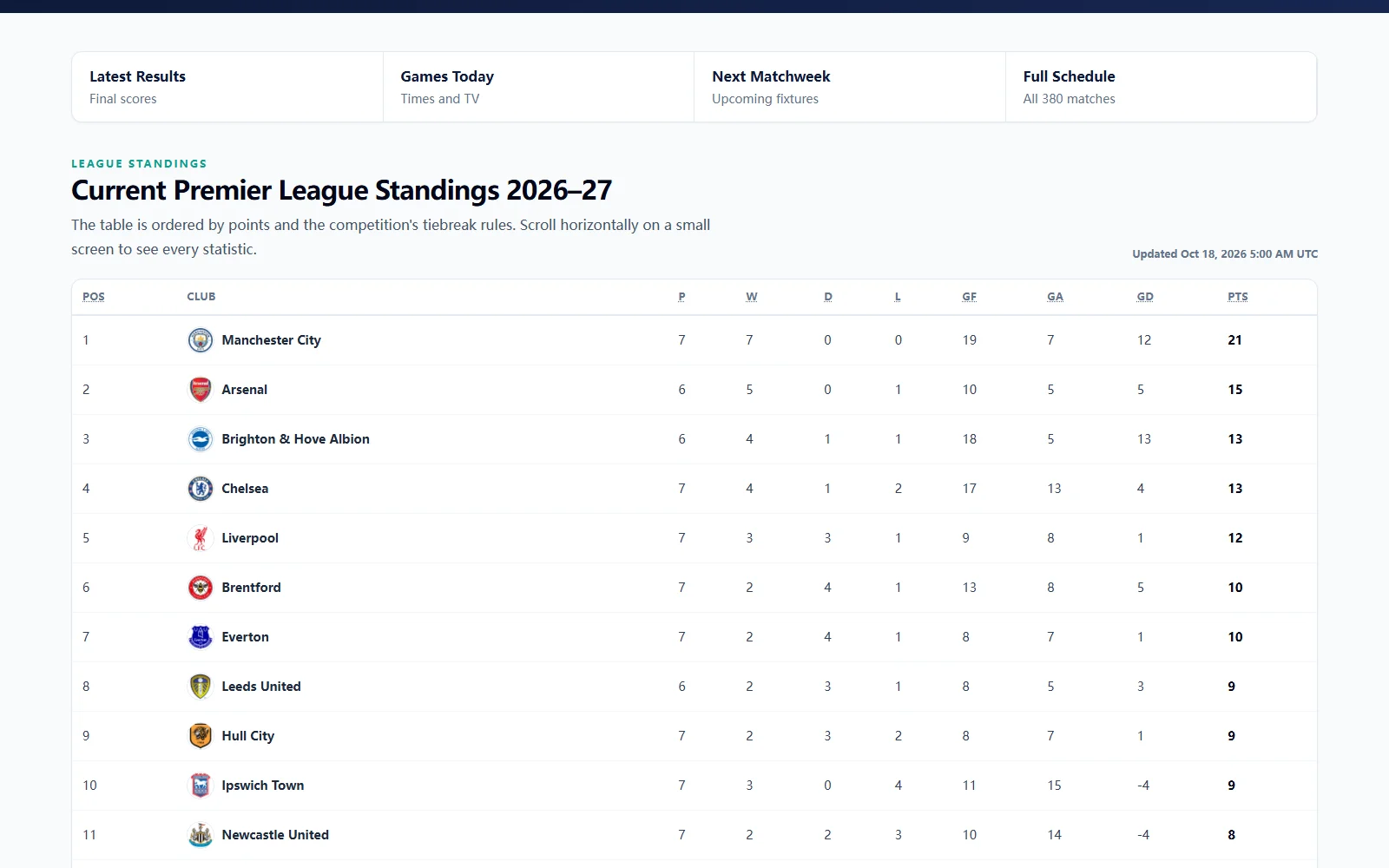
Choose one cutoff time for the calculation and record only completed results in the starting totals. A table before Saturday's matches and a table after Sunday's matches are different datasets. Note the position you are trying to establish: first place, at least 17th, or a particular qualifying rank. Then list every club that can still affect that target. For a live calculation, retain the starting totals and add provisional points in a separate column, so a late goal does not leave you unsure which numbers were already included.
For each club, write its points as P and its remaining league matches as R. Its ordinary maximum is P + 3R, because a win awards three points. A club with 62 points and four fixtures remaining can reach 74. It can also finish below 74, so the maximum is useful for ruling possibilities out rather than predicting an exact total. Under the present format, R normally equals 38 minus matches played. A game in hand increases R; it does not increase the points already earned.
Next, mark fixtures between the relevant clubs. Independent point ceilings can describe an impossible combination if two clubs still have to play each other. They cannot both win their meeting: a decisive result distributes three points between them, while a draw distributes two. If you are modelling two separate matches, there are nine combinations of win, draw and loss before scorelines are considered. If two rivals meet directly, there are only three match-result branches for that meeting. Build the branches from actual fixtures, not from each club in isolation.
Use precise language for the conclusion. “A win is sufficient” means winning guarantees the stated outcome whatever else happens within your assumptions. “A win is necessary” means every path without a win fails, but winning might still require help elsewhere. “Still possible” means at least one compatible route remains. Those distinctions explain why a club can win and still go down, or draw and still become champion. Check the latest completed league results before using any copied scenario sheet.
Work out the title scenarios
Winning the title means finishing first, so a clinching claim must deal with every club still capable of reaching that position. Beating the current runner-up's ceiling is not enough if another contender has additional matches available. Begin with the full relevant set, then remove clubs only when their maximum or the competition's ranking rules make first place unreachable.
A useful scenario sheet separates branches where the points total is strictly higher from branches that finish tied. The first can often be resolved with result labels alone; the second may need exact scores. The worked example below deliberately reduces the race to two clubs, A and B, with every other club already eliminated. That boundary keeps the calculation readable without implying that a real multi-club title race can always be reduced to second place.
When is the leader mathematically champion?
Imagine A has 84 points and B has 82, with one match each remaining against other opponents. A can finish on 87, 85 or 84; B can finish on 85, 83 or 82. The following matrix covers all nine result combinations. A is definitely champion when it finishes with more points. The equal-85 branch remains conditional until the tiebreakers are checked, so it must not be labelled an automatic title for either side.
| A's final result | B wins: 85 points | B draws: 83 points | B loses: 82 points |
|---|---|---|---|
| A wins: 87 points | A champion | A champion | A champion |
| A draws: 85 points | Tiebreakers decide | A champion | A champion |
| A loses: 84 points | B champion | A champion | A champion |
From A's perspective, a win is sufficient on its own. A draw is also enough if B fails to win, while even an A defeat leaves A first if B draws or loses. From B's perspective, winning is necessary: a draw cannot reach A's existing 84. B also needs A to drop points, and an A draw leads only to a tiebreak opportunity. “B must win” is therefore incomplete as a full title scenario; it states one necessary condition without explaining the other match.
The same reasoning can establish an earlier clinch without playing out the last round. If A has 87 points and B has 80 with two games remaining, B's maximum is 86 and A is already uncatchable, assuming every other contender is also eliminated. If B instead has 81, its ceiling is 87, so the equal-points branch requires more care. A large current goal-difference advantage may make an upset extremely unlikely, but “unlikely” and “mathematically impossible” are different claims when later score margins are not bounded.
What happens when contenders finish level?
When a consequential final position is tied on points, the next comparisons are goal difference and then goals scored. If those are also equal and the title, European qualification or relegation remains undecided, the rules then use points in the head-to-head matches and away goals in those head-to-head matches. A still unresolved decisive tie can require a play-off at a neutral ground. The Premier League's table-order explanation sets out that distinction between an in-season display and an end-season decision.
Result labels alone are therefore insufficient in some branches. For a separate hypothetical example, suppose A starts the final round on 85 points with goal difference +40, while B has 82 points and +36. An A defeat and a B win would leave both on 85 points. An A loss by one goal takes A to +39. A B victory by three goals also takes B to +39. That four-goal swing closes the initial gap, but it does not finish the calculation: goals scored must now be compared. A 3-0 win and a 4-1 win have the same goal-difference effect but add different numbers to goals scored.
Do not jump from equal points and goal difference to “there will be a play-off”. Check every applicable separator in order, using both head-to-head fixtures where required. For a public scenario sheet, keep a tied branch labelled “depends on scorelines and tiebreakers” until you have the full goals and head-to-head data needed to resolve it.
Test relegation and survival with a result matrix
Relegation scenarios ask whether a club can avoid the final bottom three. Consider a hypothetical last day with two relegation places already settled and one still open. All clubs above 16th are safe; X in 16th has 37 points, Z in 17th has 36 and Y in 18th has 35. Each has one match left against a different, already-safe opponent. Two of X, Z and Y will survive. Their exact goal and head-to-head records are deliberately unspecified, so tied branches remain conditional.
X wins and reaches 40: safety is guaranteed because Y can reach only 38. X draws and reaches 38: if Y fails to win, X is safe; if Y wins, Y also reaches 38. A simultaneous Z win produces Z39, X38 and Y38, leaving X and Y to the tiebreakers for the final safe place. A draw is therefore not an unconditional guarantee. If X loses and stays on 37, the following matrix shows why both other results matter.
| If X loses and finishes on 37 | Z wins: 39 | Z draws: 37 | Z loses: 36 |
|---|---|---|---|
| Y wins: 38 | X relegated | X and Z need tiebreakers | X safe |
| Y draws: 36 | X safe | X safe | X safe |
| Y loses: 35 | X safe | X safe | X safe |
The X-defeat/Y-win/Z-defeat branch is especially instructive. Looking only at X and Y would suggest disaster because Y passes X, but Z remains below both on 36 and takes the last relegation place. X survives in 17th despite losing. The opposite warning applies to relying on a draw: a team can collect a point yet remain exposed if enough rivals finish above it or level with a superior ranking record. The full set of attainable positions matters more than whether one result feels acceptable in isolation.

A club is mathematically relegated when no compatible remaining combination can take it out of the bottom three under the applicable rules. A commonly discussed safety target is not a substitute for that calculation: there is no universal rule that awards survival at 40 points. Nor do the relegated Premier League clubs ordinarily play the promoted clubs to defend their places; finishing in the final bottom three is the relevant league outcome. Recheck all ceilings and tied branches before treating a commentator's “must win” as a complete mathematical statement.
Separate a European league place from a competition berth
A European scenario contains two calculations. First, can a club finish in the required league position? Second, which European competition and entry stage does that position earn under the season's access arrangements? The first uses the same result matrix and tiebreak logic as a title or survival calculation. The second can depend on cup results and UEFA mechanisms outside the remaining Premier League matches.
Write the league season and the European entry season explicitly. Finishing the 2026/27 Premier League concerns qualification for the following European campaign, whereas a page describing who entered Europe in 2026/27 refers to achievements from an earlier cycle. Put “league rank secured” and “European destination confirmed” in separate columns. A club may have secured a minimum rank while still waiting to learn the exact route. Read the relevant competition's access and admission rules before converting a sporting scenario into an unconditional participation claim.
How cups and European Performance Spots change the route
The domestic cup results are one dependency. The Premier League's European qualification guide describes an FA Cup winner's Europa League route and an EFL Cup winner's Conference League route, alongside the league-based places. If a cup winner also qualifies through its league finish, the applicable reallocation rules matter. Record the cup winner's exact rank and existing route; do not assume every duplicate qualification produces another Champions League place or simply moves every coloured band down one row.
European Performance Spots are another dependency. UEFA awards them to the two associations with the strongest collective performance in the relevant European season. The additional Champions League access therefore depends on that association competition, rather than a permanent promise that England's fifth-placed club always qualifies. A scenario can be conditional on England earning an EPS, and that condition should remain visible until the allocation is established. A previous season's successful allocation is not proof that the next one has already been earned.
European titleholder routes can introduce further interactions when a club's cup success overlaps its domestic qualification. Use the exact case in the official explanation instead of generalising that a winner's spare berth always passes to the next English team. For a practical worksheet, list the unresolved dependencies as separate items: the cup winner, its final league rank, any relevant European winner and the EPS outcome. This lets you say precisely what is settled by league results and what still needs another competition's conclusion, without guessing a future access list.
Build and verify a matchday scenario sheet
A reliable sheet should let another supporter reproduce the conclusion from the same inputs. Save the cutoff time, starting totals and remaining fixtures, then state the target and assumptions in one sentence. For example: “With no later points changes and these three clubs the only remaining survival contenders, X is safe if Y fails to win.” That is more useful than an unexplained “X needs a point”, because a reader can see both the condition and the limits.
- Confirm completed scores in the results tool and take one timestamped table snapshot.
- List all relevant clubs and their actual remaining opponents, including games in hand and rearranged matches.
- Enumerate compatible result branches, then mark which need exact scorelines or further tiebreak information.
- State cup, EPS or other unresolved conditions separately from the league-results calculation.
- Refresh the fixture dates and status before matchday and recheck the final outcomes afterwards.
Before calling a result sufficient, deliberately search for a counterexample. Could another contender win and still pass the club? Could a goal-difference swing leave an equal-points branch unresolved? Have two rivals both been credited with winning the same fixture? If one valid counterexample survives, the guarantee is too strong. Rewrite it as a conditional claim and name the missing dependency. This is also a useful way to assess a circulating fan graphic: the number of scenarios displayed matters less than whether every compatible branch has been handled.
During play, identify live standings as provisional and update both sides of every relevant fixture. A late equaliser changes the points awarded to both clubs, not just the team that scored. Wait for the decisive final whistles, check that the displayed table has incorporated the completed results and confirm any relevant official ruling before announcing a settled outcome. Ordinary points arithmetic does not predict later administrative decisions. Keep that boundary visible, and the same worksheet remains useful for a title race, a survival battle or a conditional European place.
Comments
Ask a useful question or share a helpful tip. Comments are reviewed before publication.
Loading comments…