A Premier League season usually lasts about nine months of elapsed time, from August to May. It touches ten named calendar months, which is why you will also see it described as a ten-month season. For 2026/27, the scheduled span from 21 August 2026 to 30 May 2027 is 282 days: 40 weeks and two days. That is the interval between the two dates, rather than a count that includes both dates as separate whole days.
The other common answer, 38 Matchweeks, measures the competition's rounds rather than its length on a calendar. Each club has 38 league fixtures, but they do not arrive at an unbroken rate of one every seven days. International football, cup commitments and midweek rounds give the campaign a changing rhythm. This guide separates those measures so you can understand the season as a supporter, compare different years and plan around the current season's start and finish.
How many months and weeks does a Premier League season last?
For everyday conversation, August to May is the useful answer. For comparing seasons, use the dates of the opening league fixture and the final league fixture. Those boundaries can move within the familiar months, so there is no single exact number of days that applies to every campaign. A statement such as “the season lasts 40 weeks” should therefore identify the year, especially if you are using it to plan a visit rather than simply explain the competition.
Also decide whose calendar you mean. The league begins when its first match kicks off, even if your club does not play until later in that round. A club can also continue in another competition after its last league game. The 38-match league programme, the league-wide date range and the club's complete football year are related measures, but they answer different questions. Counting only one of them and labelling it “the season” creates most of the confusion.
Does August to May mean nine months or ten?
Count the month names and you get ten: August, September, October, November, December, January, February, March, April and May. That is a legitimate description of how many calendar months contain league football. It does not mean the competition occupies every day of all ten months. The opening games normally come after August has begun, and the final round can take place before May has ended. Partial months at each end make the elapsed interval shorter than ten complete months.
The 2026/27 dates illustrate the distinction. From 21 August to 21 May is nine calendar months; the scheduled finish on 30 May adds another nine days. Calling that “about nine months” describes the elapsed time, while “across ten months” describes the diary pages involved. Neither phrase requires an argument over whether a month always means 30 days: it does not. If you need precision, give the actual dates or a day count rather than a decimal number of months that conceals the counting method.
How long is the 2026/27 season in exact days?
The scheduled first league match was on Friday 21 August 2026, and the final round is scheduled for Sunday 30 May 2027. Subtract the first date from the second and the interval is 282 days, or 40 weeks and two days. Use the Friday when measuring this season: a Saturday headline about the opening weekend is not the same as the earliest match date. The opening round itself continued beyond that first evening.
| What you count | 2026/27 answer | What it means |
|---|---|---|
| Elapsed date interval | 282 days | 30 May 2027 minus 21 August 2026 |
| Elapsed weeks | 40 weeks, 2 days | 282 divided by seven |
| Calendar-month interval | 9 months, 9 days | Same day of the month, then the remaining days |
| Named months touched | 10 | August through May |
| Dates counted inclusively | 283 | Both the opening and closing dates counted |
An online calculator may return 283 if its “include end date” option is selected. That is a different convention, rather than evidence that a fixture has moved. These are date-based calculations, not a measurement of the hours between the opening whistle and the final whistle. They also do not guarantee the timing of a particular club's games. For the wider announcement and its qualifications, use the 2026/27 season dates guide; for a specific trip, check the individual fixture.
Why do 38 Matchweeks take more than 38 calendar weeks?
A Matchweek is a fixture-round label. It is not a promise that every club will play once between a particular Monday and Sunday. For 2026/27, the announced programme contains 33 weekend rounds and five midweek rounds. Those add up to 38, but the five midweek rounds do not each require another empty week in the diary. Some rounds fit between weekends, while other dates inside the season contain no Premier League football at all.
Imagine a club playing on a Wednesday and again on the following Sunday. That is two league matches within five calendar days, even though they belong to different rounds. Now imagine the next weekend falls in an international window. The club may have no league game, but time has not stopped: that weekend still sits between the season's opening and closing dates. These are examples of how the calendar works, not a prediction of any particular team's next fixtures. Busy spells and pauses coexist inside the same campaign.
Rescheduling adds another complication. A postponed match can retain its original round identity when it is played much later, so a list of Matchweek numbers need not describe the order in which a club actually completes its games. This is also why a league table can contain unequal totals in the matches-played column. A game in hand is an outstanding fixture, not three points already earned. When judging how far a team has progressed through its programme, count completed league matches before relying on the round shown at the top of a fixture page.
- Matchweek: where a fixture belongs in the round structure.
- Matches played: how many league fixtures a club has completed.
- Calendar duration: the time between the competition's opening and closing dates.
The distinction matters if you are choosing a weekend to attend. Dividing 38 matches by the length of the season gives an average, not a booking schedule. It cannot tell you whether your chosen club will be at home, away, playing in a cup, or without a league fixture that weekend. Likewise, reaching a particular numbered round does not necessarily mean that every club has completed that many games. Use the actual fixture list for attendance and viewing decisions; use the season's duration to understand the broader stretch of the year in which those decisions arise.
What changes the shape of the season?
There are two levels of certainty in a season calendar. Its opening and closing dates describe the outer frame; the individual fixtures fill that frame with appointments that can change. Knowing that a campaign runs from August to May does not establish that a particular match will stay on its original Saturday. Broadcast selections can change both the day and the kick-off time, and clashes with other competitions can force a fixture onto another date.
For supporters, this means a published fixture list is the beginning of planning, rather than the final booking instruction. Check whether the relevant television selections have been announced and whether a cup-dependent change remains possible. Even an announced broadcast slot can be affected by later developments. A season-length answer is useful for choosing the right part of the year; a match-status check is what helps you choose the right train or hotel night. Treat those as separate decisions rather than asking one date range to answer both.
How do international breaks and cup competitions fit in?
International windows are built into the wider football calendar before the remaining league dates are allocated. A Premier League pause therefore does not mean every footballer is on holiday: selected players can be representing their national teams. The September–October 2026 window provides a useful dated example. The league paused after its opening five rounds and returned on 10 October. That gap was part of the running 2026/27 season, even though a supporter searching only for league matches would have found an unusually long wait.
Club cup football is different again. A team may have an FA Cup, EFL Cup or European match during a period when it has no league fixture. Those games increase the club's workload without increasing its allocation of 38 Premier League matches. Participation and progress vary between clubs, so a team eliminated from a cup can have a different weekly rhythm from one still involved. Thursday European fixtures can also affect the following league weekend, which is why a nominal Saturday entry should not be treated as settled in isolation.
When a weekend looks empty, start by asking which competition you are looking at. Then check the club's complete fixture list and any confirmed rearrangement. A blank league weekend, an international window and a postponed individual match are three different explanations; none by itself means the entire season has stopped or every player has been given time off. Our guide to weekends without Premier League matches follows that distinction. It is more useful than assuming that every gap in an August-to-May calendar has the same cause.
When has the usual August-to-May pattern changed?
The strongest warning against a fixed answer is 2019/20. The COVID-19 suspension interrupted the campaign for around three months, and the season was completed in July 2020. The Premier League's review describes a campaign lasting 352 days. The following season then began on 12 September 2020 and finished on 23 May 2021, a date interval of 253 days. A lengthened season and a shortened calendar followed one another; neither can be explained accurately by repeating “August to May” without the year.
The 2022/23 World Cup interruption was another kind of exception. That season's released fixtures began on Friday 5 August 2022, and the final round was on 28 May 2023, giving a 296-day interval. League football stopped after the weekend ending 13 November and restarted on Boxing Day, 26 December. The absence of league games during that stretch did not remove those dates from the season's overall span. Nor did it give every player the same break, because those taking part in the World Cup were occupied with another competition.
| Season | Calendar distinction | Lesson for a duration question |
|---|---|---|
| 2019/20 | 352 days, as described in the league's review | An unplanned suspension can extend a campaign well beyond May |
| 2020/21 | 12 September–23 May; 253 elapsed days | A September start can shorten the calendar span |
| 2022/23 | 5 August–28 May; 296 elapsed days | A planned World Cup pause changes the season's rhythm |
These examples show why match allocation, elapsed time and workload should remain separate. A competition can keep its home-and-away programme while finding very different amounts of calendar space in which to complete it. A longer span need not mean more league games, and a shorter span need not mean fewer. Equally, time without league fixtures cannot tell you whether a player was recovering, training or playing internationally. The calendar answers when a competition operated; it cannot answer every question about what its participants were doing.
For a historical comparison, check the season label and the actual opening fixture before subtracting dates. Initial announcements sometimes use the Saturday of an opening weekend even when a Friday match subsequently becomes the curtain-raiser. Keep a record of the convention you use for both seasons, including whether you count both endpoints. Our recent historical league tables can help identify the correct completed campaign, but a final standings table should not be mistaken for a complete dated fixture archive.
How should supporters plan around the season calendar?
Use the season's months to narrow your search, then switch to the fixture itself. A visit during the league campaign does not guarantee a home match for your club, and an entry in a released schedule does not automatically have its final kick-off time. For watching from home, check the correct country in the Premier League TV schedule. A broadcaster holding rights in a territory does not establish the assignment for every game; a listing marked TBA is still unconfirmed.
- Choose the season. Use the two-year label, such as 2026/27, rather than an ambiguous calendar year.
- Choose the club and competition. Confirm that the match is a Premier League fixture and whether it is home or away.
- Read the fixture status. Look for confirmed changes and outstanding broadcast or cup dependencies.
- Check the official club notice. Reconcile the published day and time before committing to travel.
- Keep a live calendar. Subscribe for changes and check again before setting off or arranging your viewing.
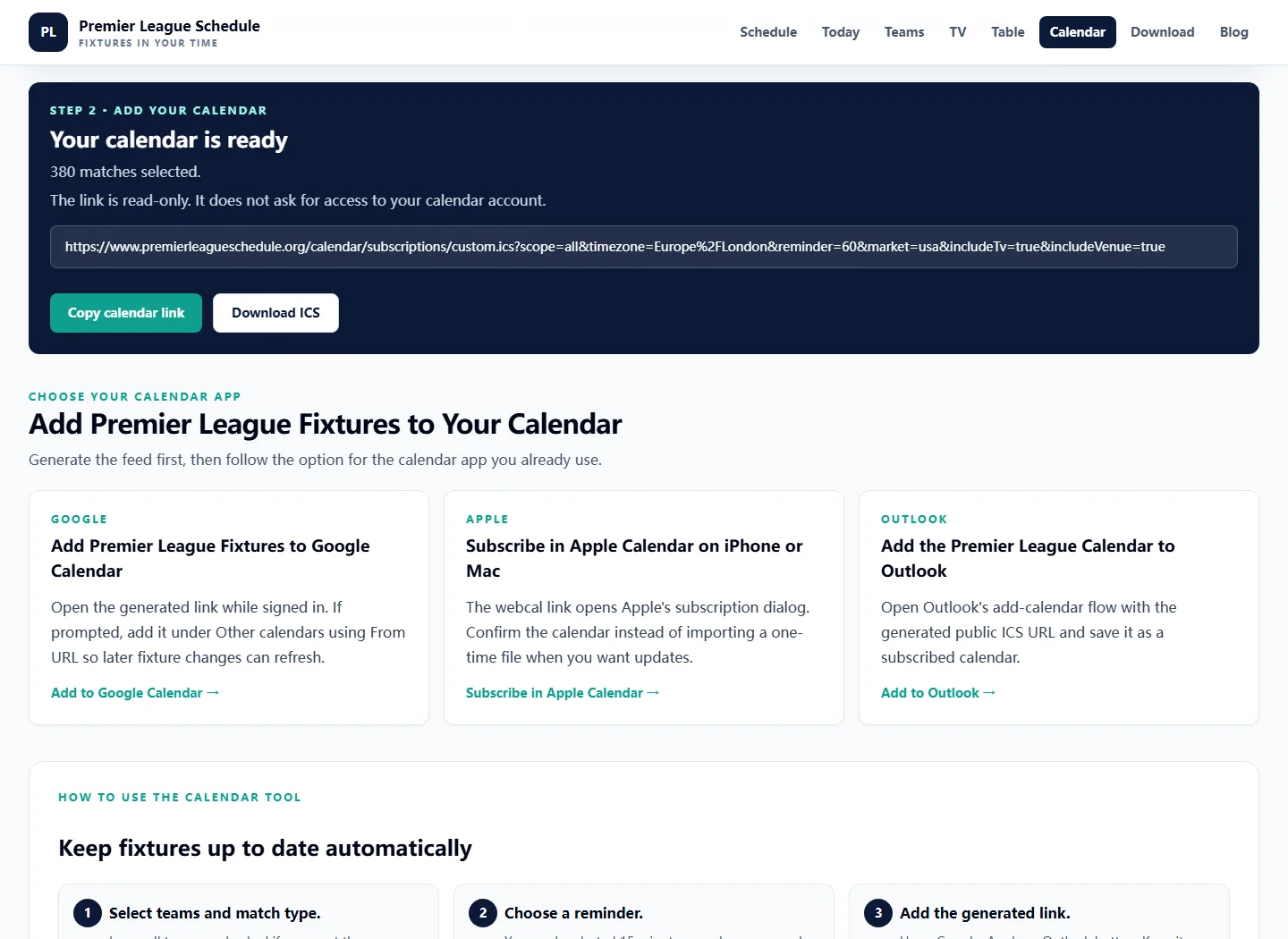
The calendar tool lets you select one club, several clubs or the whole league. When you want changes to follow through, add the generated feed as a subscription in your calendar app. Downloading and importing an ICS file once normally creates a snapshot, which is useful for a fixed copy but is not the same ongoing connection. A subscribed calendar can receive updates when the provider refreshes it; the refresh is not necessarily immediate. Keep that limitation in mind if a fixture changes close to matchday.
A campaign stretching across autumn, winter and spring also crosses the UK's clock changes. Britain uses GMT in winter and BST when the clocks are one hour ahead. For this season, the changes fall on 25 October 2026 and 28 March 2027. Use Europe/London when you need UK local time, rather than assuming a fixed GMT offset for all ten named months. If you follow from abroad, check the local date as well as the hour: your country's clock-change pattern may differ from Britain's.
Finally, keep the responsibilities separate. The club can explain its ticket arrangements, while a train operator, airline or hotel controls the terms of its own booking. A change to a match does not by itself tell you what those providers will refund. Flexible arrangements can make an uncertain fixture easier to manage. If your question is simply how long you will follow league football, “roughly nine months” is a helpful answer. If your next action is spending money on one match, the specific confirmed fixture and the booking terms deserve the closer attention.
Comments
Ask a useful question or share a helpful tip. Comments are reviewed before publication.
Loading comments…