If there are no Premier League matches across an entire weekend, an international break is one likely explanation: clubs pause while players join their national teams. A cup weekend, an individual postponement or a fixture moved to another day can also explain an empty view. First check the Premier League weekend fixtures with all teams selected. The reason depends on the actual dates, rather than on the wording of a search result.
This guide covers the 2026/27 calendar and the practical checks that identify the cause. The extended autumn interruption ended with the league returning on 10 October 2026, so that break should not be used to claim that every later October weekend is empty. A useful answer separates a scheduled league pause, a single club's gap and a television listing that shows only part of the competition. Each sends you to a different next step.
First check whether the whole league is actually on a break
An empty fixture list can describe several different situations. Your team might have no match in the selected period, the page might exclude completed games, or a search filter might hide the remaining fixtures. None of those proves that all 20 clubs have stopped playing. Start with the full competition view and remove the club, Matchweek and text-search restrictions. Then read the actual date range rather than relying on the page title alone.
There is a useful order to this check: establish the competition, establish the dates, then establish the match status. Searching for a channel before doing those things can turn a simple date problem into a confusing rights problem. If every team disappears from the same genuinely empty weekend, compare it with the official international windows below. If just one club is absent, look for its next fixture and any dated club announcement about a change.
One empty day is different from an empty weekend
A Saturday without Premier League football does not automatically mean a weekend without it. A round can be spread across different dates, and a supporter looking only at today's list sees a smaller slice than someone looking at the whole round. The games today page follows your selected timezone. That matters when a late UK kickoff falls after midnight where you live: the same match can belong to different local calendar days without its underlying kickoff changing.
The weekend tool covers Friday through Sunday, with fixtures grouped by UK date. A Monday game therefore needs a separate check in the full schedule or next-week view. This creates an easy mistake: a fan can see no game on Sunday, assume a club has a free week and miss a Monday fixture. Before diagnosing a break, look at the dates on either side of the empty period. Treat a saved screenshot as a record of the view when it was captured, rather than as a permanently current schedule. The match list and official club fixture page are better places to answer a new date-specific question.
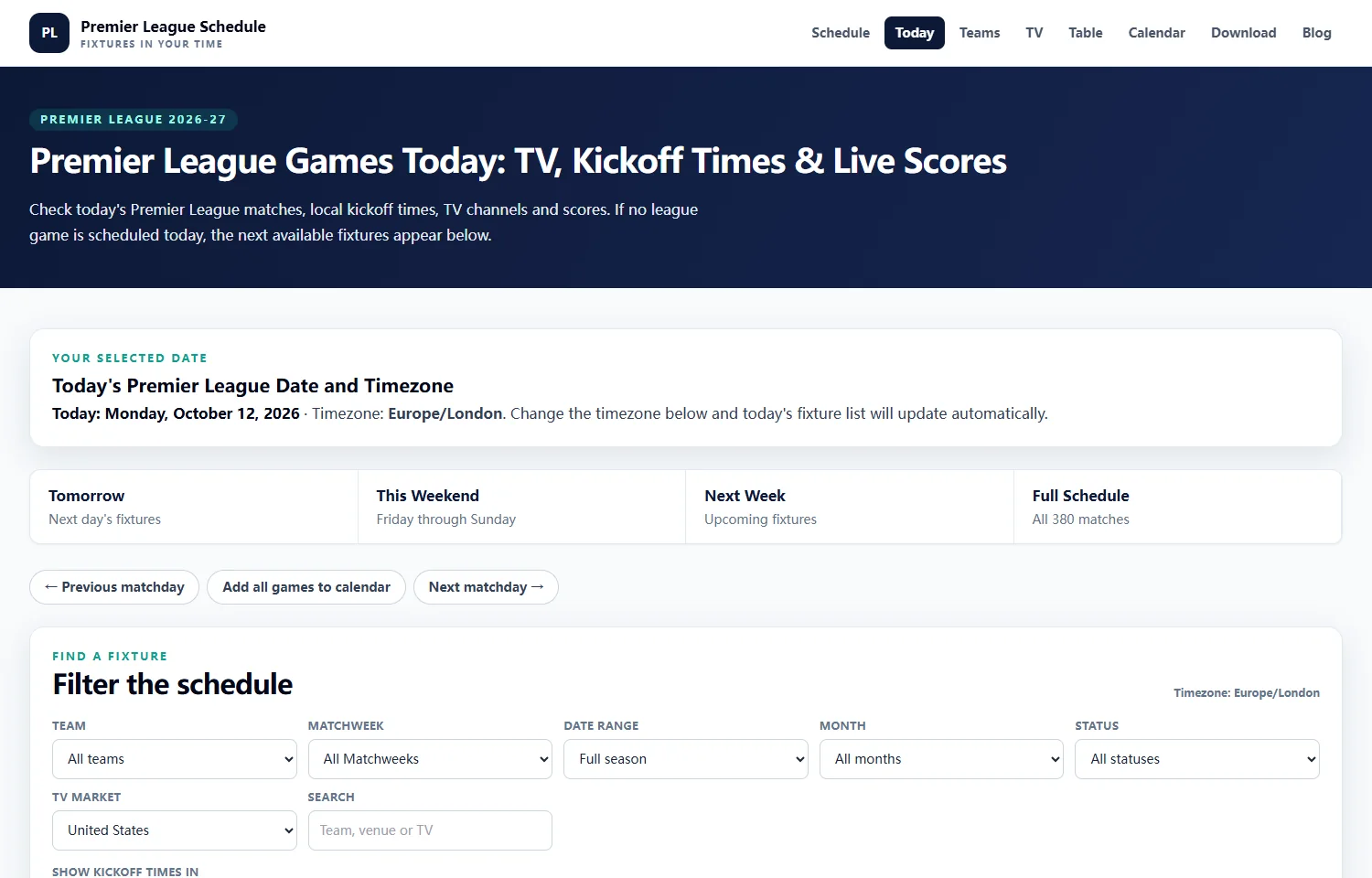
An empty TV listing does not mean there are no matches
A television guide answers where a match can be watched in a particular market. A fixture list answers whether it is scheduled to take place. Those questions overlap, but they are not interchangeable. The Premier League's broadcast guidance explains that rights are regional and that live UK television normally excludes the Saturday afternoon window from 14:45 to 17:15. A game can therefore exist even when your UK live-channel list has no entry for it.
Likewise, a TBA beside the television field means that the assignment has not been verified. It should not be read as a postponement notice. Check the country-specific TV schedule only after finding the fixture and its status. Make sure the listing says live coverage of that match rather than highlights, a studio programme or a replay. If the club and league still list a kickoff but your service does not, investigate the local rights and match assignment before assuming the competition has paused or purchasing another subscription. A broad broadcaster brand is not enough to identify the programme you need.
The official 2026/27 international break dates
The official 2026/27 international calendar has three in-season windows affecting Premier League rounds. Older guides often describe separate September and October interruptions, so their familiar four-break pattern is a poor shortcut for this season. Use the full window and year, then check the neighbouring Matchweeks. The affected weekend is the practical detail for a supporter deciding when to watch or travel.
| Official national-team window | Weekends without league games | Between Matchweeks |
|---|---|---|
| 21 September–6 October 2026 | 26–27 September and 3–4 October | 5 and 6 |
| 9–17 November 2026 | 14–15 November | 10 and 11 |
| 22–30 March 2027 | 27–28 March | 30 and 31 |
A season label crosses two calendar years. Searching only for “March 2026 international break” while planning the spring end of the 2026/27 season sends you to the previous campaign. Similarly, a search result published during September can correctly describe a then-upcoming pause while being useless as a statement about today's football. The table identifies scheduled interruptions; it does not replace a dated fixture list for a particular club after the window. Read the league's return announcement separately if you need the first confirmed match.
Do not assume that every international tournament means the Premier League stops. A player can be absent on national duty while his club continues its domestic schedule. The correct test is whether the competition calendar pauses, rather than whether an international match exists somewhere in the world. That distinction also prevents a misleading explanation when a club is missing a few players but still has a listed league fixture. For a trip outside these windows, continue checking cup progress and later fixture amendments.
Why September and October now form one longer break
The longer autumn interruption is a planned calendar change. FIFA's March 2023 Council decision introduced one 16-day, four-match window from 2026 in place of two shorter September and October windows. Four matches is the window's maximum allowance, not a promise that every country or every selected player will play four games. The cause therefore differs from an unexpected cancellation announced shortly before kickoff.
The league explains the design partly through fewer separate travel periods and fewer interruptions before the end of the year. For supporters, the trade-off is easy to understand: there is one longer spell without club league games instead of two shorter stops. That does not tell us whether a particular team will return in better form, or whether a particular player will be fresher. It does tell us that the familiar habit of expecting football to resume after one missing weekend needs adjusting when planning autumn viewing or a visit.
The FIFA window and the wait between league games are different
There are two clocks in a break announcement. The international window identifies the period allocated to national-team football. The gap a supporter experiences runs from the last club match they watched to the next club kickoff. These are not the same interval. In autumn 2026, the formal window ended on 6 October, while the Premier League returned on 10 October. Calling the window sixteen days long and describing the domestic wait as roughly three weeks are therefore compatible statements, rather than competing schedules.
For planning, use the next confirmed club fixture instead of adding a fixed number of days to the window's closing date. The return round can span more than one day, and your team's game might not be the first one played. This also explains why a countdown on another site may differ by a day: one can count endpoints or the interval between dates differently. Neither countdown should override the actual dated fixture. If a calendar summary says the break ends on Tuesday, do not infer that your club must play Tuesday evening; look for the following round and its individual listing.
How FA Cup and European fixtures change the weekend
Cup participation can leave a club without a Premier League game while other clubs continue playing. The league's fixture-change explanation notes that FA Cup semi-finals and the final occur on weekends that also contain Premier League rounds. A team cannot fulfil two fixtures at once, so progress in another competition can displace its league match. The resulting round may contain fewer games than supporters expect without being a league-wide international pause.
European football can also explain why a familiar Saturday slot is empty. A club playing on Thursday in the Europa League or Conference League cannot play its next Premier League match on the following Saturday under the scheduling approach described by the league. That commonly points a supporter towards a later weekend day rather than towards a total cancellation. The right response is to look at the amended date; do not infer a specific Sunday kickoff or TV channel from European participation alone.
Compare the club's all-competition schedule with the league-only schedule. If the club is playing a cup tie, you have found an activity outside the list you were searching. If its league opponent is in the cup instead, the original league meeting can still be affected even though your own team has been eliminated. This is why following only your club's cup run is insufficient for travel planning. Find the notice naming both teams and the revised fixture, then use the next-week schedule to see what remains. A date gap is a clue; the competition and amendment provide the explanation.
Postponed, rescheduled and not yet confirmed mean different things
Postponed tells you that a match will not happen in its original slot. Rescheduled tells you that a replacement slot has been announced. A provisional date or an unconfirmed kickoff has a different implication: further scheduling information is still needed. Read the field next to the label, because an unconfirmed television assignment is not the same thing as an unconfirmed match date. These distinctions determine whether you should wait for a new fixture, update an existing calendar entry or simply keep checking the broadcaster.
Two historical cases show why conditions alone are insufficient evidence. Everton's league meeting with Liverpool, originally scheduled for 7 December 2024, was postponed because of Storm Darragh; the replacement announcement identified 12 February 2025, initially with a European-competition condition. In contrast, Liverpool's home match against Manchester United on 5 January 2025 went ahead after two safety meetings, according to the club's confirmation. Both are examples from 2024/25, not warnings about an upcoming 2026/27 fixture.
If a forecast looks poor, find the current official match notice instead of projecting one of those past outcomes onto today's game. A rumour that an inspection is taking place describes a process, not its final decision. Keep the original fixture separate from any replacement and read conditions attached to a new date. For an away trip, one particularly useful habit is to save the announcement naming the match and date, so everyone travelling has the same information. If no replacement has been confirmed, leave the date open rather than inventing a convenient midweek slot.
Find the next match and protect your plans
Once you have identified the cause of the gap, switch from explaining the missing weekend to locating the next useful fixture. Start with the full schedule, then select your club. Write down the opponent, competition, match date and status before adding a television service or transport plan. This is more reliable than passing around a message saying “football is back next weekend”, which can become ambiguous as soon as someone reads it several days later.
- Clear old team and date filters, then choose the period you actually want.
- Check whether the missing fixture is an international pause, a cup clash or a named postponement.
- Open the next listed club match and confirm the date, local kickoff and current status.
- Check the broadcaster in your country for that individual match.
- Recheck the official club announcement before committing to a journey.
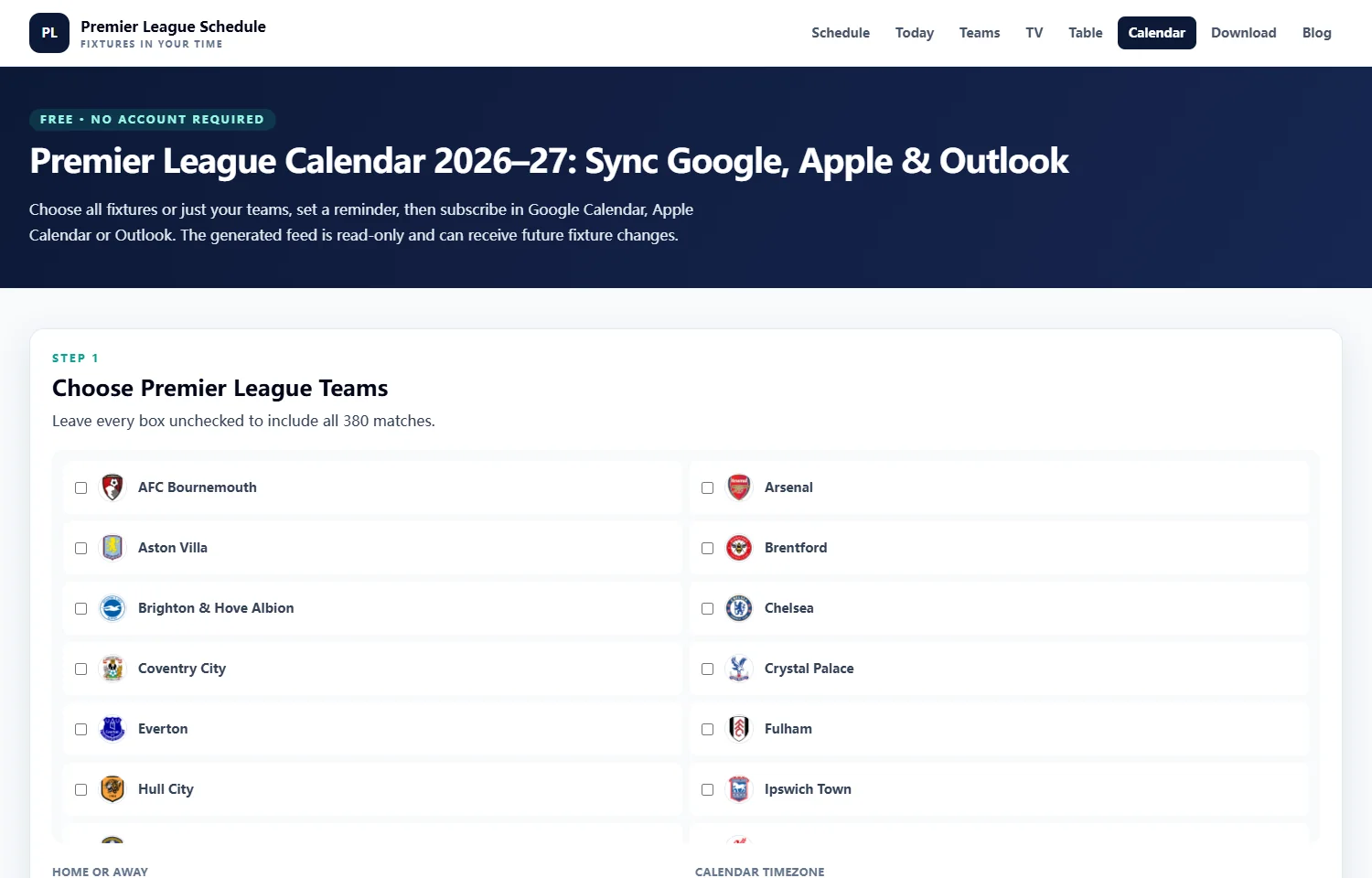
The Premier League calendar tool can reduce repeated manual searches. Choose the team or teams you follow and keep the generated feed as a subscription if you want later fixture changes to refresh. A one-time imported ICS file is a snapshot and normally retains its old information. Even a subscription is not an instant alert system: the calendar provider controls refresh timing. For a high-stakes journey, open the latest fixture and club notice as well as looking at the event already stored on your phone.
A changed match also separates your bookings into different responsibilities. Ask the selling club about its ticket policy, and ask the company that supplied your travel or accommodation about those purchases. The league's fixture FAQ does not promise that a ticket change automatically reimburses a hotel or train fare. A practical planning sheet can keep each booking, supplier and change deadline in its own row. That makes the action clear if a kickoff moves: update the match first, then evaluate each affected booking rather than assuming one cancellation message settles everything.
When sharing a plan with friends, use explicit dates and locations: the fixture's UK date, your local kickoff time, the competition and the confirmed viewing option. Add the time you last checked it if arrangements are still developing. This small change prevents a group in different timezones from confusing one empty local day with a whole league break. It also gives you a clean way to revise the plan after a new announcement. The objective is a dated match everyone can identify, with a reason for any gap and a clear place to verify the next change.
Comments
Ask a useful question or share a helpful tip. Comments are reviewed before publication.
Loading comments…