
The Premier League's off-season usually means the gap from the final league matches in May to the next campaign's opening games in August: roughly two to three months, with the exact length changing each year. That is not the amount of holiday every player receives. Club matches, international duty and pre-season preparation can occupy substantial parts of the same summer.
For supporters, three dates matter: when the league stops, when a particular footballer's competitive commitments finish, and when their club asks them to return to work. Those dates need not line up. This guide separates the league calendar from personal rest and pre-season, using dated examples rather than treating a summer photograph or a generic holiday estimate as a universal rule. For the current campaign's opening and closing dates, keep the 2026/27 season calendar alongside this explanation.
How long is the gap between Premier League seasons?
Use the last league match of one campaign and the first league match of the next as the endpoints. In summer 2026, the final round was on 24 May and the next opening match was on 21 August. Subtracting those dates gives 89 elapsed days, or 12 weeks and five days. That is a measure of the league's calendar, before any allowance for other competitions, training or a particular player's commitments.
Counting conventions explain why a headline can look slightly different. There are 88 calendar dates strictly between 24 May and 21 August if both matchdays are excluded. The Premier League's season announcement retains the phrase "89 clear days", while its fixture list places the actual opener on the Friday. For comparisons here, the convention is simple date subtraction: 89 elapsed days. Neither wording means that every footballer was entitled to 89 days away from work.
| Measure | Summer 2026 example | What it tells you |
|---|---|---|
| Previous league final day | 24 May 2026 | End of league fixtures |
| Next league opener | 21 August 2026 | Beginning of the next league campaign |
| Elapsed interval | 89 days | Date subtraction between those endpoints |
| Dates strictly between them | 88 days | Both matchdays excluded |
| A player's personal holiday | Not established by these dates | Requires that player's actual commitments and return arrangements |
"May to August" is therefore useful shorthand, but it cannot answer every planning question. It includes parts of four named months without providing four months off; nor does it establish a fixed three-month break every year. To make a comparison, use the same endpoints and counting method for each summer. To plan a trip, use a named fixture and its current status. The season-dates guide covers that competitive calendar; a training-return announcement answers a different question.
Why the league break is not every player's holiday
There are three overlapping clocks. The league clock stops when its fixtures finish. A club's clock includes any remaining competitive matches and the preparation for what comes next. An individual's clock also includes national-team obligations. A blank Premier League weekend therefore tells you very little about whether a particular footballer is resting, travelling with a squad or preparing for another match.
A useful personal interval would run from the end of that player's commitments to their actual return to club work, with any other obligations considered. Those details cannot be recovered from the league fixture list alone. Nor should a supporter treat a team photograph as an attendance register for every contracted player. The right starting point is the relevant club or national team's announcement, rather than a universal summer-holiday number.
Club commitments can continue after the last league match
Some club competitions extend beyond the familiar league finish. Manchester City were involved in the Champions League final on 10 June 2023. In another summer, Chelsea won the Club World Cup final against Paris Saint-Germain on 13 July 2025. These were competitive fixtures, not optional holiday entertainment or extra Premier League rounds. They show why the end of league football cannot automatically be treated as the end of all club football.
The effect is specific to the club, competition and summer. It would be just as misleading to apply Chelsea's July commitment to every other English club as to ignore it when discussing Chelsea. When following your own team, check whether its competitive schedule continues and identify the event by name. Our FA Cup and Premier League comparison explains another important competition boundary. The principle is the same: finishing one tournament does not settle every other commitment, and it does not disclose each player's leave arrangements.
International players follow a different summer timetable
National-team football occupies another part of the summer. The 2026 World Cup ran from 11 June to 19 July; those matches belonged to the international calendar, even when the players also represented Premier League clubs. Summer 2024 supplied a different combination of European Championship, Copa America and Olympic football. A quiet club calendar could therefore coexist with a very active tournament schedule for some members of its squad.
Progress matters too. A player's final tournament appearance can come much earlier than the final itself. In its July 2026 pre-season guide, the Premier League explained that late-stage World Cup participants might not return to their clubs until early August, while other players were already reporting back during July. That was a description of expected staggered returns at the time, not a confirmed return date for every international.

This is why absence from the first training photographs needs context. It does not, by itself, establish a transfer, an injury or an unusually long holiday. First identify whether the player had summer internationals, then look for the club's explanation of their return. The same caution applies when comparing two teammates: a shared employer does not necessarily produce an identical sequence of matches, rest and preparation. A genuine answer about one player requires their own timetable.
When pre-season starts and what it includes
A club's declared first day of pre-season is a useful landmark, but preparation can be more complicated than one squad arriving together. Liverpool's 7 July 2026 update showed three players undertaking preparatory work ahead of the following week's start, while others were working on rehabilitation. The distinction matters: being inside a training ground, formally beginning a pre-season programme and appearing in the first friendly are three different events.
Chelsea provide a clear counterexample to a universal early-July return. After their 2025 Club World Cup campaign, the club published its return-to-training gallery on 4 August. That belongs to a specific tournament summer, not a new rule that Chelsea always start in August. It also shows why a generic claim that every Premier League team gets the same number of preparation weeks can be misleading.
Choose the date that answers your question. To know when players start club preparation, read the return announcement. To attend a match, find the confirmed friendly fixture and its ticket information. To follow the competitive campaign, use the league schedule. For example, the Liverpool league-fixture page serves that last task; it should not be treated as a promise to list every training session or summer exhibition.
Is pre-season part of the off-season?
In a league-calendar sense, yes: pre-season happens in the interval before league matches resume. In the sense of time away from football work, no: players who have returned for preparation are working again. Both uses appear in ordinary conversation, which is why a bare statement that someone has a “long off-season” needs a definition. Training, fitness work and organised preparation should not quietly be counted as holiday.
The same distinction applies to matches. Chelsea's August 2025 programme included friendlies against Bayer Leverkusen and AC Milan at Stamford Bridge. Those fixtures helped prepare for the competitive campaign, but they did not add points to the Premier League table. A summer ticket can still buy a real matchday experience; it simply buys entry to a different type of event. Check the competition label rather than relying on the month or the teams' reputations.
- Holiday: time away from the player's scheduled club preparation, subject to their actual arrangements.
- Training: work before or between matches, whether or not supporters can attend.
- Friendly: a preparation match, rather than a fixture earning Premier League points.
- Competitive summer fixture: an official tournament match that can sit inside the league's summer gap.
Why the summer gap changes from year to year
There is no fixed number of weeks that must appear between every pair of Premier League campaigns. Move the previous final day, the next opening fixture or both, and the answer changes. Tournament summers also place different demands inside that interval. A useful comparison therefore starts with actual league dates and one consistent counting convention, rather than comparing a holiday estimate from one article with a fixture-release headline from another.
| Summer | Previous final league day | Next first league match | Elapsed days |
|---|---|---|---|
| 2024 | 19 May 2024 | 16 August 2024 | 89 |
| 2025 | 25 May 2025 | 15 August 2025 | 82 |
| 2026 | 24 May 2026 | 21 August 2026 | 89 |
The seven-day difference between the 2025 and 2026 examples describes the league schedule. It does not show that every player gained seven extra days of leave. Likewise, the equal 89-day intervals in 2024 and 2026 do not make those summers identical: the international competitions and their participants differed. A longer gap can provide more room in the overall calendar while still containing substantial competitive work for particular footballers. Comparing workload requires more information than these two endpoints.
Season labels matter when using older answers. A page about 2022, a January player break or a particular international tournament cannot establish the next summer's dates. Even knowing that the 2026/27 league finishes on 30 May 2027 does not, by itself, reveal the following campaign's opener. Keep historical examples as examples, and calculate a new interval once both relevant dates are known. This also avoids treating every unusual gap as a permanent change to the Premier League's annual format.
How to follow football and plan fixtures over the summer
Start with the event you actually want to attend or watch. A Premier League opener, a club friendly and a national-team match can involve familiar players but have different organisers, ticket arrangements and viewing information. The league's summer gap is not a list of empty football dates. Equally, a broadcaster showing Premier League matches does not automatically establish that it will show your club's friendly tour.
- Name the competition. Establish whether the event is a league match, friendly or tournament fixture.
- Find the relevant announcement. Use the club for friendlies and the competition organiser for its own fixtures.
- Read the status and venue. Distinguish a released fixture from a confirmed change, and retain any stated condition.
- Check your viewing market. Use the specific match assignment, rather than assuming a season-rights holder covers every summer event.
- Keep the calendar current. Subscribe where appropriate, and recheck important bookings against the latest official fixture.
For league fixtures, the Premier League calendar tool lets you choose teams and add a subscribed feed. That is more useful for receiving later changes than treating a one-time downloaded file as permanently current. Your calendar provider controls refresh timing, so an amendment may not appear immediately. A subscription also cannot make a provisional match final: it follows the available schedule rather than removing the possibility of another change.
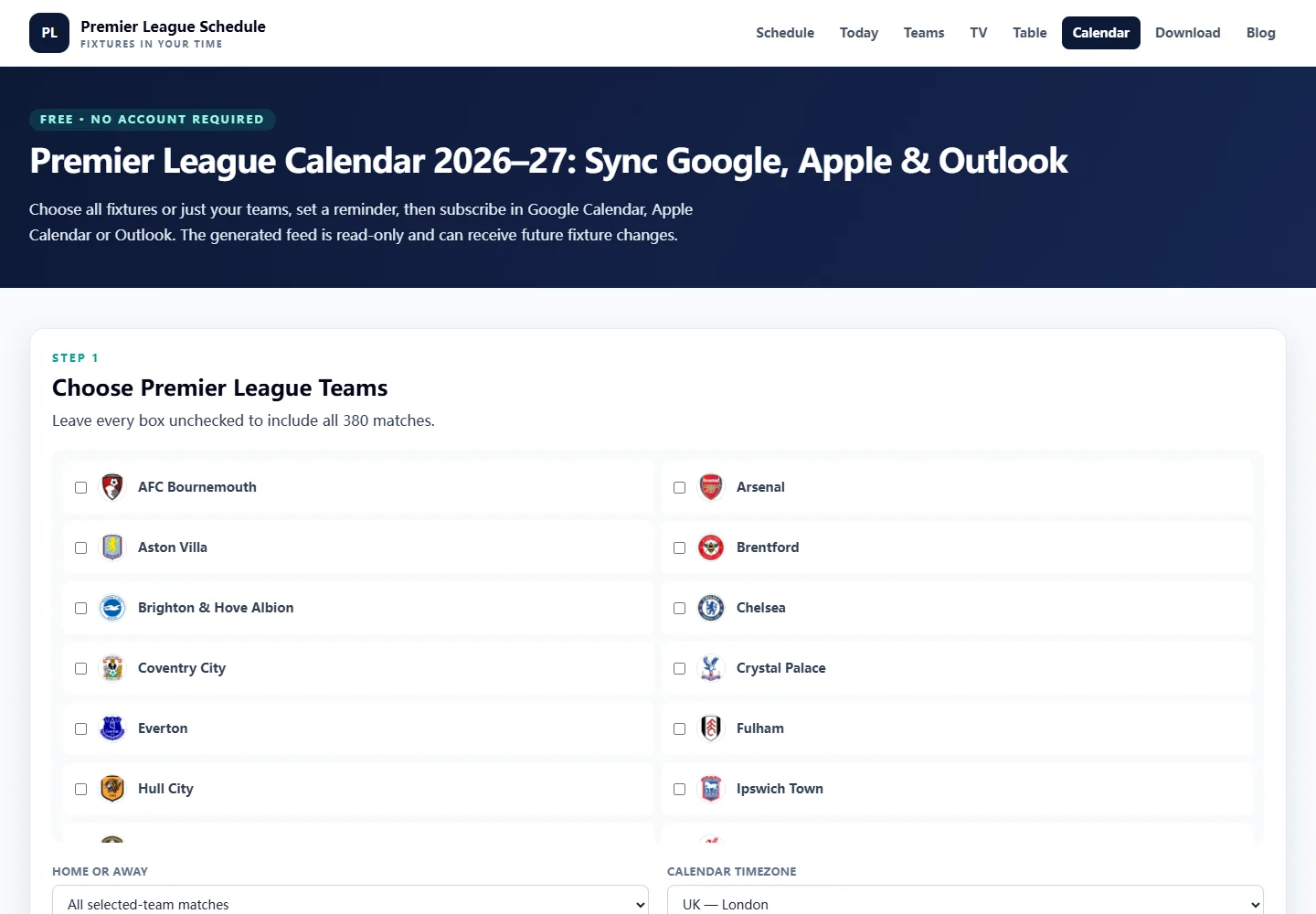
Viewing and travel require a further check. Choose the relevant country in the TV schedule, read the actual assignment and leave TBA as unconfirmed. For a UK match date, distinguish GMT from BST; if you are travelling or watching elsewhere, compare the converted time for that date. The TV announcement guide explains why a fixture release is followed by later selections and possible amendments. An opening weekend in a headline is useful context, but a particular booking needs a particular fixture.
Finally, respect each tool's scope. A league calendar is designed around league matches, not every training session, national-team call-up or exhibition. If it has no Premier League fixtures during a summer period, that answers the league question only. To fill that gap with football, consult the relevant club or tournament programme separately. Keeping those calendars distinct gives you a clearer summer plan and avoids confusing a player's continued work with the return of the Premier League itself.
Frequently asked questions about the Premier League off-season
The most useful short answers depend on which calendar you mean: time without league matches, time away from competitive football, or time before returning to club preparation.
A league fixture feed answers the first question. Dated club and international announcements help with the others; none should be replaced by an assumed holiday allowance for every player.
Do Premier League players get the whole summer off?
No. A gap in Premier League matches can still contain competitive club football, international duty and pre-season preparation. Chelsea's July 2025 Club World Cup campaign is one example of competitive work during the league's summer interval. A player's actual holiday is a separate period governed by their commitments and return arrangements. Do not turn the length of the league gap into a guaranteed number of days off.
Do all clubs and players return on the same date?
No. Clubs announce their own preparation programmes, and individual circumstances can produce different return dates within a squad. Preparatory work can also precede a club's formal first day. Read the dated club update and distinguish training return from the first friendly and the league opener. An old photograph or another club's timetable cannot establish when a particular player is due back this summer.
Is the winter break the same as the off-season?
No. A winter player break takes place within a league campaign; the summer off-season separates two campaigns. Winter arrangements also vary by season, so a historical January pause is not a promise of the same break every year. International windows are another separate reason for a quiet league weekend. The guide to weekends without Premier League matches explains those in-season interruptions.
Comments
Ask a useful question or share a helpful tip. Comments are reviewed before publication.
Loading comments…