
The Premier League does not have regular play-offs to decide its champion or which three clubs are relegated. Those outcomes come from the final league table. If you are searching for a “Premier League play-off schedule” or bracket, you probably mean the Championship promotion play-offs: the separate competition that decides the last club to move up into the Premier League.
There is an important change for 2026/27. Six Championship clubs, finishing third to eighth, enter the promotion play-offs instead of the previous four. The successful club earns a place in the 2027/28 Premier League. This guide explains that route, the different advantages attached to league positions and the rare top-flight tie-break exception. For the wider relationship between divisions, start with our English football pyramid guide.
How the Premier League decides champions and relegation
The Premier League is a season-long league competition. Its 20 clubs meet each other home and away, giving each side 38 matches. A victory earns three points, a draw one and a defeat none. The accumulated table determines the champion, with tie-breakers where required. There is no normal stage at which the leading clubs abandon those totals and enter semi-finals for the league trophy. A club can therefore secure the title before its final fixture if rivals can no longer catch it.
Relegation follows the table too: the clubs finishing 18th, 19th and 20th move down to the Championship. They do not normally play a last survival series against each other or against Championship contenders. European qualification is another table-related question, with season-specific cup and UEFA conditions, but it is not a knockout competition for the Premier League title. The league table and its rule explanations are the appropriate starting point for those outcomes.
| What you want to know | Correct competition or outcome | Regular play-offs? |
|---|---|---|
| Who wins the Premier League? | First place in its final table | No |
| Which Premier League clubs go down? | Its bottom three final positions | No |
| Who takes the last Championship promotion place? | Championship promotion play-offs | Yes |
The competition name matters when finding a fixture. “Premier League final” can misleadingly describe either the league's last round or a different cup final involving Premier League clubs. Neither phrase identifies the Championship promotion final precisely. Read the tournament name alongside the teams, round and season before choosing a schedule. A Wembley appearance alone does not establish what is being decided there, and a bracket labelled only “English football” leaves out the most useful detail.
The Championship route into the Premier League
The Championship is the second tier of the connected English men's football pyramid. Its promotion competition concerns clubs trying to move into the top flight, not Premier League clubs deciding their own champion. Calling these matches “play-offs for a Premier League place” is understandable; calling them the Premier League's post-season tournament obscures who is actually taking part. Our division-by-division pyramid guide shows where the competition sits.
The season handover is equally important. Promotion earned at the end of the 2026/27 Championship campaign provides entry to the 2027/28 Premier League. Three successful clubs replace the three relegated from the top division. That movement connects the divisions without combining their competitions. A club can celebrate earning future Premier League status while its decisive match remains, correctly, a Championship fixture. The next season's Premier League programme is a later planning question.
Automatic promotion and the remaining place
The Championship's first- and second-placed clubs go up automatically. They do not have to win the promotion play-off final after earning those positions. The play-offs allocate the third and last available promotion place. This is why a supporter should distinguish “in the promotion places” from “in the play-off places”: one describes a position that earns promotion directly, while the other describes entry to a competition in which promotion still has to be won.
The six-team expansion does not turn three promoted clubs into six or eight. It gives more Championship clubs a route to the same remaining place. Finishing third or fourth now brings a bye to the semi-finals, but it is still short of automatic promotion. The second-to-third boundary therefore remains substantial, while the fourth-to-fifth and eighth-to-ninth boundaries acquire their own practical consequences. If you want to see the result of a completed handover, the 2026/27 Premier League teams guide records that season's actual entrants; it should not be mistaken for a prediction of the clubs promoted in 2027.
How the six-team Championship play-offs work in 2026/27
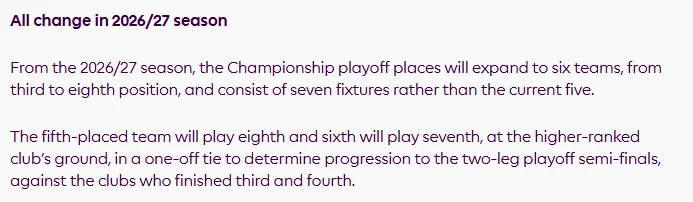
From 2026/27, the Championship play-offs involve the clubs finishing third to eighth. The two extra entrants create an opening round before the semi-finals. Broadcasters commonly call those first ties “eliminators”; the EFL's current rules label them single-leg quarter-finals. Both terms refer to the same stage. The expansion changes who can reach the final, while the prize remains one promotion place.
An older four-team bracket starting directly with third against sixth and fourth against fifth is therefore incomplete for this season. Check its year before using it. Also avoid extending the Championship change automatically to League One and League Two: their rules still specify four play-off entrants. The following table concerns the 2026/27 Championship only.
| Stage | Participants | Matches | Where |
|---|---|---|---|
| Quarter-finals / eliminators | 5th v 8th; 6th v 7th | Two single matches | 5th- and 6th-placed clubs host |
| Semi-finals | 3rd and 4th join the two survivors | Two ties, each over two legs | Club grounds; usual leg order rewards 3rd and 4th |
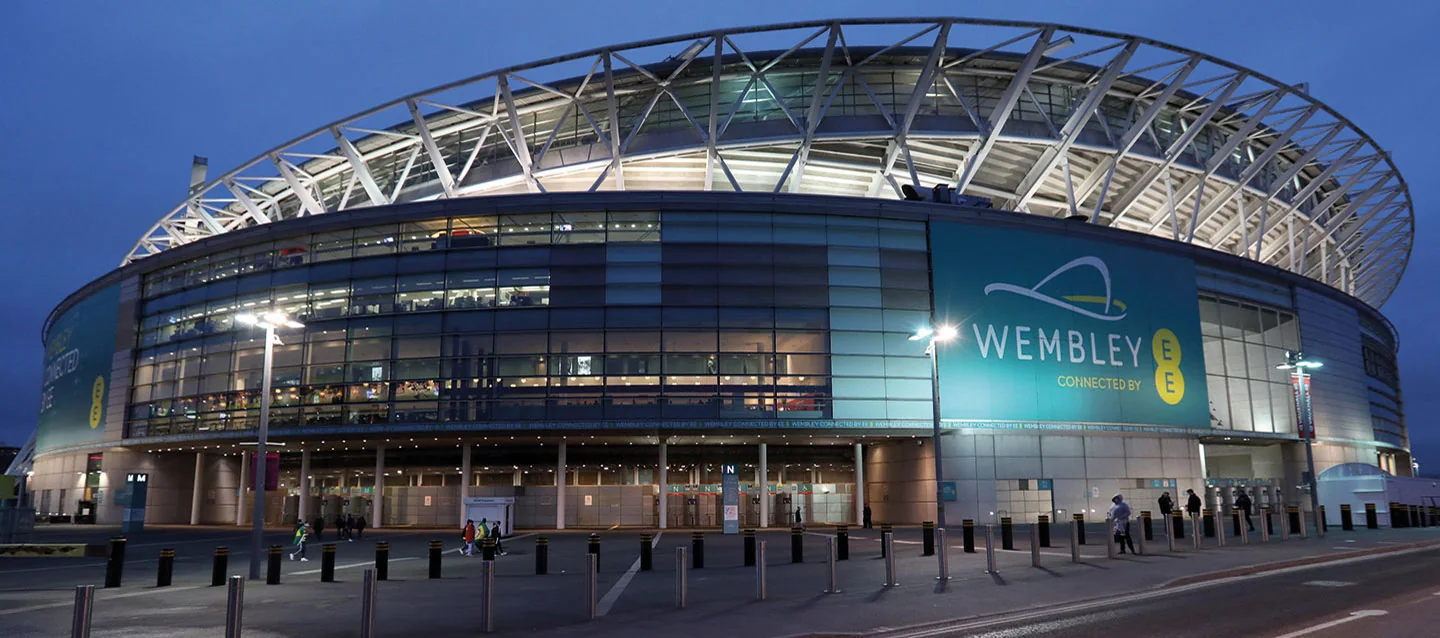
| Final | The two semi-final winners | One match | Wembley Stadium |
Fifth to eighth: the single-match eliminators
Fifth hosts eighth and sixth hosts seventh. Each pairing produces a winner in one match, so the opening stage is not a home-and-away series. Fifth and sixth gain the practical benefit of playing at their own grounds; seventh and eighth gain an opportunity that did not exist in the previous four-team format. Finishing higher still matters, even though more clubs now remain involved.
If a quarter-final is level after 90 minutes, the current EFL rules require extra time, followed by a penalty shoot-out if necessary. There is no return leg in which the losing team can recover. A sizeable league-points gap does not itself decide the tie either: once these clubs qualify, the match determines who proceeds. For a supporter, the essential first-stage check is therefore the correct pairing and host, followed by the actual match outcome, rather than assuming the better league record guarantees progression.
Third and fourth: byes, two legs and reseeding
Third and fourth skip the quarter-finals and enter at the semi-final stage. Those ties have two legs, with third and fourth normally away first and at home second, unless the EFL Board determines otherwise. The bye removes an entire single-match elimination risk from their route. It does not put either club straight into the final, and it does not turn the semi-final into a single fixture.
The semi-final opponents are also reseeded after the opening results. Third plays the lowest-placed club still remaining, with fourth facing the other survivor. For example, if eighth eliminates fifth and sixth eliminates seventh, the semi-finals become third against eighth and fourth against sixth. These are hypothetical finishing positions, not predicted clubs. A diagram that permanently connects the winner of fifth versus eighth to one seed can therefore mislead: the correct connection depends on both quarter-final outcomes. Wait for those results before treating a semi-final pairing as settled.
The Wembley final and the number of matches
The two semi-final winners meet in one Championship play-off final at Wembley. The successful club takes the remaining promotion place; the other does not go up through this route. If the final is level after 90 minutes, extra time is played, with penalties if the scores are still equal. This is the decisive end of the promotion competition, not an extra match to determine who won the Premier League.
Count fixtures separately from ties. Across the whole tournament, there are seven matches: two quarter-finals, four semi-final legs and one final. A finalist that finished third or fourth plays three of those matches itself; a finalist coming from fifth to eighth plays four. That does not mean it must win every individual semi-final leg, because a two-legged tie is a combined contest. The distinction helps when reading a programme or planning travel: “semi-final” can mean a pairing with two match dates, whereas “final” means one event. Our 2026/27 team-list guide illustrates an earlier completed handover; it does not identify the clubs that will go up in 2027.
The rare Premier League tie-break play-off
“No regular play-offs” is more accurate than saying the Premier League could never require any extra tie-break match. Its rules allow a one-off game at a neutral venue if a decisive position remains unresolved after the applicable ranking criteria. The relevant stakes are the title, European qualification or avoiding relegation. This is a contingency for an inseparable outcome, rather than a planned annual stage that the leading or lowest clubs must enter.
- Compare the completed season's points totals.
- If equal, compare goal difference and then goals scored.
- For a still-unresolved decisive position, apply head-to-head points and then away goals in those head-to-head matches.
- Only if the relevant tie remains unresolved does the exceptional play-off provision become the next issue.
That mechanism has a completely different job from the Championship promotion play-offs. The latter deliberately offer a knockout route to several eligible clubs; the Premier League provision exists because ordinary league comparisons may fail to separate a consequential tie. Equal points alone are nowhere near enough to announce that an extra game will happen. Even equal points and equal goal difference leave goals scored and further applicable criteria to check.
When reading a dramatic final-day scenario, look for the missing step between “these teams could finish level” and “there will be a play-off”. Is the position decisive? Have all ranking criteria been checked? Has the organiser actually announced a fixture? Our detailed scenarios guide explains how to keep a tied branch conditional. The existence of this narrow rule does not justify inventing a Premier League post-season timetable, Wembley final or ticket sale alongside the regular Championship event.
Finding the right 2027 dates, tickets and coverage
Search for the Championship competition by season and round, rather than rely on the ambiguous phrase “Premier League play-offs”. The EFL's calendar separates the end of the regular league season from its other competition dates. Knowing when the Championship table is completed does not tell you every subsequent quarter-final, semi-final leg and final kick-off.
Work through the details in order: identify the competition and year, establish which stage you mean, then check the actual clubs, ground, date and time. Only after that should you make a ticket or viewing decision. A page from a previous May can still rank prominently in search results, and a general Wembley listing is not proof that the event you want is already on sale.
Check the competition and the season before booking
The EFL's current key-date calendar places the Championship's regular-season closing round on Saturday 1 May 2027. That is a league milestone, not a complete promotion play-off programme. Use the organiser's current fixture announcement for the actual knockout dates and keep any missing item unresolved. Do not move a 2026 final date forward by a year simply because the competition usually takes place in May.
Check the ground as carefully as the date. Quarter-finals and semi-final legs are club-hosted fixtures; Wembley is the final venue. Record the stage and leg on your plan so that a semi-final first-leg ticket is not mistaken for admission to the return match. Once a precise kick-off is available, convert it using the timezone for that date and check travel separately. If a club has not yet qualified for the next stage, treat your preferred journey as conditional rather than assuming the bracket guarantees that fixture.
Use the organiser, finalist clubs and local broadcaster
For tickets, start with the EFL's event information, the current Wembley event page and the competing clubs' own notices. Wembley's 2026 Championship final page directed standard ticket sales through the relevant clubs; that is a useful example of where to look, rather than a promise about 2027 sale dates or eligibility. Check the actual allocation, purchase window and admission conditions when published. Hospitality is a separate offering and should not be confused with an ordinary club ticket allocation.
For viewing, use the EFL's current broadcast-partner information and then the exact match listing for your country. Sky Sports is the UK EFL partner, but a particular channel, stream or overseas service still needs checking. Premier League rights and Championship rights are different packages: finding a match on our Premier League TV tool does not establish access to the promotion final. Live video, later highlights and radio commentary should also be checked as separate ways of following the event.
- Confirm the competition, season, round, venue and announced kick-off.
- Read the relevant club's actual ticket eligibility and sale notice.
- Check the current event's admission conditions before travelling.
- Verify the exact fixture and service in the country where you will watch.
Frequently asked questions
Most remaining confusion comes from treating three achievements as interchangeable: qualifying for the play-offs, earning a shorter route through them and actually winning promotion. The new format gives those achievements different meanings, so keep the finishing position and the stage reached alongside any headline.
These answers concern the 2026/27 Championship competition and entry to the following Premier League season. They do not describe a new top-flight championship tournament or establish an unannounced final pairing.
Can the eighth-placed Championship team be promoted?
Yes, from the 2026/27 season. Eighth enters the single-match quarter-final away to fifth and can progress through a two-legged semi-final to the final. It must succeed through those stages to earn promotion; finishing eighth does not itself secure a Premier League place. The route involves four individual matches if that club reaches Wembley, compared with three for a finalist that finished third or fourth.
Are third and fourth promoted automatically?
No. First and second are the automatic promotion positions. Third and fourth receive a bye past the quarter-finals, then enter the two-legged semi-finals. They still need to win their tie and the final to take the remaining promotion place. The bye is a meaningful reward because it avoids an opening elimination match, but it does not guarantee a Wembley appearance or entry to the Premier League.
Is the Championship play-off final the Premier League final?
No. It is the Championship play-off final, deciding which additional Championship club earns promotion to the next Premier League season. The Premier League title is determined by its own completed league table, not by this Wembley game. Calling it a final “for a Premier League place” describes the prize accurately, but leaving out Championship can confuse promotion with winning the top-flight trophy.
Comments
Ask a useful question or share a helpful tip. Comments are reviewed before publication.
Loading comments…