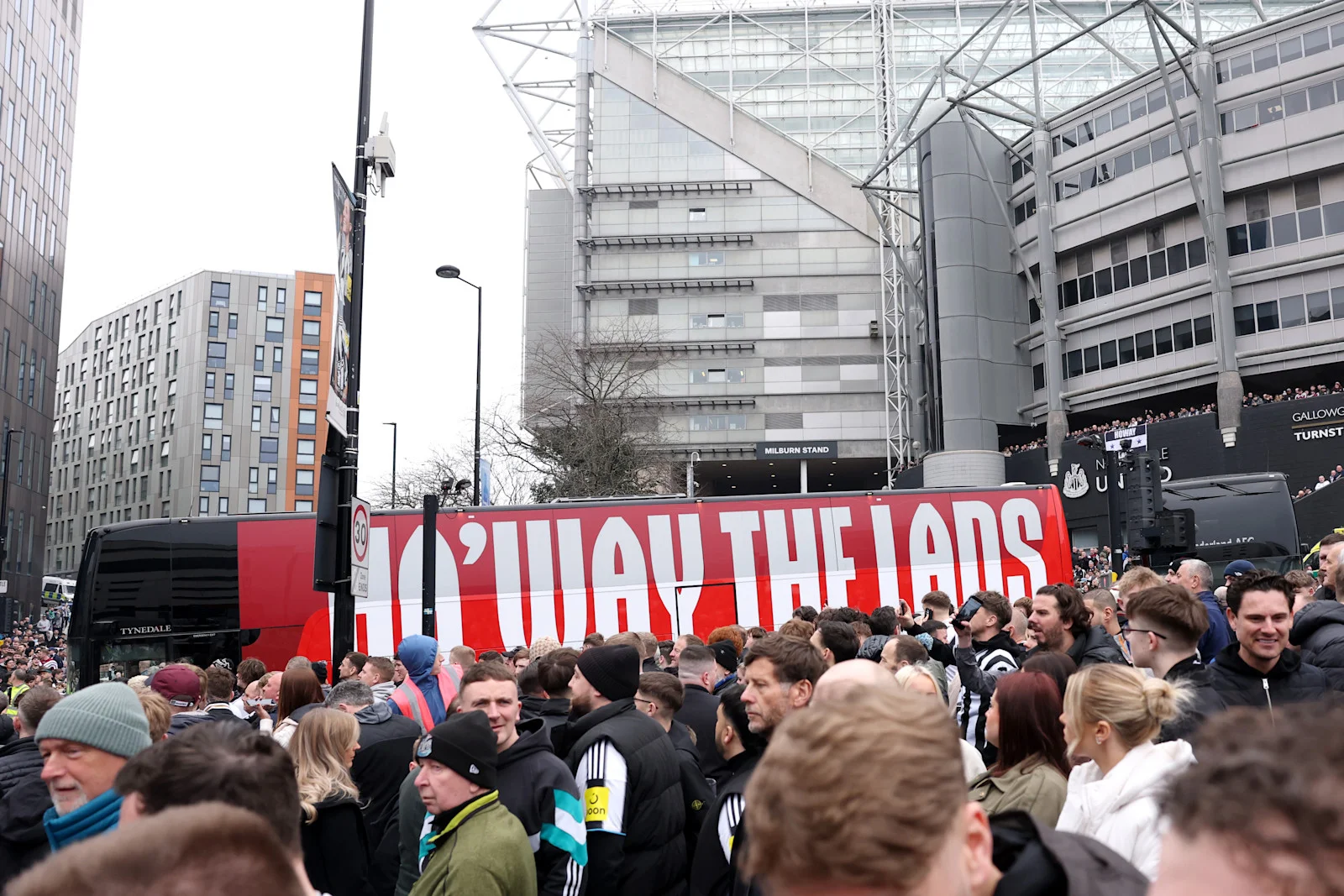
Sunderland supporters attending the Tyne–Wear derby at St James’ Park on 6 December 2026 face compulsory travel to and from Wearside on official club coaches. That is the “bubble” arrangement announced by Newcastle United on 19 October. It restricts how away supporters reach and leave the match; it does not mean the fixture is behind closed doors, and the term has nothing to do with a new public-health restriction.
The position is contested rather than settled by agreement. Sunderland asked for alternatives in a statement reported on 28 October, while police maintained their safety assessment. A request for talks is not an announcement that independent travel has been restored. This guide explains the confirmed December scope, who is involved in the decision and the questions supporters should resolve before buying tickets or committing to a journey. The information reflects announcements and reporting checked on 29 October 2026.
What is confirmed for the December derby?
The Premier League’s December schedule lists Newcastle United v Sunderland for Sunday 6 December at 14:00 GMT, with Sky Sports showing the match in the UK. Newcastle’s travel announcement concerns Sunderland supporters attending that fixture at St James’ Park. The requirement covers the journey to and from Wearside on official club coaches. These are two connected pieces of information: the league identifies when the match takes place, while the club announcement describes a condition affecting away attendance.
For an away supporter, that changes the starting point of planning. Ordinarily, choosing a train, lift or local meeting point is part of organising a trip around a ticket. Here, the published arrangement ties the away journey to organised transport. Do not treat a match ticket as evidence that walking straight to the away turnstiles will be permitted. Equally, do not assume the first announcement contains every operating detail. It explicitly leaves further ticket information for later, so check the eventual instructions for the meeting point, identification requirements, boarding arrangements and any approved exception before making a booking.
The December decision is also narrower than some discussion suggests. Newcastle specifically says this recommendation does not determine travel for the return match at the Stadium of Light in May 2027; the relevant local Safety Advisory Group will consider that fixture nearer the time. It would therefore be misleading to describe a compulsory bubble for both derbies as already agreed. Keep separate entries for each game in your Premier League calendar, and attach the correct club instructions to the correct match. A restriction announced for one ground, date and visiting allocation should not be copied automatically into a guide to the reverse fixture.
Who made the decision, and what is the safety case?
The announcement came from Newcastle, but the club’s explanation describes a wider safety process. Understanding that process matters because asking who issued the statement is different from asking who assessed the risk, recommended a measure or holds responsibility for the stadium’s safety certificate. Those questions lead to different organisations, rather than a single all-purpose decision maker.
There are also two distinct disputes to examine. One concerns the evidence for compulsory travel; the other concerns how supporters were involved before the arrangement was announced. An explanation of the safety machinery does not, by itself, establish that a particular restriction is proportionate. Equally, criticism of consultation does not establish that the police identified no safety concerns.
Police advice, the Safety Advisory Group and the council
Newcastle identifies Northumbria Police as the source of advice to the stadium’s Safety Advisory Group, chaired by Newcastle City Council as certifying authority. The Sports Grounds Safety Authority’s guidance explains the distinction: a SAG provides specialist advice, while the local authority issues the safety certificate. Ground management retains its own safety responsibilities. Describing the SAG as if it were a separate court making a binding judgment would obscure these roles rather than clarify them.
Both clubs were invited to the relevant SAG meeting to hear the police submissions, according to Newcastle’s announcement. That does not answer the supporter trusts’ different question about consultation with fans. Club representation and supporter representation should not be treated as interchangeable. A productive request for clarity can ask which organisation supplied the risk assessment, what alternatives were considered and how supporter experience informed the recommendation. These are more precise questions than assuming that every body involved had identical authority or that publishing the announcement makes the host club solely responsible for every part of the process.
Why police reject repeating last season’s walk-up
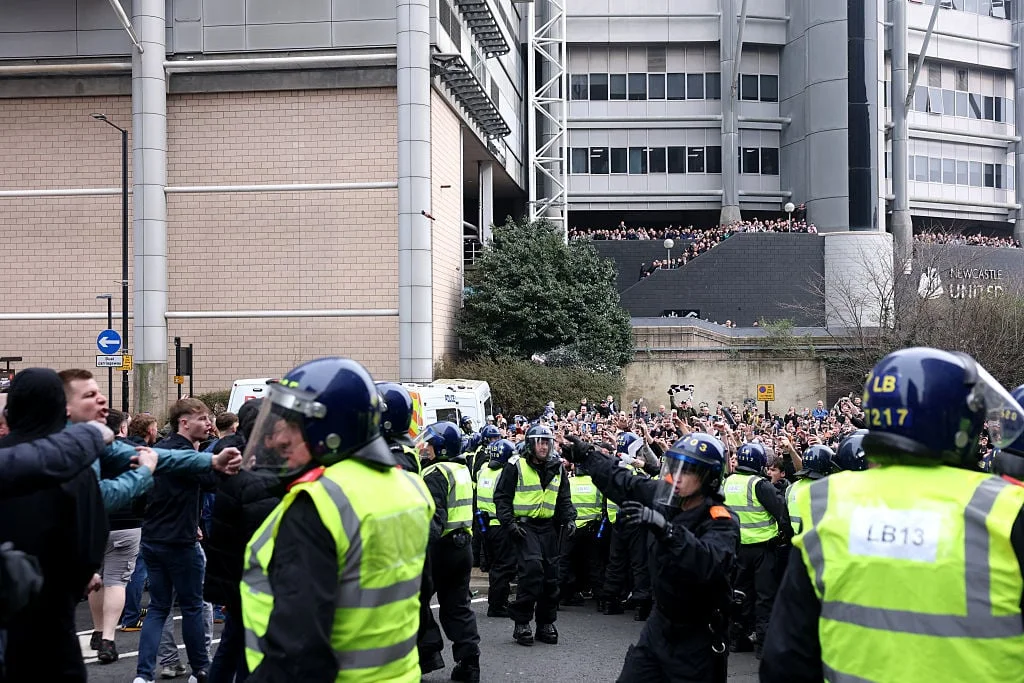
In correspondence reported by the Shields Gazette on 28 October, Northumbria Police said the previous supporter walk-up involved missiles and fireworks near police horses in crowded areas. Their position was that repeating the same approach would leave risks that had not been sufficiently mitigated. That is the police’s explanation for rejecting an independent-travel alternative, not a claim that every visiting supporter behaved badly. The force also acknowledged that the great majority simply wanted to attend the match.
Supporters have challenged that assessment by pointing to earlier descriptions of the derby and seeking the underlying evidence. A low arrest count and a risk assessment measure different things: one concerns recorded enforcement outcomes, while the other concerns possible harm and prevention. Neither is a complete substitute for the other. The useful comparison is between the identified hazards and the restrictions proposed to address them, including whether a less restrictive option could achieve the same purpose. The published disagreement should therefore be read as a dispute about evidence and proportionality, rather than reduced to a verdict that one side must be inventing the problem.
Why rival supporter groups oppose the bubble
The opposition crosses the rivalry. RAWA and Newcastle United Supporters Trust have jointly asked for clearer evidence and meaningful participation in the process. RAWA’s initial statement also argues that measures aimed at a small minority should not impose the same burden on thousands of well-behaved people. These are the positions of named organisations, rather than proof of what every supporter thinks. Their joint intervention is significant because supporters who want opposite results on the pitch are identifying the same concern about the conditions of attending it.
The practical objection is not limited to the price of a coach seat. A supporter may live close to St James’ Park, work a shift nearby or normally meet family after the match. Requiring that person to begin and end the away operation in Wearside can turn a convenient local journey into a detour. The FSA uses the example of a Sunderland fan living in Newcastle to illustrate this problem. That example is an explanation of the impact, not confirmation that local residents have been given permission to avoid the coaches. Fans in that position need an answer tailored to their circumstances before assuming an ordinary routine will work.
The trusts’ demand is for a proportionate approach with supporters involved, rather than for safety risks to be ignored. That distinction gives the debate a practical direction. Which risks require controlled transport? Could voluntary organised travel be made more attractive? How would any alternative protect people near the ground? What assistance is needed for those whose circumstances make the standard plan difficult? Publishing useful answers would let supporters judge the reasoning and make arrangements with fewer unknowns. It would also distinguish disagreement about a policy from disregard for safety. A football rivalry does not stop both groups from expecting clear explanations of a restriction that affects their matchday freedom.
What away fans need to check about tickets and travel
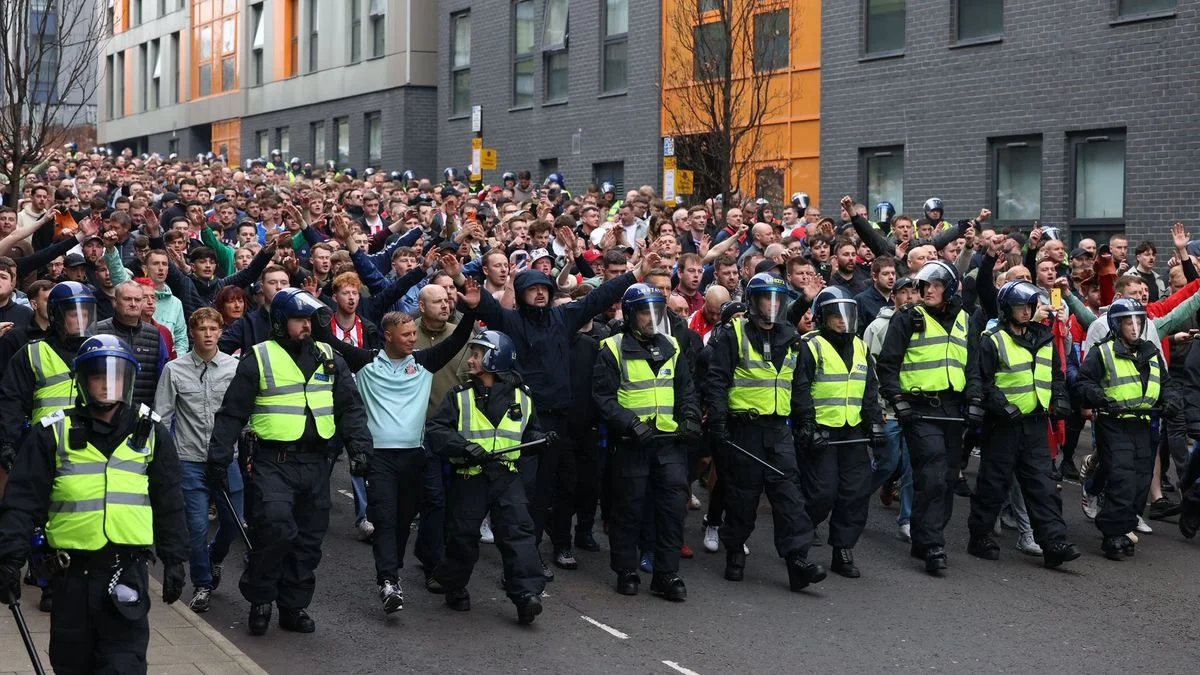
Treat the detailed ticket notice as essential reading before committing to a trip. The initial announcement did not set out sale dates, coach departure times or a final transport price. The Premier League has extended its £30 away-ticket cap, but a cap on admission is not an assurance that the whole away day, including transport, will cost that amount. Sunderland's later discussion of subsidised travel is also not a published fare.
Start with the official away-ticket channel and ask how admission and coach booking fit together. A generic description of bubble operations may mention exchanging a voucher on a coach; that does not establish the mechanism for this match. Supporters need fixture-specific instructions, including what happens if a problem prevents them reaching the designated departure. Do not rely on a resale listing or an old cup-tie arrangement to fill gaps in the current information. When contacting the club, describe the actual booking decision you need to make: whether you can reach the departure point, which part of the journey is still uncertain and when you need an answer. Ask for the current written instructions and the correct contact if they change. Save the response with its date, rather than relying on a remembered telephone conversation or a screenshot shared without context. That creates a clear record to refer to if a later announcement appears inconsistent, without assuming a particular refund, exemption or remedy has been promised.
- Check eligibility and the named purchaser requirements before assuming you can buy for someone else.
- Read the travel conditions in both directions, including where you must report and which documents are required.
- Separate the admission price, coach charge and any other booking costs in your budget.
- Confirm how the actual match ticket will be delivered or issued, and what help is available if something goes wrong.
- Raise any access or personal-circumstance question before purchase, and keep the club's written response with your booking.
Allocation, accessibility and supporters who live elsewhere
The FSA and subsequent local reporting put Sunderland's allocation at 2,200. Treat that as the reported allocation until checking the final club sale notice. The current Premier League handbook starts from 3,000 away tickets, or 10 per cent of capacity for a ground below 30,000, but includes agreement and Board qualifications and guidance for reductions. It is therefore inaccurate to treat 3,000 as an unconditional number guaranteed in every circumstance, or to declare a reported lower allocation automatically contrary to the rules without checking the approval process.
Accessibility needs require an individual answer. General FSA guidance says bubble operations can include exceptions for disabled supporters, but it does not confirm the precise December arrangements for every person. Contact Sunderland's disability access or supporter liaison staff with the actual difficulty: vehicle access, boarding, equipment, a personal assistant, residence away from Wearside or another relevant circumstance. Ask which approved arrangement applies and obtain confirmation rather than assuming an exemption. The same principle applies to a Sunderland supporter who lives in Newcastle or is travelling from another region. Explaining why the standard route is inconvenient does not establish permission to use a different one. A written answer before purchase is more useful than a dispute at a coach departure point or stadium gate.
Could the restrictions change before the match?
Sunderland's latest reported position leaves room for discussion: the club wants authorities, Newcastle and supporter representatives to explore practical alternatives, including making organised transport more attractive through support for subsidised travel. Police, meanwhile, say their assessment has not changed. These positions explain why the story continues, but they do not establish an agreed replacement. RAWA's call for a meeting and publication of the SAG minutes is also a request for action, rather than evidence that an alternative has already been approved.
A useful update would say exactly what has changed and who it applies to. If a future club announcement permits a different journey, check whether it covers all away supporters or only a specified arrangement, and whether the ticketing process has changed with it. A headline saying that talks are planned, a politician has intervened or a club wants a rethink does not answer those operating questions. Before changing an existing booking, read the dated club notice itself and compare it with the instructions attached to your purchase. Do not treat an opinion, a request or a possible compromise as permission to arrive independently.
While the position remains contested, supporters can still make progress: identify the official sales channel, decide what questions affect their own attendance and seek a written answer from the appropriate club contact. Keep the fixture notice and any subsequent revision together. Our Premier League ticket guide explains the wider purchasing process, but a general guide cannot replace this derby's specific conditions. The practical test for the next update is whether it changes a rule you must follow, supplies a missing detail or simply records another party's view. That distinction helps supporters plan without either assuming the restriction will disappear or presenting a future outcome as inevitable.
| Information | Status checked on 29 October | Supporter action |
|---|---|---|
| December fixture | Listed for 6 December, 14:00 GMT | Use the confirmed date and UK time. |
| Official-coach travel | Announced requirement | Follow the club's specific instructions. |
| 2,200 away tickets | Reported allocation | Check the final sale notice. |
| Alternative or subsidised travel | Proposed for discussion | Wait for an agreed, published arrangement. |
| Individual assistance | Case-specific details needed | Ask before buying or travelling. |
Comments
Ask a useful question or share a helpful tip. Comments are reviewed before publication.
Loading comments…