In the 2026/27 Premier League, VAR can assist with goals, penalties, qualifying red-card incidents and mistaken identity. This season, that includes a clearly incorrect second yellow card which has resulted in a sending-off. It does not mean VAR can search for every missed booking, and the Premier League has declined the optional power to correct ordinary wrongly awarded corners. Those two boundaries explain why superficially similar complaints can receive different responses from the video officials.
The useful question during a stoppage is therefore more specific than whether a replay shows something wrong. First identify the type of decision, then the referee's original call, and finally the evidence needed to change it. A disputed tackle can be outside the review categories, inside a category but short of the intervention threshold, or serious enough to justify a recommended review. The match referee still makes the final decision. This guide explains those stages using the Premier League's published rules for this season, checked on 29 October 2026, with hypothetical examples clearly separated from actual match reports.
The decisions Premier League VAR can review this season
Think of VAR's remit as a set of gates. Goals and penalties are two familiar entrances; qualifying red-card incidents and mistaken identity are the others. The new second-caution provision sits within the dismissal rules. Passing through a gate means that the incident may be examined under the protocol, not that the original decision must be overturned. A supporter can reasonably believe a decision was poor while the video official is still unable to intervene, because the complaint concerns something outside those gates.
For example, imagine a defender conceding an ordinary free-kick near halfway. Whether that modest challenge deserved a first booking is not generally a standalone VAR question. Change the facts to a potentially dangerous tackle serious enough for a direct red, and there is a reviewable category. Alternatively, an attacking foul may become relevant when officials examine the attacking phase leading to a goal. The location on the pitch alone does not settle the issue. When following today's Premier League matches, identify the actual event being checked rather than assuming that every replayed challenge has the same procedural status.
| Decision family | Typical reviewable issue | Useful limit |
|---|---|---|
| Goal or no goal | Offside, an attacking offence, or the ball leaving play in the relevant build-up | Not a licence to revisit every earlier stoppage |
| Penalty or no penalty | A missed penalty offence, an incorrect award, or whether contact was inside the area | Ordinary non-penalty fouls do not all qualify |
| Red-card incidents | Serious foul play, violent conduct, DOGSO, or a clearly wrong awarded second caution | A missed ordinary second booking is different |
| Mistaken identity | A card given to the wrong player | Correcting identity does not automatically reopen the offence |
| Routine corner award | No standalone Premier League review this season | Other reviewable offences at a corner remain possible |
Second yellow cards: the important one-way change
The statement that VAR never deals with second yellow cards is out of date for this competition. A clearly wrong second caution which produces a dismissal can now be corrected. The significant detail is that the referee has actually awarded that second caution. The provision addresses an erroneous sending-off that has happened, rather than authorising an unlimited search for every caution that could have happened.
That creates an asymmetry supporters may find unsatisfactory: rescuing a wrongly dismissed player is permitted, while sending off someone through an otherwise ordinary missed second booking is not. Understanding that distinction does not require agreeing with the policy. It does mean that two clips cannot be compared simply because both involve an already-booked player and a contentious challenge. The card shown, the seriousness of the offence and the referee's original assessment all matter.
A clearly wrong second booking that sends a player off
Consider a hypothetical defender who has already been cautioned. The referee then books that defender again for a challenge and shows the consequential red card. If a clear replay establishes that the alleged foul did not occur, the second caution and resulting dismissal fall within the new correction route. The intervention concerns the decision which removed the player from the match. It does not depend on supporters discovering that a routine first booking several minutes earlier was also controversial.
The earlier caution is not automatically wiped away when the second is corrected. Nor does the existence of a red card make every arguable second booking a compulsory overturn. There must be the required clear error, not merely a replay from which a different referee might have chosen a less severe response. For a viewer, the most revealing comparison is between what the official thought happened and what the footage establishes. An unmistakable case of no relevant contact is a different evidential proposition from a disagreement over how much an admitted challenge impeded an opponent.
A missed second booking and a possible direct red are different
Now change the hypothetical incident: an already-booked player commits an ordinary tactical foul, but the referee awards no second caution. The new provision does not let the VAR order that missing yellow simply because it would have caused a dismissal. Supporters shouting that the player is already on a booking are identifying the possible consequence of a caution, not creating a new review category. That remains true when a television replay makes the tactical nature of the challenge look persuasive.
A potentially straight-red challenge is different. If the tackle endangers an opponent's safety or uses excessive force, the serious-foul-play category can permit intervention whether the referee showed yellow, played on, or failed to see the incident. The player's earlier booking is incidental to that assessment. It would therefore be wrong to say that VAR can never help turn a yellow into a direct red. The correct question is whether this single offence meets a reviewable sending-off standard, rather than whether the video official can manufacture an additional ordinary caution.
Why ordinary corner decisions are still outside VAR's scope
IFAB's worldwide framework permits competitions to allow an immediate correction of a clearly wrongly awarded corner without delaying the restart. The Premier League has said it is not adopting that option for 2026/27. A feature seen in another competition therefore does not automatically apply to an English league match. Reading a global law-change headline without its competition-option qualification is one reason an otherwise informed viewer may expect an intervention that these officials are not authorised to make.
An ordinary corner dispute usually asks which team touched the ball last before it crossed the goal line. Imagine the ball plainly coming off an attacker, but the assistant indicating a corner. That last-touch error alone does not give Premier League VAR a standalone review. It is a separate issue from a defender committing a penalty offence as the corner is played, or a player committing violent conduct near the corner flag. Calling all three situations a corner controversy obscures the decision family which actually determines eligibility.
A goal from a wrongly awarded corner has a separate boundary
A goal does not retroactively turn the original routine corner award into a reviewable decision. The Premier League's VAR FAQ explicitly addresses that frustrating situation: an incorrectly awarded corner is not reviewed merely because the resulting set piece produces a goal. Supporters may understandably see a direct chain of cause and effect. Procedurally, however, a goal check is not an invitation to reopen the decision which gave a team an earlier restart.
Compare that with a different hypothetical: after the corner is taken, an attacker pushes a defender out of the way and a teammate scores. The attacking foul can be relevant to the goal review because it is an offence in the scoring phase. The question is then whether the goal was scored lawfully, not whether the corner should originally have belonged to that team. If a goal is disallowed in this second situation, it does not demonstrate that the League has quietly adopted VAR correction of ordinary corner awards.
Clear and obvious errors, referee's call and the monitor
Eligibility is only the first test. The Premier League's published Football Principles maintain a high threshold for intervention: the on-field call should stand unless the readily available evidence establishes the required clear error. Allowing play to continue is an original decision too. A referee need not have whistled before the VAR can consider a serious missed incident. Conversely, simply finding an angle which makes a different interpretation plausible does not necessarily justify replacing a subjective decision. Asking whether a foul could have been given is different from asking whether intervention was warranted.
A check and an on-field review are also different. Officials can examine an eligible event and find no reason to intervene, often without a conspicuous stoppage. Subjective matters, such as the intensity of a challenge or interference with an opponent, normally suit the referee watching the footage. Factual matters, such as where an offence occurred, can usually be resolved using information from the video official. The IFAB review procedure leaves the final decision with the referee in either case. A correction without a trip to the monitor is therefore not inherently a procedural mistake.
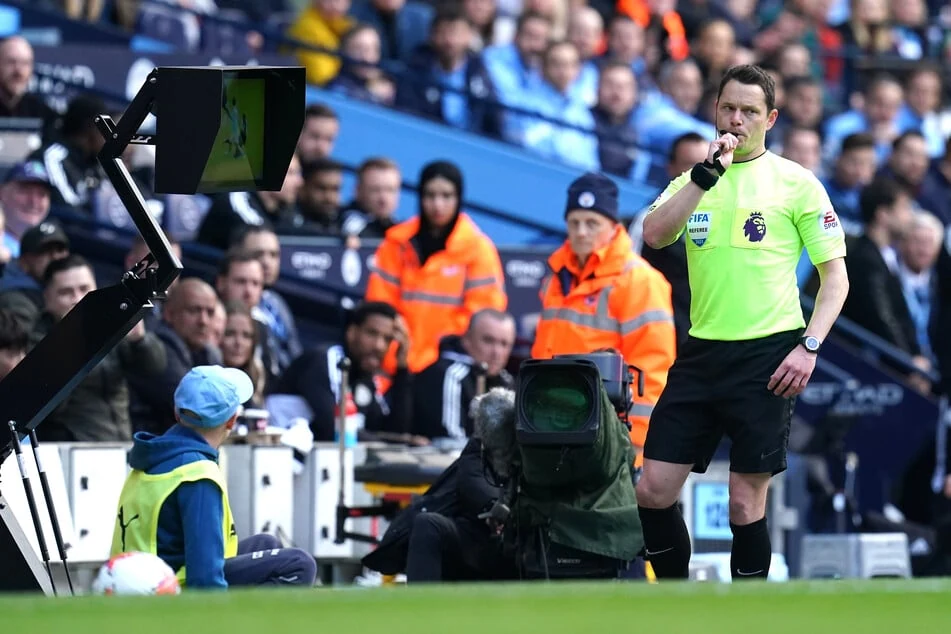
Replay speed can change how convincing an incident looks. A frozen frame can establish a point of contact, but it cannot by itself convey the speed and force of an entire challenge. The protocol distinguishes slow-motion factual examination from normal-speed assessment of intensity. Watch the approach, contact and aftermath before treating one dramatic still as conclusive. There is no fixed maximum duration after which a review automatically expires or the original call must change. A long wait may be frustrating, but its length alone tells you neither the answer nor whether the required threshold has been met.
How to follow a check and read the explanation afterwards
Start with the wording of the official explanation, not the loudest description of the controversy. The Premier League Match Centre publishes reasons for decisions, and the League collates them in matchweek articles. An explanation may identify an offside interference judgment, a significant-contact penalty or a direct-red offence. Those descriptions tell you what the officials were resolving. They do not mean that every other perceived error in the same passage was independently eligible for review. A television replay is evidence to assess; a presenter's prediction is not the final decision.
- Identify the reviewable event: goal, penalty, qualifying dismissal or identity.
- Note the original decision, including a decision to play on.
- Distinguish a factual measurement from an interpretation of force, interference or opportunity.
- Read the final referee decision and its stated reason.
- Check later KMI findings separately from any disciplinary announcement.
The Key Match Incidents Panel is useful because it separates two questions which a short headline can collapse. Was the original on-field decision correct? If it was wrong, was the error sufficiently clear for VAR intervention? The panel can judge the referee's call incorrect while also judging that the video official was right to leave it alone. That is not a claim that the two initial choices were equally good. It reflects the additional threshold the video official has to apply, and helps explain why arguing only about whether there was a foul can miss part of the controversy.
A later performance assessment is not itself a mechanism for editing the score. Keep an analysis of decision quality separate from the recorded Premier League results, the league table and a formal announcement about a player's suspension. If a report says a decision was wrong, ask which body reached that view and what authority its decision actually carries. This habit makes it easier to criticise inconsistency precisely, without assuming that a later disagreement automatically creates a replay, a points adjustment or a new ban.
Frequently asked questions
These remaining questions concern the difference between the offence, the colour of a card and the identity of the player receiving it. Each can affect the outcome, but they do not all give the video official the same powers.
The answers describe Premier League rules for 2026/27. Applying them to an actual incident still requires the relevant footage and the official explanation; a player's previous caution alone cannot settle every question about what VAR should do.
Can VAR remove the first yellow card as well?
Generally, no: correcting a clearly wrong second caution does not automatically erase the player's first booking. Ordinary first yellows are not a standalone invitation to re-referee the offence. Mistaken identity has its own correction route, and a separately reviewable incident can have disciplinary consequences. Those exceptions should not be confused with a general power to revisit a player's earlier booking history.
Can a yellow card be upgraded to a straight red?
Yes, when the incident qualifies for direct-red review and the original decision meets the intervention threshold. A challenge initially punished with yellow may prove to be serious foul play, for example. The referee can change the sanction after review. That authority comes from the direct-red category; it does not mean VAR can issue any ordinary caution the referee missed.
Can VAR correct a card shown to the wrong player?
Yes. Mistaken identity allows officials to identify the player who committed the penalised offence and correct a card shown to somebody else. The identity route does not generally allow the underlying offence to be reconsidered as well. To reopen that question, the incident must independently qualify through another reviewable category, such as a goal, a penalty or a direct-red offence.
Comments
Ask a useful question or share a helpful tip. Comments are reviewed before publication.
Loading comments…