The Premier League run-in means the closing stretch of the league season: the remaining matches in which clubs settle the title, European qualification and relegation. It is a football expression for the finish of the campaign, rather than a separate competition or a new set of points. A club's run-in is also its remaining fixture list, which explains why supporters talk about one team having a harder run-in than another.
To follow it, start with the Premier League table, then look at the matches each relevant club still has to play. A headline about the title race may matter little to a supporter whose team is fighting to stay up, while a match between clubs outside the top four can still change the European picture. This guide explains the language, the arithmetic and the practical checks that make those final weeks easier to understand. Examples use imaginary clubs and stated assumptions, so they remain useful without pretending to predict the outcome of a particular season.
What the run-in means and when it starts
The expression has two closely related uses. “We are entering the run-in” describes the final part of the season, when fewer opportunities remain to change the table. “Their run-in looks difficult” describes the opponents and dates a particular club still faces. Neither use creates a fresh league table. Points earned in August remain just as valuable as points earned in May, and a win has the same value throughout the campaign. What changes is the amount of time available to recover from a bad result.
There is no universal match number at which ordinary football conversation must switch to run-in language. A discussion may compare the final ten matches, the last six weekends or the fixtures after an international break. The Premier League can also give its own coverage a defined launch: its 2025/26 Run In campaign began on 10 April 2026 with Matchweek 32, covering the final seven Matchweeks. That was a specific editorial campaign boundary, rather than a permanent rule stating that every future season's run-in begins at Matchweek 32. When comparing articles, check which remaining matches the writer has counted.
For the current 2026/27 season, the scheduled endpoint is the final match round on 30 May 2027. That date provides a calendar reference without identifying which clubs will still be competing for particular positions. An October table cannot tell you the full spring story. It is more useful now to understand the method: identify the goal, count the fixtures remaining and keep the actual dates current. Once the season approaches its finish, the same method works whether a club has three games left or seven.
Three races can be unfolding at the same time
The Premier League's own run-in coverage separates the title race, the race for Europe and the relegation battle. Those objectives produce different groups of relevant opponents. Your nearest rival for a European place might be several positions away, while a club near the bottom may care far more about the result immediately above the relegation line than about the leaders.
Choose the objective before choosing the matches to follow. Then identify every club that can still affect it, including clubs with fewer games played. This prevents an easy mistake: treating a famous fixture as the most consequential game simply because it attracts the biggest audience. A less prominent match can change a team's chances directly, and one result can affect more than one race.
The title run-in
The title run-in concerns who can finish first once the league schedule is complete. A leader can become champion before its last fixture if no remaining rival can catch it. Consider an imaginary two-club race in which all other teams are already eliminated: Club A has 80 points and Club B has 73 with two matches remaining. B can reach only 79, so A is beyond reach even if A loses both games. That is a mathematical conclusion, distinct from saying a team “looks certain” to win.
If B instead has 74 points, its maximum is 80. A may have an excellent goal difference, but equal points require the relevant tiebreak assessment rather than an automatic declaration based on the points gap alone. A direct meeting between contenders is especially influential because the same result changes both clubs' totals: a win gives one three points and the other none. The phrase “six-pointer” describes the swing between opposite outcomes; the winner still receives only three actual league points. When reading a title-race headline, ask whether it describes a proven clinching condition or a judgment about likely results.
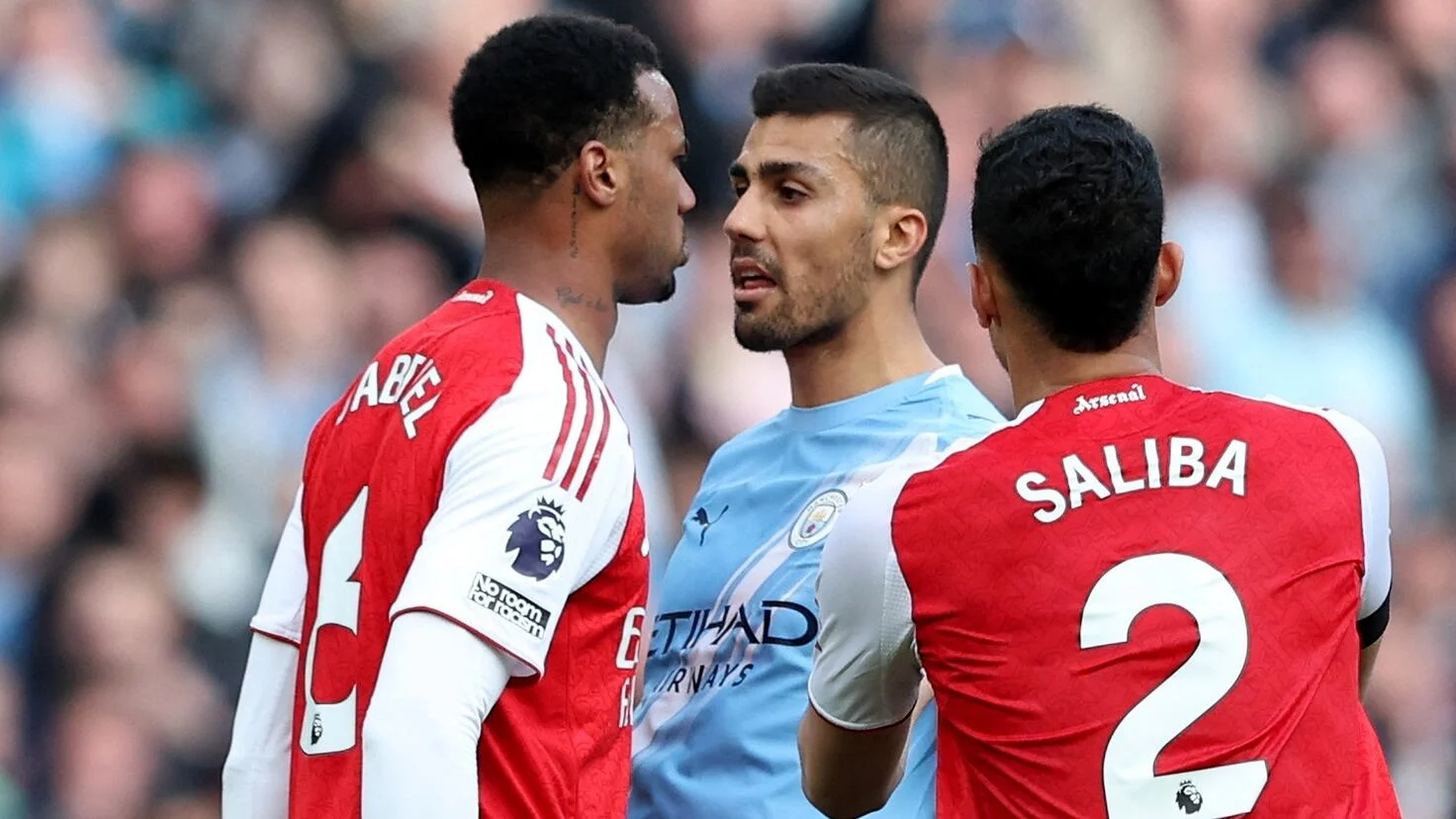
The race for European qualification
The European run-in is harder to reduce to one line on a table. Clubs can be competing for the Champions League, Europa League or Conference League, and their route can depend on more than final league position. Domestic cups, European titleholder routes and UEFA access arrangements can all matter. An extra Champions League European Performance Spot depends on the collective results of an association's clubs in the relevant European season. It is an earned allocation with specific rules, rather than an extra place permanently attached to a particular English finishing position.
For supporters, separate two questions: “Can we finish fifth?” and “What would fifth qualify for in this season's circumstances?” The first is a league-results question; the second requires the appropriate access rules and cup outcomes. Finishing higher can remain valuable while the exact destination is unsettled. Follow the official race-for-Europe explanation for the relevant campaign and read its season label carefully. A confirmed route into the 2026/27 European competitions does not automatically establish the route earned through the 2026/27 Premier League for the following year.
The relegation run-in
The clubs in 18th, 19th and 20th in the final Premier League table are relegated to the Championship. Survival therefore means avoiding those final three positions, rather than reaching a universal points total. A club can be safe below a commonly quoted target if its rivals cannot catch it. Conversely, a points target discussed by commentators is not itself a rule that guarantees safety in every possible season.
An imaginary club on 39 points with two games left must consider the ceilings of all relevant teams below it. If enough rivals can still finish above 39, safety has not been established merely because the club is currently 16th. Some clubs may also play each other, restricting which totals can occur together. That is why a survival calculation should test combinations of results rather than assume every rival can independently take maximum points from a shared fixture.
The most useful question after each match is how many positions remain reachable, not simply whether the latest result felt positive. A draw away from home may be valuable, but it does not necessarily improve the gap if rivals win. Equally, a defeat does not necessarily cause relegation if other results preserve an attainable route to 17th. Distinguish a difficult position, a model's relegation probability and mathematical relegation: they describe different levels of certainty, and only the final one closes every remaining path to survival.
Read the points gap before predicting the finish
Read the points column and the played column together. In the current 20-club format, each team plays 38 league matches, so subtracting matches played from 38 gives its outstanding league fixtures. A three-point gap means something different when both clubs have two games left than when the chasing club has an extra fixture. Record the same snapshot for every club: comparing one team's total before its Saturday game with another's total after Sunday can make a simple table look misleading.
A useful first calculation is maximum final points = current points + three times matches remaining. An imaginary side with 61 points and five matches left can reach 76. That is an upper limit, not an expected finishing total. It helps eliminate impossible claims: a team already on 77 cannot be caught by that side through ordinary match points. It does not tell you whether 70, 73 or 76 is the likely result, and it does not automatically solve a multi-club race where remaining opponents include one another.
When ceilings overlap, keep goal difference and goals scored in view. The league's table-order explanation also distinguishes an in-season display from the additional end-season criteria used when a consequential position remains tied. A live table is a running picture, not a guarantee of the final placing. Treat a displayed lead while games are being played as conditional until the results are complete, and be precise about whether a claimed outcome survives an equal-points finish.
What a game in hand changes
A game in hand means a club has played fewer league matches than the club being compared with it. Suppose Club A has 66 points after 32 games and Club B has 64 after 31. If B wins its extra match, it reaches 67 and moves ahead on points. A draw takes it to 65, still behind A; defeat leaves it on 64. Saying B is “effectively top” assumes the most favourable of those outcomes before it happens. The accurate description is that B has an opportunity to move ahead.
Also identify the opponent in that outstanding fixture. If it is another club in the same race, the result distributes points between two relevant teams. They cannot both win that match, and a draw awards one each rather than three each. For a quick comparison, write down each club's played total and remaining opponents next to its points ceiling. For a firm clinching or survival declaration, check the compatible combinations. Games in hand explain uncertainty in a table; they should not be silently converted into earned points just to simplify a headline.
How to compare two clubs' remaining fixtures
Start by writing down every remaining opponent, with the venue alongside it. Looking only for the biggest club names can miss useful information: an opponent's current level may differ from its reputation or its position months earlier. Opta's 2025/26 run-in analysis, for example, compared opponents using its own power ratings. That illustrates a method for defining difficulty, rather than proving which club will take the most points. If you use a ranking, explain what it measures and when it was updated.
Then compare the home-and-away mix and the direct meetings. Two clubs with similarly placed opponents can face different practical sequences: one might have successive away trips, while the other plays a direct rival at home. A direct meeting also changes the points available to both sides in the same race. Put it on both lists rather than treating each schedule as independent. None of these observations makes an individual fixture a guaranteed win or loss; their purpose is to expose the assumptions behind “easy” and “hard”.
Add the wider calendar. The fixture programme must coexist with domestic cups, European competitions and international football. A club advancing in another competition can acquire additional matches and have a league fixture moved. Compare the dates actually available, not a June list that has since changed. You can note a short interval between games without inventing a player's fatigue, injury or selection decision. Those require separate evidence, and a manager's eventual team choice cannot safely be inferred from the calendar alone.
Finally, keep two conclusions separate. A scenario says what would happen if specified results occur; a prediction estimates which results are more likely. A good comparison can support either, provided its assumptions are visible. “Three wins would take this club to 75” is transparent arithmetic. “They will win all three because the fixtures are easy” adds an unsupported forecast. Revisit the comparison after a postponement, a significant new result or a confirmed change in dates. The run-in evolves, and an honest assessment should evolve with it.
Build a practical run-in viewing plan
Make a short watchlist containing your club, its direct rivals and any other fixtures that affect the same objective. Use the weekend fixture schedule to identify what is coming next, then return to the full schedule for rearranged midweek matches. A weekend-only view can omit the game in hand that changes the entire comparison. Keep postponed matches on a separate reminder list until a new date is confirmed, rather than treating the old date as an appointment that still stands.
For each match, check three things together: the date, the timezone and the broadcast market. A late UK kickoff can fall on the following calendar day for an overseas supporter. A national rights holder is also different from a confirmed assignment for that specific fixture. Use the country-specific Premier League TV guide, and treat TBA as information still awaiting confirmation. Recheck important viewing and travel arrangements against the club, competition or broadcaster once the assignment is published.
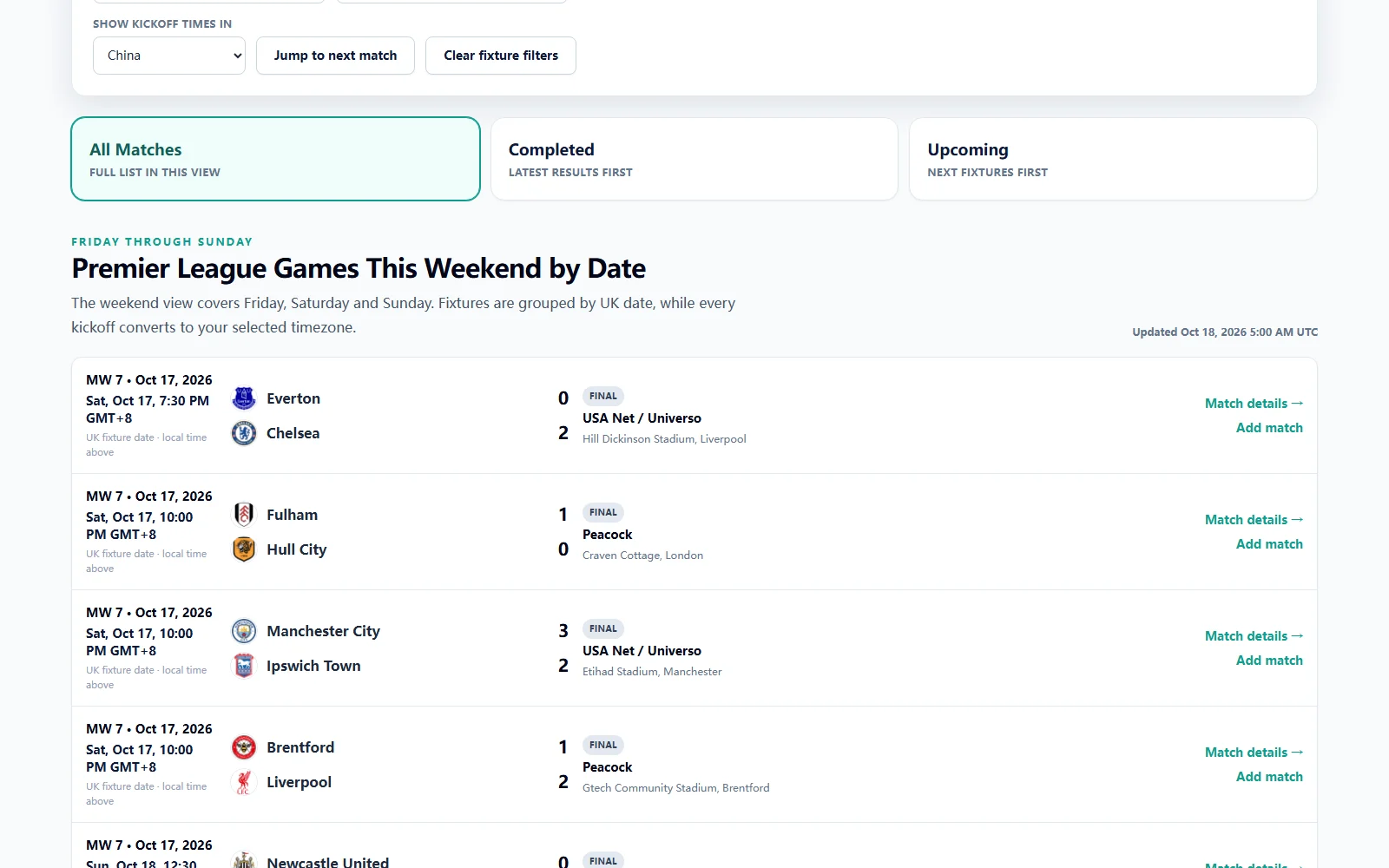
If you want reminders across several weeks, use the Premier League calendar tool and choose a subscription when you want later changes to refresh. A one-time ICS import is a snapshot, so moving the real fixture does not normally update that imported appointment. Subscribed calendars can receive changes when the calendar provider refreshes the feed, but that refresh is not necessarily immediate. Before an important match, open the current fixture listing even if a calendar reminder already exists.
During the final round, keep the relevant scores and the live table available together. A goal elsewhere can alter the provisional situation while your own game continues. Wait for the decisive matches to finish before turning a live position into a final outcome, then check whether any unresolved rule or official decision affects the conclusion. The most useful run-in plan is therefore modest and repeatable: know the objective, track the right fixtures and refresh the information when results or dates change. That turns a dramatic phrase into a clear way of following the season.
Comments
Ask a useful question or share a helpful tip. Comments are reviewed before publication.
Loading comments…