A player can commit an offside offence without touching the ball. An attacker who was in an offside position when a teammate played the ball may become involved by obstructing an opponent's view, challenging for the ball or making another action that meets Law 11's interference conditions. The missing touch is therefore not a complete defence. At the same time, simply standing beyond the defensive line does not automatically make an attacker guilty of an offence.
The decision has two parts: where the attacker was at the relevant teammate touch, and what the attacker subsequently did. Confusion arises when a replay or a positioning graphic answers the first question and viewers assume it answers the second. This guide separates position from involvement, explains the difference between a save and deliberate play, and shows why semi-automated offside technology still needs human judgment. The rules and Premier League explanations were checked on 29 October 2026.
An offside position is only the first part of the decision
The basic positioning test concerns an attacker's head, body or feet in the opponents' half, nearer the goal line than both the ball and the second-last opponent. Hands and arms do not count, and the halfway line is not part of the opponents' half for this purpose. Being level with the second-last opponent is not an offside position. Those conditions tell officials whether the attacker was in a potentially relevant position, rather than whether play must immediately be stopped.
Position is normally assessed when a teammate plays or touches the ball, using the first point of contact; a goalkeeper throwing the ball has a specific last-contact provision. Involvement may occur later. An attacker cannot necessarily solve the problem by running back behind a defender before receiving the same ball. Conversely, a player who was in an offside position but never becomes involved in the relevant way does not create an offence merely by appearing in the background of the replay.
Also notice the wording second-last opponent, rather than last outfield defender. The goalkeeper is not permanently assigned a special place in that order. For a viewer following today's Premier League fixtures, it helps to examine two moments: first the teammate's touch and relevant positions, then the attacker's action and its effect. A single freeze-frame can help with the first moment. It usually cannot establish every aspect of the second, especially when the attacker never contacts the ball.
How interference can be offside without a touch
Law 11 separates interfering with play by touching the ball from interfering with an opponent. The latter includes clearly obstructing the opponent's line of vision so they cannot play the ball, challenging an opponent for it, clearly attempting to play a nearby ball when that affects an opponent, or making an obvious action which clearly affects an opponent's ability to play it. Those routes give the missing-touch answer its substance: the law protects an opponent's opportunity to deal with the ball as well as regulating who eventually kicks it.
The wording also sets limits. A runner being somewhere in a defender's awareness is not automatically an offence, and a goalkeeper's complaint does not establish interference by itself. Officials have to identify the relevant action and its effect, using the particular route in the law. For an attempted touch, proximity to the ball and impact on an opponent matter. For a challenge, asking only whether the attacker won the ball misses the reason the challenge can already be significant.
Blocking the goalkeeper’s view is about actual impact
Imagine a shot passing an attacker who was in an offside position when the teammate struck it. If the attacker clearly obstructs the goalkeeper's view and thereby prevents the goalkeeper from playing or being able to play the ball, the attacker can commit an offside offence without a touch. The evaluation is about the relevant line of vision and the opportunity to respond. It is not necessary to turn the argument into a claim that the goalkeeper would certainly have saved every legally unobstructed shot.
Now imagine the same attacker standing off to the side, neither blocking that view nor making another qualifying interference action. The attacker is not automatically guilty just because the television picture places both players near the goal. A wide camera angle and a view from behind the shot can reveal different things. Watch the goalkeeper's sightline at the important moment, not simply the distance between attacker and goalkeeper after the ball has gone in. This is why a positioning line alone cannot complete a sightline judgment.
A challenge or missed attempt can affect an opponent
A player in an offside position can also become involved by challenging a defender for the ball before the attacker makes a successful touch. The defender's available response may already be affected by that contest. Asking who finally struck the ball can therefore come too late in the sequence. The analysis is not limited to the eventual scorer or the final shot: it includes the qualifying intervention which happened while the opponent was trying to play the ball.
A clearly attempted but missed kick has its own boundary. In a hypothetical example, an attacker swings at a ball close by and that action affects an opponent trying to deal with it. Missing the ball does not necessarily make the attempt irrelevant. But an unrelated movement several metres away is not automatically the same offence. Officials must connect the action to the close ball and the opponent's ability to play it. Avoid replacing the law with a vague assertion that any distraction anywhere near the penalty area means offside.
What Everton’s October Johnson incident shows
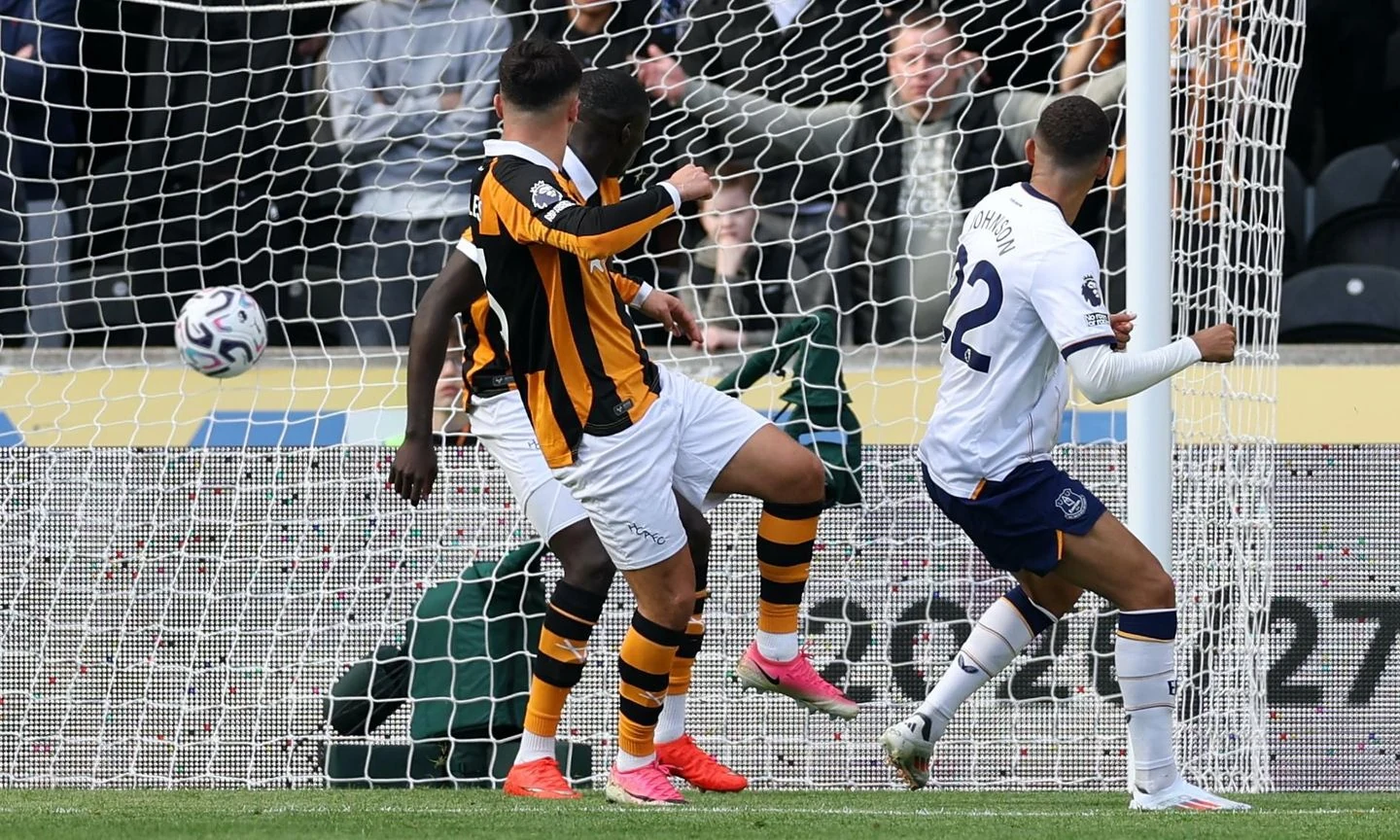
The Premier League's explanation of Hull–Everton on 11 October provides a useful current example. Brennan Johnson's apparent goal was overturned because he was in an offside position and challenged an opponent for the ball. The League's later KMI account identifies the relevant teammate action as Harrison Armstrong's shot. After a defensive save by Mendy, Johnson challenged Giles, limiting the defender's options to clear. The crucial issue was therefore not simply the position of the player who eventually put the ball into the goal.
The explanation links two legal ideas. First, the block was treated as a save rather than deliberate play which would end the relevance of the earlier offside position. Second, Johnson became active through the challenge on Giles. Saying that a defender touched the ball, without classifying that touch, does not answer the first point. Saying that the attacker had not yet made the decisive scoring touch does not answer the second. Nor should this example be described as a claim that Johnson never touched the ball anywhere in the sequence.
Read the official KMI explanation as a sequence rather than treating the final goalmouth image as the whole incident. Where was Johnson when Armstrong shot? What kind of defensive action followed? When did Johnson's challenge affect the next opponent? Those are the questions which explain the disallowance. They also show why a goal can be ruled out for active interference before the final scoring action, without requiring a separate physical foul or a fully automated computer verdict about the defender's options.
Why saves and deflections do not work like deliberate play
The idea that any defender touch resets offside is too broad. Law 11 preserves the relevance of the earlier position when the ball rebounds, is deflected or is deliberately saved, and the attacker then becomes involved in the specified way. A save does not have to be made by the goalkeeper. An outfield player blocking a ball which is going into or very close to the goal can also make a save under the rule.
The terminology can sound contradictory in everyday English. A defender may intentionally throw a leg in front of a shot, yet that deliberate effort to save is not the same as the law's deliberate-play provision. Saves are expressly treated differently. That is the point made by the League about Mendy's block in the October example. Classification depends on the action and circumstances, not merely on whether the defender meant to move towards the ball. The attacker's subsequent involvement must still be examined rather than assumed.
A controlled clearance can be deliberate even when it goes wrong
Deliberate play involves control with the possibility of passing, gaining possession or clearing. Indicators include whether the defender had a clear view, time to coordinate and a reasonably predictable ball, rather than an instinctive stretch at a fast and unexpected delivery. Imagine a defender seeing a pass arrive, setting their body and attempting a controlled clearance which is mishit. Poor execution does not necessarily stop that action being deliberate play. Compare an unsighted defender barely deflecting a close-range shot: the mere fact of contact does not establish the same control.
Judge the opportunity to play the ball, not simply whether the clearance reached its intended target. The law expressly allows a deliberate pass or clearance to be inaccurate or unsuccessful. There is also a timing boundary: an attacker may already have committed an offside offence by challenging an opponent before a later defensive action. A subsequent touch cannot automatically erase an offence which has already occurred. That is another reason to watch the sequence in order instead of reducing every decision to whichever team last touched the ball.
What SAOT measures and what the referee still decides
Semi-automated offside technology supports the positioning part of this process. The Premier League describes optical tracking which proposes the relevant kick point and places offside reference lines, reducing manual work. The VAR still checks that the system has selected the correct players, moment and relevant body references. That is why semi-automated is a meaningful description: generating tracking information and confirming a lawful offside decision are connected tasks, but they are not identical.
The League's technical explanation explicitly preserves human decisions about deliberate play and an attacker who does not touch the ball but may interfere with an opponent. IFAB's protocol likewise distinguishes factual positional checks from subjective interference judgments, for which an on-field review is appropriate. A correctly measured position can coexist with a difficult question about a challenge or blocked view. Faster line placement cannot by itself decide the defender's available options, and a human review of that second question is not proof that the positioning system has failed.
Thicker lines and a clear graphic do not settle every judgment
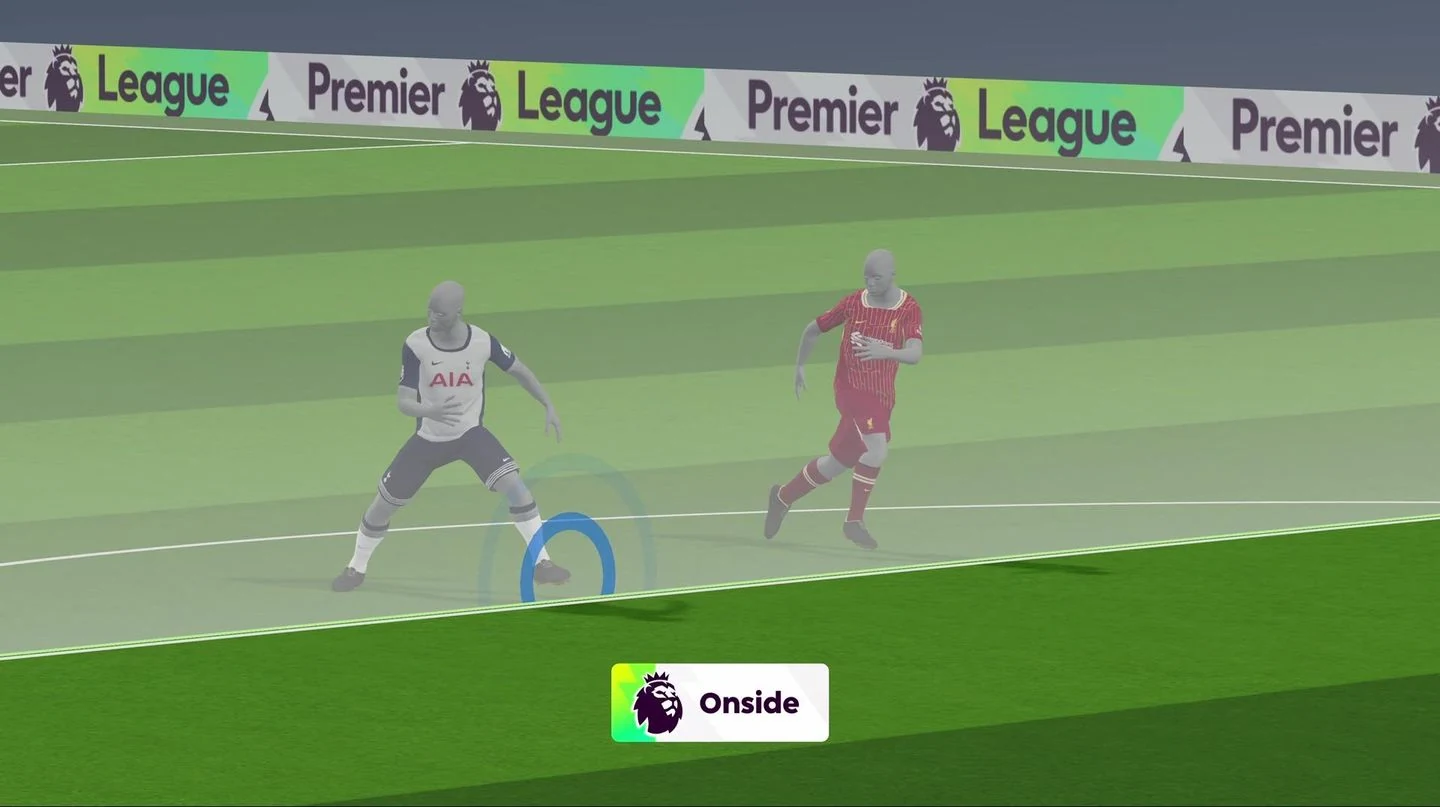
The Premier League has also confirmed this season that its existing thicker-line approach continues with SAOT. Its September KMI explanation used a close onside decision involving Dedic and Robertson to illustrate the benefit of that approach for an attacker. It would be wrong to assume that adopting automated line placement quietly replaced the domestic tolerance framework with whatever a viewer remembers from a different tournament. There is no need to invent a centimetre margin to explain the principle.
A clean positional graphic helps supporters see the measured comparison. It does not show, by itself, whether a goalkeeper's view was blocked, whether a defender made a controlled play or whether an attacker challenged an opponent. Those questions concern the moving sequence and the law, not just the displayed distance. The official sample pictured here illustrates the measurement process; it is not a reconstruction of Johnson's October incident. Treating a visualisation as a complete explanation of every offside element gives the technology a responsibility it does not have.
How to read the next offside check
Begin with the relevant teammate touch rather than the moment the ball enters the net. Locate the attacker, ball and second-last opponent, then let the replay continue. Identify what made the attacker active: a touch, a challenge, a blocked view or another qualifying action. If a defender touched the ball between those moments, classify that action instead of assuming it automatically ended the earlier phase. This ordered approach is more reliable than switching repeatedly between one positional still and the celebration.
- Identify the teammate touch which fixes the relevant position.
- Check the ball, playable body parts and second-last opponent.
- Identify the specific involvement or opponent-interference action.
- Classify any defensive touch as a save, deflection or deliberate play.
- Distinguish a measured position from the referee's subjective judgment.
- Read the official reason before treating the graphic as a complete explanation.
Two apparent exceptions become easier to understand through that sequence. There is no offside offence when a player receives the ball directly from a throw-in, goal kick or corner. Once another teammate plays it, however, the normal analysis can apply to the new action. An indirect free-kick for offside can also be taken in the offending player's own half if that is where the offence occurred after the player had been in an offside position at the relevant earlier touch. The positioning moment and offence location need not be the same.
During a close attack, keep following play until the referee stops it rather than assuming that a delayed flag means the earlier position was accepted as onside. Afterwards, compare the official explanation with the moving sequence, and use the confirmed results and current table for the match outcome. A sound explanation should identify the relevant involvement, not merely say that a computer found an attacker beyond a line. That is the information needed to assess a non-touch offside decision on its actual merits.
Comments
Ask a useful question or share a helpful tip. Comments are reviewed before publication.
Loading comments…