
Premier League clubs operate under the current financial rules: Squad Cost Ratio (SCR) and Sustainability and Systemic Resilience (SSR) in 2026/27. The first links squad spending to football income; the second examines whether a club can meet its wider financial commitments. They replace PSR for the new season. The familiar 85% figure is an important starting point, but it does not mean every club spending one pound above that level immediately loses points.
This guide explains the framework as available on 29 October 2026. It separates an accounting cost from a cash payment, a monitoring exercise from a compliance decision, and a general rule from an allegation against a particular club. Those distinctions matter when a transfer headline is presented as proof that a team must sell players or will receive a deduction. The examples below use invented clubs and numbers, so they explain the arithmetic without pretending to reveal confidential club budgets.
What replaced PSR in the Premier League?
The change was approved at the league shareholders meeting on 21 November 2025, with the new regime beginning in 2026/27 after non-binding monitoring. Clubs supported SCR and SSR but did not approve top-to-bottom anchoring. That last distinction matters: a percentage linked to each club's own income is a different policy from a spending ceiling linked to the income of the lowest-earning club. The adopted system therefore does not give every team an identical amount to spend.
Under the old PSR approach, the important figure was an adjusted financial result across an assessment period, ordinarily three years. The league's historical explanation includes permitted adjustments for activities such as infrastructure and youth development. It was never simply a limit on the amount a club could announce in a transfer window. Comparing a newspaper transfer total with a PSR loss allowance mixed different measurements, even before the new framework arrived.
SCR directs attention towards the cost of assembling and paying the football squad, while SSR addresses the financial resilience of the organisation supporting it. Think of them as two questions: how much playing investment is justified by income, and can the club continue meeting its obligations? A club can face a difficult answer to one without the other question becoming irrelevant. When looking at the Premier League table, keep any financial enforcement separate from points earned on the pitch until an official decision changes the calculation.
How the 85% squad cost ratio is calculated
A ratio needs two defined amounts: relevant squad costs and the income base against which those costs are measured. Dividing the first by the second produces the percentage. Neither amount is simply the latest bank balance. A club might have cash available but already be committed to substantial future wages, while another might record income before every corresponding payment has arrived.
The league includes player and head coach pay, agent costs and relevant registration charges. Its income base includes football operations and player-trading results. UEFA also uses defined accounting inputs, but its own rules have distinct details and reporting periods. For a domestic calculation, use the domestic definitions first; similarity between the systems does not make every accounting adjustment interchangeable.
Why a transfer fee is not the same as a yearly squad cost
Consider an invented signing costing £40 million on a four-year contract, with straight-line amortisation and a full year in the accounts. Spreading that registration cost produces a £10 million annual charge before wages and other relevant items. That does not make the player a £10 million purchase. It describes how an asset cost is allocated to accounting periods. Equally, calling the whole £40 million the player's first-year squad cost ignores the accounting method.
Now imagine the buying club agrees to pay the selling club in two instalments. Those payments describe cash settlement; they do not automatically change the annual amortisation to match the instalment schedule. A supporter therefore needs three separate numbers: acquisition price, accounting expense and cash due. Salary, agent charges, acquisition timing, bonuses and any required impairment can complicate the simplified example. Looking only at a list of reported transfer fees leaves too much missing to establish whether a squad fits its financial limit.
Revenue, player sales and a simple worked example
Football income can come from matchdays, commercial activity and competition distributions. The important boundary is whether an amount qualifies under the applicable rules. An owner providing cash is not automatically the same as the club earning additional operating revenue. UEFA's detailed denominator rules also show why analysts check adjustments to reported income, including fair-value issues, instead of treating every large entry in a set of accounts as unrestricted spending capacity.
Use a deliberately simplified invented income base of £200 million. Squad costs of £170 million give a ratio of 85%: £170 million divided by £200 million. If the club sells a player for net proceeds of £25 million when the remaining registration book value is £10 million, the illustrative disposal profit is £15 million. The sale price and the profit are different figures. This example isolates one accounting principle; it does not reproduce every adjustment in an actual league submission.
The same percentage also produces unequal cash-scale allowances. Applying 85% to £400 million produces £340 million, while applying it to £200 million produces £170 million. That is arithmetic, not a finding that either club can actually spend those amounts under every applicable rule. It explains why a revenue-linked system can restrain overspending while leaving substantial differences between clubs. A supporter can favour or criticise that design without confusing it with an equal budget for all twenty teams.
Why the green and red thresholds are different
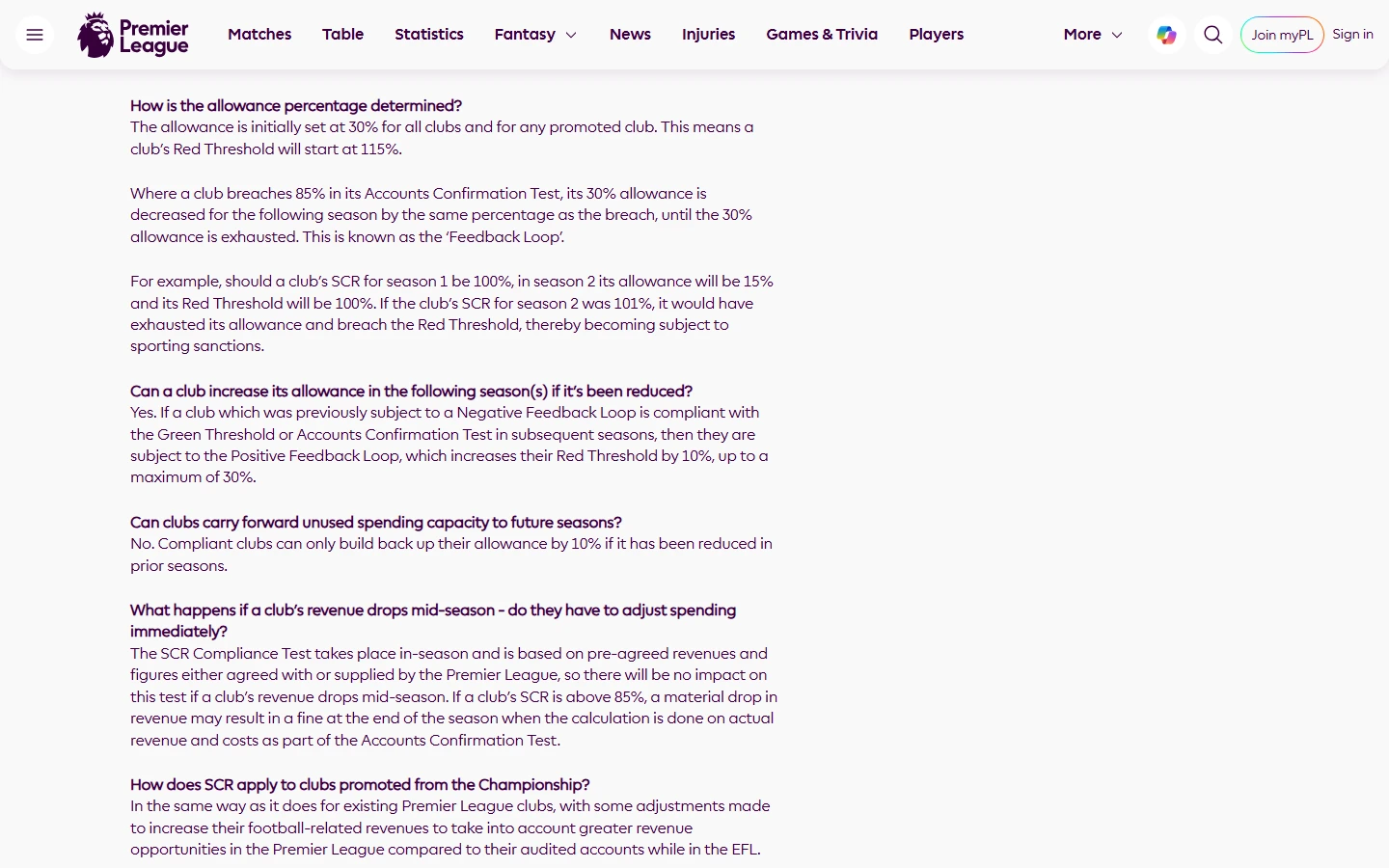
The green baseline is 85%; the initial red boundary is 115%. The difference is an allowance of 30 percentage points. On an invented £100 million base, those lines would be £85 million and £115 million. Multiplying 85% by 1.30 would produce 110.5%, which is a different calculation. The handbook defines the red amount using 85% plus the applicable club margin.
The distinction provides room for investment ahead of income, while making repeated use of that room consequential. It should not be read as a permanent invitation for every club to target 115%. A club can be above green without having crossed red, and its future red boundary can change. Asking which boundary a headline refers to is therefore essential before discussing points deductions.
How overspending changes a club's future allowance
Imagine a club beginning with 30 percentage points of allowance and recording an assessed ratio of 95%. That is ten points above 85%, so the feedback mechanism can reduce its future allowance to twenty points. Its next red boundary would consequently be 105%, assuming the relevant framework conditions and no other adjustment. This invented example shows why staying below the original 115% figure is not enough to understand a club's position across several seasons.
The positive mechanism can rebuild a reduced allowance by ten percentage points after the required compliance, up to the thirty-point maximum. This is not a bank account containing money saved in a quiet transfer window. An unused £5 million does not automatically become an extra £5 million of permission next year. The practical implication is strategic: a costly season may create tighter later choices even when it does not trigger an immediate sporting sanction. Supporters should evaluate the recruitment plan over more than one summer.
When clubs are tested and when sanctions can follow
October monitoring is an early checkpoint. The principal compliance test follows the winter transfer window on 1 March. For 2026/27, that means March 2027, not March 2026. Clubs requiring further assessment move through accounts confirmation after the season, with a later October true-up. Those later checks must not be confused with the monitoring taking place during the current October. Writing the year beside every stage prevents a surprisingly common misunderstanding.
There is also a material first-season exception: levies become payable for breaches in 2027/28 onwards. That does not suspend the sporting-sanction framework in 2026/27. A generic explainer saying every club above green pays a fine this season would therefore miss the transition. Looking ahead, levy assessment and potential offsets require the prescribed calculations; paying a levy is not the same as purchasing an unlimited right to exceed the red boundary.
For red-threshold breaches, the handbook specifies a fixed six-point component plus a variable component based on overspend divided by £6.5 million, rounded up. It also contains provisions for consecutive breaches and formal challenges. Consequently, a neat social-media calculation can omit an important procedural or numerical step. This is a description of the mechanism, not a prediction that a particular club will receive a specific deduction.
For supporters, the useful sequence is to identify the season, the test, the published decision and when any sanction takes effect. Match results on the results page establish what happened in games; a financial allegation is a separate matter. If a report relies on estimated accounts, ask whether it describes a possible future position or a completed assessment. Those are different levels of certainty even when both reports use an apparently precise percentage.
What SSR checks beyond the playing squad
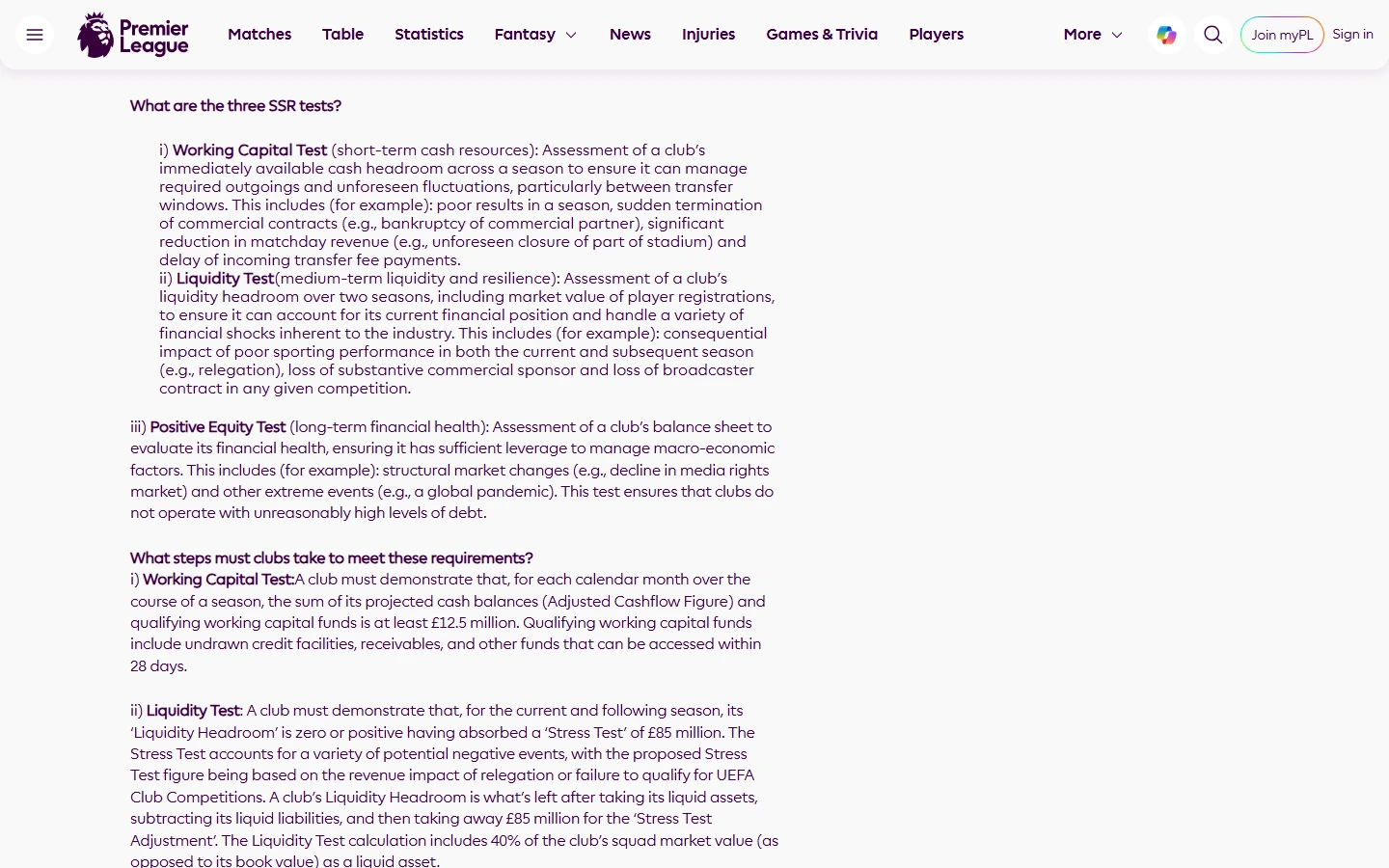
SSR asks about immediate resources, resilience over two seasons and the balance sheet over a longer horizon. Its three checks are working capital, liquidity and positive equity. That broader perspective matters because an acceptable squad-cost percentage cannot, on its own, tell you whether a club can pay its next obligations or withstand a major financial shock. A team with modest recruitment could still have an awkward payment schedule or substantial debt commitments elsewhere in the business.
Consider another invented situation: a club expects a transfer instalment on Monday but the payment is delayed while wages and supplier bills still fall due. The annual accounts may eventually contain the expected income, yet cash is needed at a particular moment. A resilience test addresses that timing problem. Similarly, having a valuable squad is not identical to having spendable cash today; selling a player takes a willing buyer, agreement and completion. These examples explain why spending discipline and financial stability need related but separate checks.
The ordinary annual assessment date is 7 July, with additional call-in assessments possible. Newly promoted clubs have their liquidity and positive-equity assessments on 31 October, a different event from SCR October monitoring. If a club fails a relevant test, a business plan and remedial measures can be required. The handbook permits escalating controls such as spending or registration restrictions where necessary. That framework seeks to restore compliance; it does not guarantee that financial difficulties can never happen, nor does every failed test automatically mean the same deduction of league points.
Why UEFA rules and historical PSR cases still matter
UEFA sets a 70% squad-cost limit in its 2026 regulations. A Premier League club participating in Europe must consider that framework alongside domestic obligations. Passing a domestic test does not provide permission to ignore a separate organiser's requirements. The useful analogy is needing two permissions for the same activity: satisfying one authority does not automatically satisfy the other. That is why the 85% domestic headline alone may not explain a European participant's recruitment decisions.
The reporting clocks are also different. UEFA specifies calendar-linked periods and particular treatment of player-trading elements; domestic SCR is organised around the season. Before comparing two percentages, check whether both calculations cover the same people, income definitions and dates. A ratio lifted from last year's financial statements and an estimate for the current campaign may be answering different questions. Putting them side by side without that context can manufacture an apparent contradiction.
The domestic transition also preserves enforcement powers over PSR periods ending in 2025/26 and earlier. A new rulebook for current spending does not erase a historical case. Equally, the new SCR deduction formula should not simply be pasted onto alleged conduct from a different regulatory period. Identify which rules the proceedings concern and what stage the decision has reached. Changes to the system and decisions under the previous system can legitimately appear in the news at the same time.
How to read a club spending claim without guessing
Start with the evidence behind the number. A full regulatory submission contains accounting information and reconciliations that a transfer rumour does not. UEFA expressly requires consistent reporting linked to financial statements and underlying records. Domestic SCR information also has confidentiality protections. A public estimate can be useful analysis, but its author should say what has been assumed and what remains unavailable. A precise-looking percentage does not remove uncertainty in the underlying wage or revenue figures.
Then identify the competition and period. Is the report about domestic SCR, UEFA cost control, SSR cash resilience or a historic PSR case? Is its number an annual accounting expense, a cash instalment, a sale receipt or a profit? Does it compare spending with the green baseline or with the club's current red boundary? Working through those questions often explains why two apparently conflicting reports can both contain elements of truth without establishing the same conclusion.
Finally, distinguish prediction from decision. A report that a club might need to reduce costs is not a published breach finding, and an appeal is not automatically a successful appeal. Keep the current standings tied to decisions that actually apply, while following confirmed financial announcements for changes. Supporters do not need to reconstruct confidential accounts to discuss recruitment sensibly. They need the right measurement, the right season and a clear statement of what the available evidence can support.
Comments
Ask a useful question or share a helpful tip. Comments are reviewed before publication.
Loading comments…