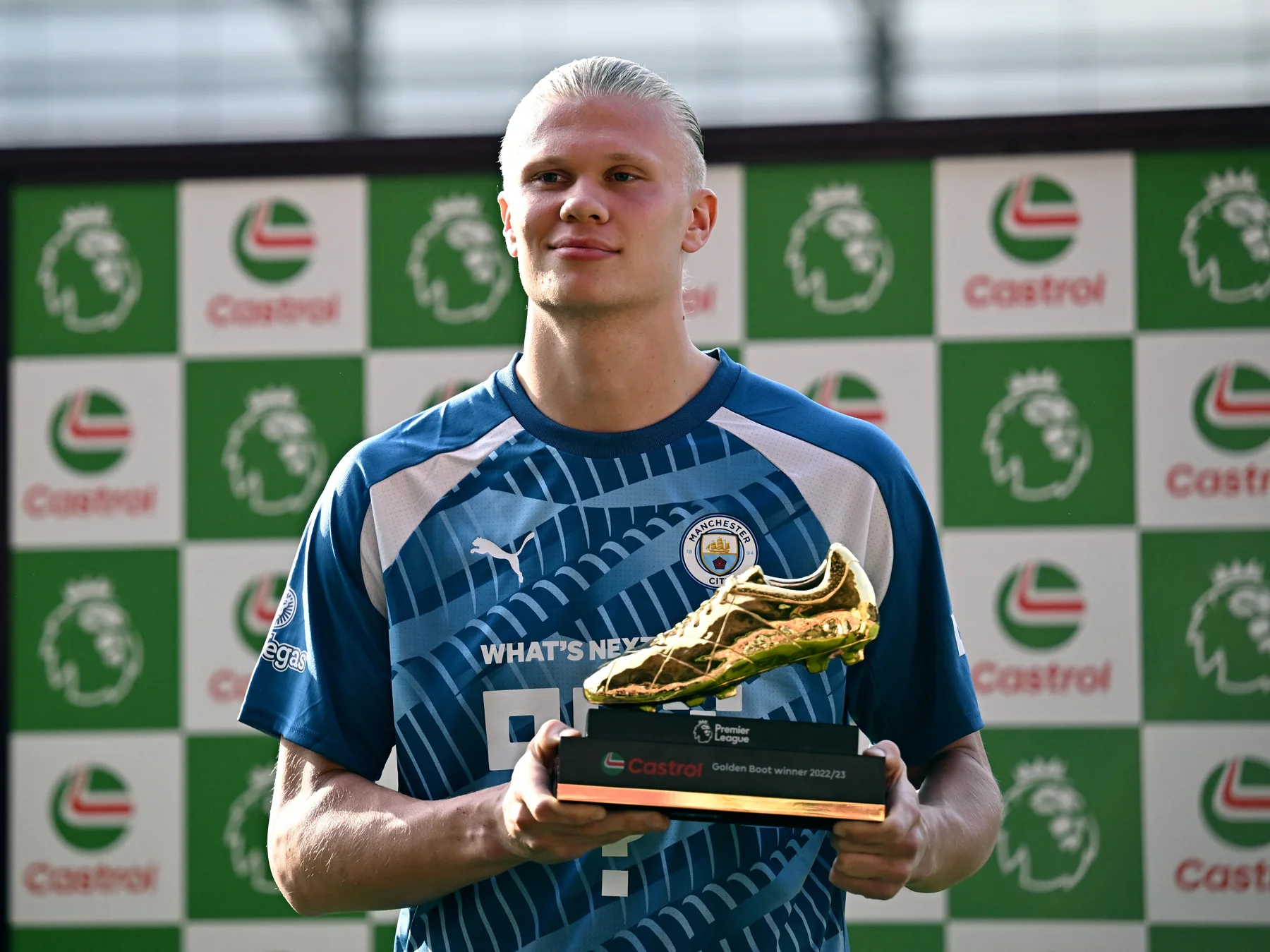
Manchester City won the 2022/23 Premier League with 89 points, five more than Arsenal. Manchester United and Newcastle United completed the top four; Leicester City, Leeds United and Southampton were relegated. Erling Haaland won the Golden Boot with a Premier League-record 36 goals.
This page is a fixed record of the completed 2022/23 league season. It will not move when a current match finishes. Readers looking for today's order should use the current Premier League table.
2022/23 Premier League final table
Every club completed 38 matches. Manchester City led the final ranking with 28 wins and 89 points, while Southampton finished 20th. The table below preserves the official season totals rather than a later form view.
| Pos | Team | P | W | D | L | GF | GA | GD | Pts |
|---|---|---|---|---|---|---|---|---|---|
| 1 | Manchester City | 38 | 28 | 5 | 5 | 94 | 33 | +61 | 89 |
| 2 | Arsenal | 38 | 26 | 6 | 6 | 88 | 43 | +45 | 84 |
| 3 | Manchester United | 38 | 23 | 6 | 9 | 58 | 43 | +15 | 75 |
| 4 | Newcastle United | 38 | 19 | 14 | 5 | 68 | 33 | +35 | 71 |
| 5 | Liverpool | 38 | 19 | 10 | 9 | 75 | 47 | +28 | 67 |
| 6 | Brighton & Hove Albion | 38 | 18 | 8 | 12 | 72 | 53 | +19 | 62 |
| 7 | Aston Villa | 38 | 18 | 7 | 13 | 51 | 46 | +5 | 61 |
| 8 | Tottenham Hotspur | 38 | 18 | 6 | 14 | 70 | 63 | +7 | 60 |
| 9 | Brentford | 38 | 15 | 14 | 9 | 58 | 46 | +12 | 59 |
| 10 | Fulham | 38 | 15 | 7 | 16 | 55 | 53 | +2 | 52 |
| 11 | Crystal Palace | 38 | 11 | 12 | 15 | 40 | 49 | −9 | 45 |
| 12 | Chelsea | 38 | 11 | 11 | 16 | 38 | 47 | −9 | 44 |
| 13 | Wolverhampton Wanderers | 38 | 11 | 8 | 19 | 31 | 58 | −27 | 41 |
| 14 | West Ham United | 38 | 11 | 7 | 20 | 42 | 55 | −13 | 40 |
| 15 | AFC Bournemouth | 38 | 11 | 6 | 21 | 37 | 71 | −34 | 39 |
| 16 | Nottingham Forest | 38 | 9 | 11 | 18 | 38 | 68 | −30 | 38 |
| 17 | Everton | 38 | 8 | 12 | 18 | 34 | 57 | −23 | 36 |
| 18 | Leicester City | 38 | 9 | 7 | 22 | 51 | 68 | −17 | 34 |
| 19 | Leeds United | 38 | 7 | 10 | 21 | 48 | 78 | −30 | 31 |
| 20 | Southampton | 38 | 6 | 7 | 25 | 36 | 73 | −37 | 25 |
P means played, followed by wins, draws and losses; GF and GA are goals for and against, GD is goal difference, and Pts is points. These are archived totals. The linked current table is the right destination for the latest campaign.
Read the standings in competitive bands as well as individual places. City and Arsenal formed a clear title pair, while Manchester United and Newcastle completed the top four. Liverpool, Brighton and Aston Villa occupied the next European positions, and the middle of the table remained compressed: only seven points separated eighth-placed Tottenham from 14th-placed West Ham. At the bottom, the two-point gap between Everton and Leicester was the decisive survival boundary. These bands explain what the positions meant in May 2023 without importing qualification rules or safety targets from another season.
The final column is especially important because an earlier screenshot could show clubs with games in hand or a different order. The 28 May final round brought every club to 38 matches, so this archive compares like with like. Points establish the ranking, with the competition's tiebreak process separating clubs when totals match. That is why Brighton stayed above Brentford despite both recording 12 defeats, and why a complete row is more informative than position alone: wins, draws and goal difference reveal how each final points total was built.
How Manchester City won the title race
The final five-point margin hides a race with two distinct phases. Arsenal controlled first place for much of the calendar, but Manchester City's late surge converted a sizeable early-April deficit into a third consecutive Premier League title.
For supporters reconstructing the race, the useful method is to separate weekly position from the completed table. Arsenal's long spell in first made them the leading team for most of the calendar, yet matches in hand meant the visual gap did not always compare an equal number of games. City then converted their remaining fixtures with a sustained winning sequence. The championship was therefore neither a wire-to-wire City procession nor the result of one isolated Arsenal mistake; it was a 38-match contest whose balance changed sharply in spring.
How long Arsenal led the table
Arsenal spent 248 days at the top, the longest a team had led in a Premier League season without becoming champion. Their opening five league wins established the early pace, and the lead was still eight points at the end of March, although City then had a match in hand. Arsenal ultimately produced 84 points, scored 88 goals and finished nine points above third-placed Manchester United. Those totals show that second place reflected a strong season, even though the final weeks changed the identity of the champion.
The 248-day figure measures calendar time in first place, not a count of Matchweeks won or the number of days on which both contenders had played equally often. Postponements, cup commitments and matches in hand affected how large the advantage looked at different moments. A supporter comparing archived snapshots should therefore check matches played alongside points. The decisive comparison is the completed 38-game record, but the days-leading statistic remains useful for understanding how sustained Arsenal's challenge was before the late reversal.
This distinction also prevents an overly simple “collapse” reading. Arsenal's 84 points and 88 goals were substantial outputs, and their position above the rest of the league was secure. What failed was not the entire campaign but the final conversion of a lead against a rival that finished with 89 points and a long winning run. For historical comparison, keep both truths together: Arsenal set a record for time led by a non-champion, while City still satisfied the only title test that counts—the final table.
How City's finish changed the race
The official season review describes Manchester City moving from eight points behind Arsenal in early April to five points ahead by the end of May. The eight-point gap is an early-April snapshot rather than a permanent, games-equal margin, but it still shows the scale of the turnaround. Arsenal then drew with Liverpool, West Ham and Southampton before City won the direct meeting 4-1. Those results changed both the points calculation and the pressure attached to each remaining fixture.
City's final numbers explain why the chase succeeded: 28 victories, a league-high 94 goals, a +61 goal difference and 89 points. Their attack created a six-goal advantage over Arsenal across the full season, while their final points advantage reached five. Arsenal's 84 would have won some Premier League seasons, but historical comparisons cannot set the threshold in advance. In 2022/23 the required total was simply one more than City’s nearest rival could earn, and City cleared that test.
The spring sequence supplies the clearest turning point. City's 12-match winning run began after their February draw at Nottingham Forest and enveloped Arsenal's difficult April. The head-to-head victory mattered because it transferred points and confidence within the same race, yet it did not carry a special title value: City still had to win the surrounding matches. For fans reviewing the campaign, that combination of sustained form and a decisive direct result explains more than attributing the championship to one evening.

European qualification and relegation
The top four qualified for the Champions League through the final table, returning Newcastle United to that competition alongside Manchester City, Arsenal and Manchester United. The other European destinations reflected league positions plus domestic and UEFA cup outcomes in that specific season. A supporter reading the table should therefore use the confirmed 2022/23 allocation rather than assuming that sixth or seventh always leads to the same competition in every later campaign.
- Champions League: Manchester City, Arsenal, Manchester United and Newcastle United.
- Europa League: Liverpool and Brighton & Hove Albion through the season's allocation; West Ham United qualified separately by winning the UEFA Europa Conference League.
- Europa Conference League: Aston Villa entered the qualifying route after finishing seventh.
At the bottom, Everton survived in 17th with 36 points. Leicester City went down with 34, Leeds United with 31 and Southampton with 25. Everton's two-point cushion over Leicester defines the survival line more clearly than position alone. The issue remained open until the final day: Everton's home victory over AFC Bournemouth protected 17th even though Leicester also won. That context explains why the final two-point gap felt narrower than a static table may suggest.
European qualification is a good example of why a table needs explanation. League places created the main route, but cup winners could qualify separately and alter how the remaining positions were labelled. West Ham's UEFA Europa Conference League triumph produced a Europa League place independent of their 14th-place league finish, while Aston Villa's seventh place led to the Conference League qualifying route. Those outcomes belong to 2022/23; readers should verify the official allocation anew when using a different season's table.
The relegation line has a similar boundary. Thirty-six points were enough for Everton in this particular campaign because the highest relegated club finished on 34. It is not a universal safety target: the number needed depends on what all clubs collect in the same season. Fans comparing relegation battles should first identify 17th and 18th, then examine their points and goal difference. That method preserves the actual margin rather than treating a remembered points total as a permanent rule.
2022/23 Premier League top scorers
Erling Haaland won the Golden Boot with 36 goals, setting a new Premier League single-season record in his debut campaign. The total surpassed records produced in both 38-match and earlier 42-match Premier League seasons. Harry Kane's 30 was still an exceptional runner-up total: he scored in 26 different league matches but finished six behind the Manchester City striker. Reading the two totals together shows both the scale of Haaland's record and the unusually high standard set by second place.
| Rank | Player | Club | Goals |
|---|---|---|---|
| 1 | Erling Haaland | Manchester City | 36 |
| 2 | Harry Kane | Tottenham Hotspur | 30 |
| 3 | Ivan Toney | Brentford | 20 |
| 4 | Mohamed Salah | Liverpool | 19 |
| 5 | Callum Wilson | Newcastle United | 18 |
These totals count Premier League goals only. Domestic cup, European and international goals are excluded, even when a player represented the same club in those competitions during the season. The club column also records the team represented in the 2022/23 league, not a player's current employer. Finally, this is a concise top-five reference rather than a complete scoring chart, so it should not be used to infer every tie or lower ranking beyond fifth place.
Haaland and Kane reached their totals in the same 38-match league format, which makes the six-goal gap a clean comparison. Haaland's 36 established the award and record; Kane's 30 would have been a winning total in many other seasons but did not change the 2022/23 order. The remaining top five were separated by only two goals: Ivan Toney scored 20, Mohamed Salah 19 and Callum Wilson 18. That cluster illustrates why exact totals are more useful than broad labels such as “top scorer contender.”
For supporters cross-checking statistics, start with the season selector and competition filter before comparing names. A player's all-competitions total can be much larger than the number shown here, and a live scoring page will move as the active campaign continues. This archived ranking will not. The fixed scope makes it suitable for season review, while current Golden Boot questions need a current leaderboard rather than an assumption based on 2022/23 performance.
Key results and records from the season
The campaign paused after the 13 November fixtures for the FIFA World Cup and resumed on Boxing Day before finishing on 28 May 2023. That interruption made 2022/23 unlike a normal August-to-May rhythm and left clubs on unequal matches played at several points. Across the completed calendar, teams scored a then-record 1,084 Premier League goals, 12 more than the previous competition record. The figure belongs to all 380 league matches and should not be confused with goals from the domestic cups or Europe.
- Liverpool's 9-0 win over AFC Bournemouth equalled the competition record for the biggest victory.
- Nottingham Forest beat Liverpool 1-0 at the City Ground, an important example of the promoted club's home resilience.
- Manchester City finished with the best goal difference, +61, while Newcastle matched the champions' league-low 33 goals conceded.
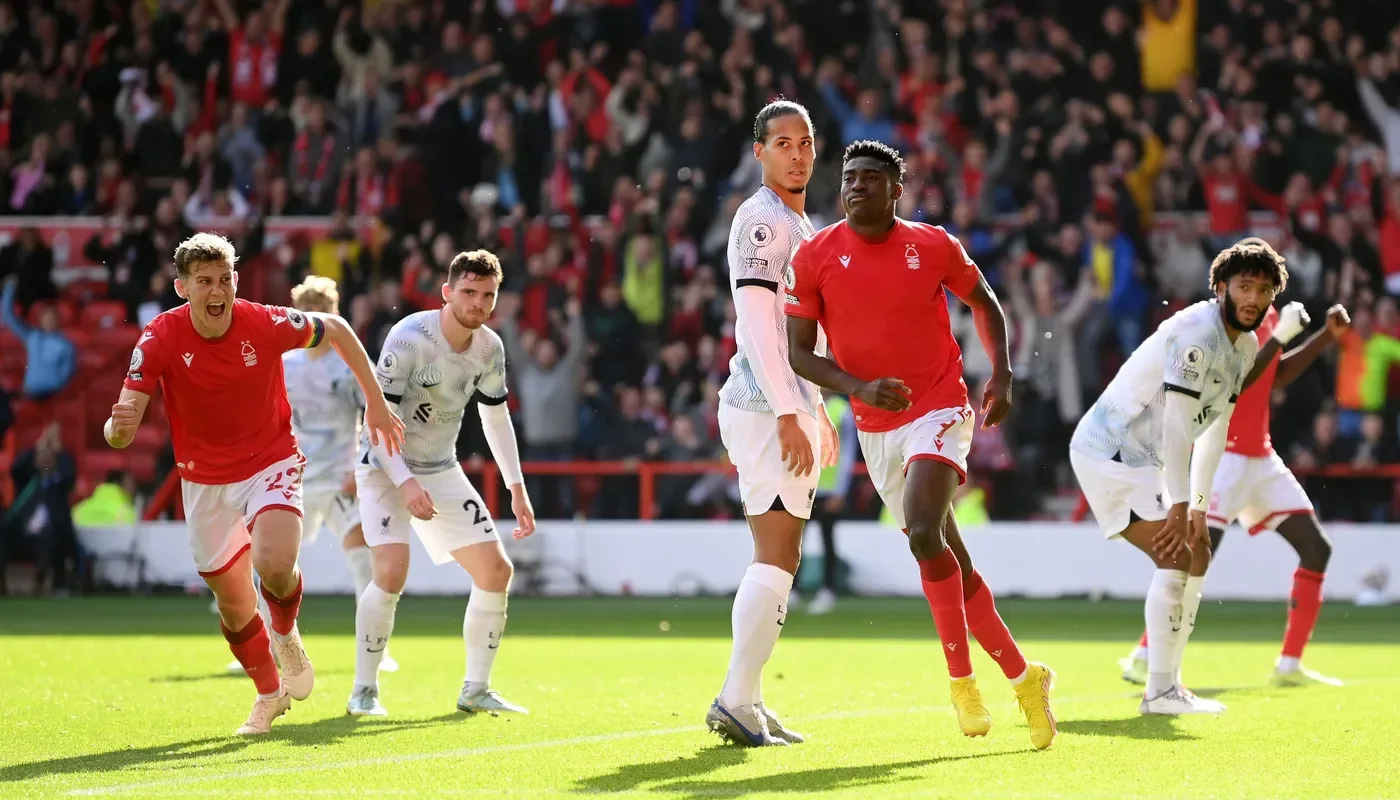
Those examples help identify the season; they are not a substitute for all 380 scores. A biggest win, an upset and a defensive record answer different questions, so none should be treated as a ranking of the “most important” matches. For a live, date-ordered view of the present campaign, use the current Premier League results page. For historical research, select the date or Matchweek first and keep the 2022/23 season label visible.
The World Cup break also affects how fans should interpret form sequences. The league stopped after only 14 or 15 matches for most clubs, remained frozen during the tournament and restarted six days after the final. A run described as “before the break” may therefore be separated from the next league result by more than a month. Even so, the season's accounting did not change: every club ultimately played 38 matches, and the final table and scoring totals include the full pre- and post-World Cup program.
Liverpool's 9-0 win and Forest's 1-0 upset show the range contained inside those totals. The first equalled the Premier League's largest victory; the second helped a promoted side build the home results needed for survival. A useful season review combines such match-level examples with table-level consequences. That approach avoids reducing 2022/23 to its champion alone, while also avoiding an unstructured catalogue of scores that gives supporters no reason why a selected result matters.
Frequently asked questions
These quick answers summarize the completed 2022/23 table, relegation line and Golden Boot record. They remain fixed historical facts from a 38-match campaign; any question about today's positions, results or leading scorer should be checked against the current season instead.
Use the answers as shortcuts to the verified outcome, then return to the full table when you need the margin, goal difference or neighboring clubs. The season label is essential: later promotions, transfers and title winners do not rewrite what happened in 2022/23.
Who won the 2022/23 Premier League?
Manchester City won the 2022/23 Premier League with 89 points after all 38 matches. Arsenal finished second on 84, making the final margin five points. It was City's third consecutive Premier League championship and their fifth title in six seasons at that point, although Arsenal had led the table for much of the campaign.
Who was relegated in 2022/23?
Leicester City, Leeds United and Southampton were relegated from the Premier League in 2022/23. Leicester finished 18th on 34 points, Leeds 19th on 31 and Southampton 20th on 25. Everton stayed up in 17th with 36 points, two more than Leicester, so the final survival boundary fell between those two clubs.
Who was the top scorer in 2022/23?
Erling Haaland was the top scorer with 36 Premier League goals for Manchester City, a competition record for one season. Tottenham Hotspur's Harry Kane placed second with 30, six fewer than Haaland. Both totals refer only to league goals; goals scored in domestic cups, the UEFA Champions League or other competitions are excluded.
Where can I check current Premier League standings?
Use the current Premier League table for the latest positions, matches played, goal difference and points. That page follows the active competition, while this article deliberately leaves the completed 2022/23 standings unchanged. Keeping the pages separate prevents a historical answer from becoming mixed with a later season's live numbers or current club status.
Comments
Ask a useful question or share a helpful tip. Comments are reviewed before publication.
Loading comments…