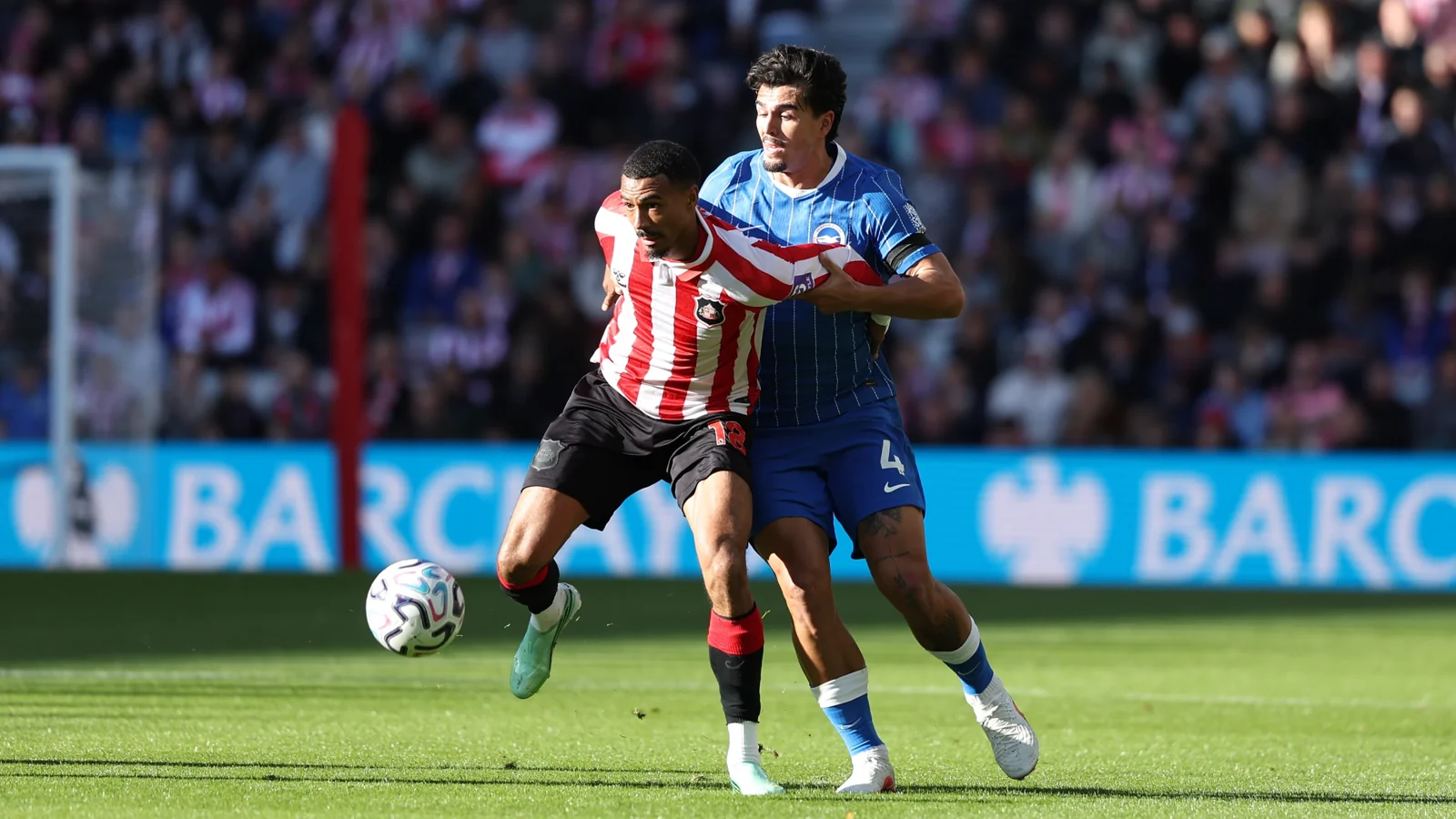
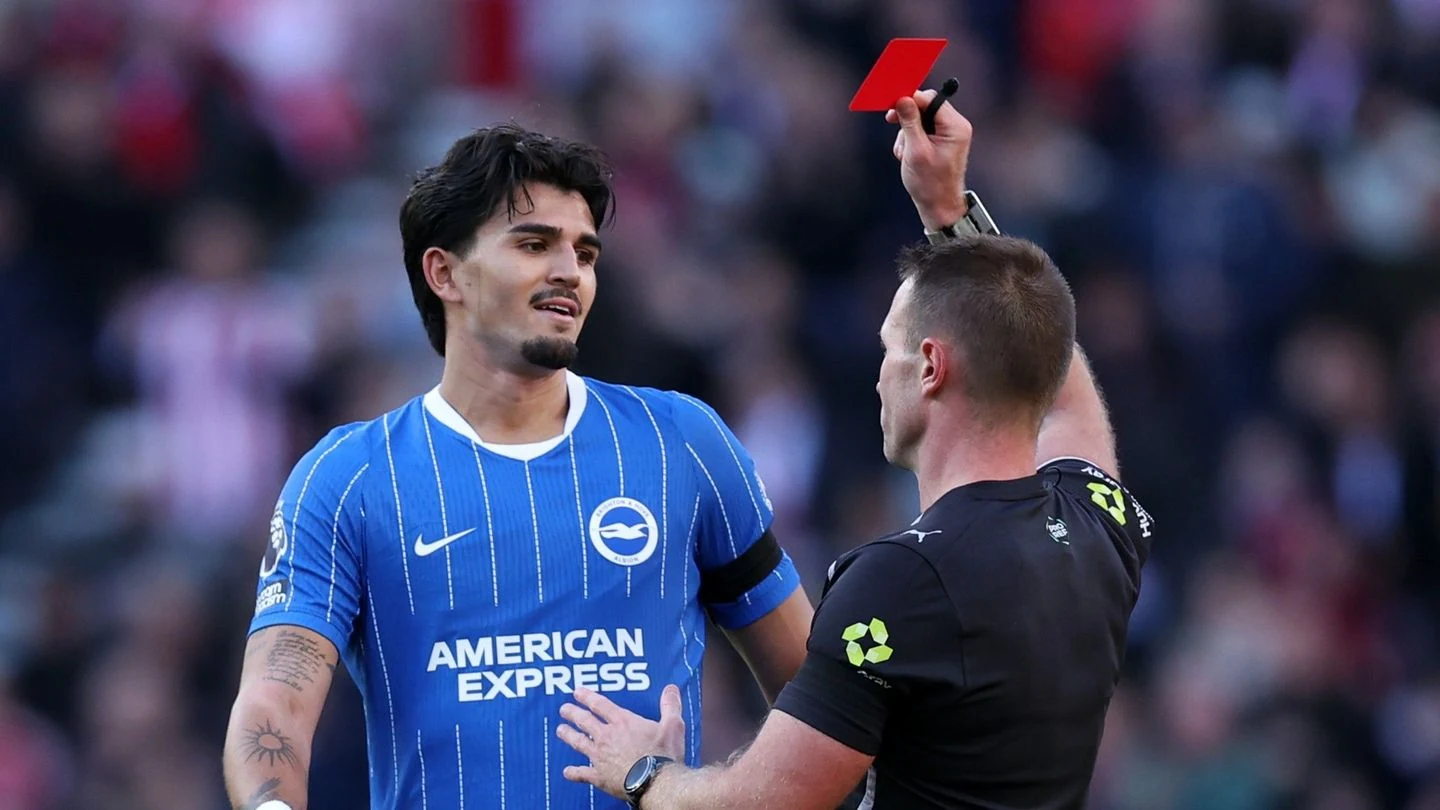
Pascal Struijk's red card against Sunderland was rescinded after an independent regulatory commission upheld Brighton's claim of wrongful dismissal. Brighton confirmed on 14 October 2026 that the resulting one-match suspension had been removed. The dispute concerned a denial of an obvious goalscoring opportunity, usually shortened to DOGSO, after a video review. The confirmed outcome is clear; the club's announcement does not publish the commission's detailed reasoning, so a commentator's explanation should not be presented as that body's official findings.
The case is useful because it contains several questions which are often bundled together. Was there a foul? Was the opportunity genuinely obvious? Did the original decision justify intervention by VAR? And what could a later disciplinary claim change? Understanding those separate questions also explains how a refereeing assessment panel could take a different view without restoring a suspension. This guide follows the official match explanation and Brighton's confirmed outcome, then applies the relevant rules rather than guessing what was said in private deliberations.
What happened at Sunderland and what changed afterwards
During Sunderland–Brighton on 10 October, Wilson Isidor went down after a challenge from Struijk while pursuing a through ball. The Premier League's official incident record identifies the 57th minute. The initial play-on decision was followed by a video recommendation and an on-field review, after which the referee awarded a direct free-kick and dismissed Struijk for DOGSO. Brighton finished the match with a 2–0 victory. That sequence matters because the disputed decision was an intervention which changed the on-field assessment, rather than a red card given immediately and simply confirmed on video.
The next development was disciplinary: Brighton announced a successful wrongful-dismissal claim on 14 October. A later report on 21 October described a different body's assessment of whether the video intervention had been correct. Reading those headlines as successive reversals of the same suspension creates unnecessary confusion. One concerned the player's disciplinary status; the other concerned the evaluation of officiating. Neither headline by itself tells a reader everything about the legal test, the evidence considered or the powers of the body involved.
| Date in 2026 | Development | What it establishes |
|---|---|---|
| 10 October | DOGSO red after review at Sunderland | The live referee decision |
| 11 October | League publishes matchweek explanation | The reason announced during the match |
| 14 October | Brighton confirms successful claim | Red rescinded and one-match suspension removed |
| 21 October | Sky reports split KMI assessment | A separate evaluation supported VAR intervention by 3–2 |
What DOGSO actually requires
DOGSO concerns an obvious opportunity denied by an offence; it is not simply a label for any cynical foul during an attack. Deciding that contact was illegal and deciding that the attacking opportunity was obvious are related but separate steps. An attacker can be fouled while chasing a ball which was unlikely to become controllable. Equally, a player need not already have the ball neatly at their feet for the possibility of gaining control to matter.
Law 12 asks officials to consider the distance from goal, the general direction of play, the likelihood of keeping or gaining control and the location and number of defenders and attackers. Those factors need to be read together. A central route towards goal can be highly threatening, but an overhit pass and a well-positioned goalkeeper may change the opportunity. A defender's absence from one television frame does not make the remaining criteria disappear.
Why the likelihood of controlling the ball mattered
The public disagreement in this case focused on whether Isidor would have gained the ball before Bart Verbruggen. The speed of the pass, the goalkeeper's position and the effect of the challenge all bear on that question. A pass travelling into the goalkeeper's reach can be different from a ball an attacker is about to collect with a clear route to goal. That is why a replay showing the ball running through does not make the debate merely about how hard Struijk made contact.
The assessment is also counterfactual: what opportunity was available without the offence? Watching the goalkeeper collect the ball after the attacker has been impeded cannot, by itself, prove that the attacker would never have reached it. Conversely, assuming that every unimpeded runner wins the race ignores the control criterion. Compare the players' movement before the challenge, not just the final position of the ball. The club's successful-claim announcement does not say precisely how the commission weighed those images, so that reasoning should remain separate from a viewer's own reconstruction.
The last-defender shortcut and the penalty-area exception
There is no automatic sending-off rule simply called being the last defender. The phrase is a convenient description, but it leaves out direction, control and the positions of other relevant players. Imagine a final outfield defender fouling an attacker whose pass is already running out of play: the absence of another defender alone cannot establish an obvious chance. Reverse the circumstances and an attacker may have a clear opportunity even though another defender exists elsewhere on the pitch, too far away to affect it.
A further distinction explains why a different DOGSO incident might earn yellow. When a penalty is awarded for an offence which was an attempt to play or challenge for the ball, Law 12 provides mitigation. Holding, pulling, pushing or having no possibility of playing the ball does not get that protection. The League illustrated the distinction in its September Greaves–Cunha explanation. Struijk's announced restart was a direct free-kick, so a comparison with a genuine ball challenge punished by a penalty and yellow does not automatically establish inconsistent card treatment. Check both the location and the nature of the offence.
Why the VAR intervention was a separate controversy
An eligible DOGSO incident is not automatically a required overturn. Officials must also apply the Premier League's high intervention threshold. This creates a second argument beyond the underlying foul: did the footage clearly establish that leaving the original decision alone was wrong? Supporters can reasonably discuss both matters, but a conclusion about one does not mechanically answer the other. The specific nature of the alleged error is more useful than a general insistence that the referee missed something.
Playing on counts as an original decision. VAR does not need a prior whistle in order to recommend review of a potential direct-red offence, but it also does not have permission to re-referee every challenge. Subjectivity does not place DOGSO entirely beyond review; it makes the evidence and intervention threshold particularly important. Once the referee goes to the monitor, the final decision remains theirs. The screen is a source of evidence rather than a command requiring a particular card.
A foul, a yellow card and a clear VAR error are different judgments
The first question is whether the challenge broke the laws. The second concerns its disciplinary consequence: did it merely stop a promising attack, deny an obvious opportunity, or satisfy another card offence? The third asks whether the original decision was sufficiently wrong for intervention. A viewer saying that a free-kick should have been awarded may have a strong view about the first question while remaining unconvinced about the second and third. The red-card review cannot be justified solely as a convenient way to retrieve an otherwise routine missed yellow.
The official KMI explanation makes this distinction explicit. A panel can regard a referee's call as incorrect and still consider non-intervention appropriate because the error did not meet the required standard. Equally, an actual DOGSO error may be clear enough to justify review even though assessing opportunity necessarily involves judgment. These are procedural positions, not proof of bias or an instruction that every close call must be ignored. In Struijk's case, the sensible disagreement concerns both the opportunity available to Isidor and what the video evidence established strongly enough to change the initial call. Those should be stated separately when comparing opinions.
Why the two panels could reach different answers
The Premier League's 21 October Match Round 6 assessment directly addresses the apparent contradiction. It continues to record the VAR outcome as correct in the KMI evaluation even though the regulatory commission upheld the wrongful-dismissal claim. That is possible because these are separate bodies with different purposes and processes. The publication does not say that one panel restored the ban or that the successful claim has ceased to count.
Two groups looking at the same footage do not become one combined appeal tribunal. Their membership, questions and authority matter more than simply adding their votes together. A split assessment of refereeing performance is not a fresh disciplinary charge. Likewise, a disciplinary outcome does not oblige every independent evaluator to adopt the same interpretation of the original match incident.
| Body | Main question here | Effect to distinguish |
|---|---|---|
| Match officials | What decision should be made during the match? | Red card and restart at the time |
| KMI panel | Were the decisions and VAR action correct? | Assessment and feedback |
| Regulatory commission | Should the suspension follow this dismissal? | Decision on wrongful-dismissal claim |
The KMI panel assesses refereeing decisions
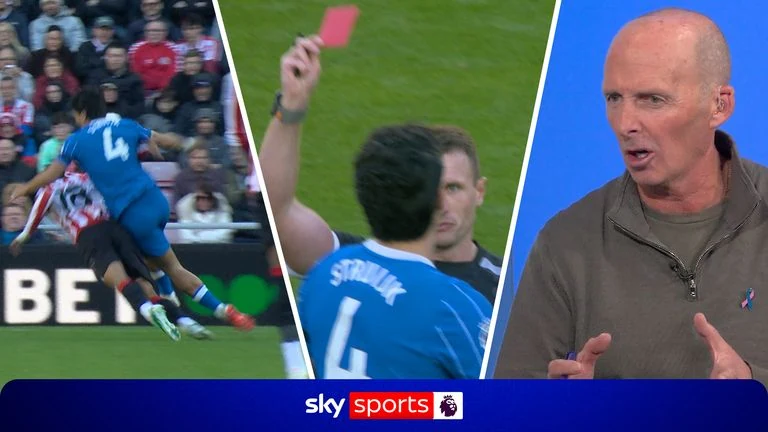
The KMI panel has five members: three former players or coaches, one Premier League representative and one Pro Ref representative. Its role is to assess important match decisions and provide an independent perspective which informs officiating. Members first consider the original decision and then, where relevant, whether an error justified video intervention. That structure explains why a published assessment may contain different votes for related questions instead of one undifferentiated verdict about the whole passage of play.
For Struijk, the official account records 3–2 support for the VAR outcome and disagreement over whether Isidor was likely to gain possession. A 3–2 vote is a divided judgment by five panellists; it is not a statistical calculation that an attacker had a 60 per cent chance of controlling the ball. Nor does it quantify how representative the verdict is of all supporters or referees. The useful information is the issue on which the assessment turned and the procedural question being evaluated. KMI's role does not give its majority authority to reimpose the one-match suspension.
The regulatory commission decides the wrongful-dismissal claim
The current FA Handbook's Fast Track 4 procedure is more specific than the everyday phrase appealing a red card. It concerns whether a suspension should be imposed in light of the facts, and requires a claim that the referee made an obvious error in dismissing the player. The procedure uses video and written evidence. It also explicitly preserves the dismissal on the club and player's record rather than substituting a new version of what happened during the match. This is a disciplinary remedy, not a chance to replay the remaining minutes with an extra player.
Brighton's announcement confirms the concrete benefit: the one-match suspension was removed, making Struijk available for selection for the following Crystal Palace fixture. Availability for selection does not guarantee a start or establish a player's fitness. The announcement does not set out a complete written explanation of how the commission assessed every DOGSO criterion. It would therefore be inaccurate to turn a pundit's preferred interpretation into a detailed finding supposedly made by that commission. The official result can be stated firmly while keeping the limits of the published explanation clear.
What the successful claim changes and how to read the next incident
The successful claim removed the suspension. It could not return the minutes Brighton played without Struijk, and it did not replace the recorded 2–0 result with a hypothetical score. That distinction applies even when a club wins the match: the disciplinary question still matters for the next selection, while the consequences of the live dismissal during the completed game cannot simply be unwound. Describing a card as rescinded is common shorthand, but it should not suggest that the original event has vanished from the match's history.
- Establish whether an offence occurred before debating its card.
- Check the actual DOGSO criteria, especially control and the relevant players' positions.
- Identify the original call and the separate threshold for VAR intervention.
- Identify which body issued the later finding and the question it considered.
- Check the stated disciplinary consequence instead of assuming a score or table change.
Use that sequence when the next apparent comparison appears. A still image of two last defenders does not show whether the passes were equally controllable. A penalty-area challenge may have a different sanction from an offence punished by a direct free-kick. A panel criticising a referee's decision may still regard non-intervention as correct. Comparing incidents fairly therefore requires more than matching the colour of the shirts or the final card. It requires the same legal question, similar material facts and the appropriate decision-making stage.
For the practical aftermath, follow the club's confirmed disciplinary availability and then its actual team news. Use the recorded Premier League results and current table for the competition outcome, and the weekend schedule to locate the next fixture. A removed ban establishes eligibility on that disciplinary issue, not a promised appearance. Keeping those distinctions clear allows a stronger criticism of a disputed decision: you can challenge its reasoning without attributing powers to a panel which it does not possess.
Comments
Ask a useful question or share a helpful tip. Comments are reviewed before publication.
Loading comments…