AFC Bournemouth is the club's formal name; its historical intended expansion needs a qualification. Club historian Neil Vacher interprets AFC as Athletic Football Club, based on his examination of board minutes reported in an August 2026 interview. That is more specific evidence than assuming the letters must mean Association Football Club. Keep AFC Bournemouth when identifying the club, and attribute the Athletic explanation when discussing its history.
The initials are only one part of the identity. Boscombe belongs to the naming story, the Cherries is the nickname, and Dean Court and Vitality Stadium refer to the ground. None of those labels tells you which division a team played in during a particular season. This guide separates those questions so that an old match report, a present-day fixture listing and a club-history page can be read together without confusing different names with different clubs.
What does AFC mean in AFC Bournemouth?
The careful answer starts with the difference between a name and an explanation of that name. The Premier League's club-name history uses AFC Bournemouth. In Jack Tanner's interview with Neil Vacher, the historian identifies Athletic Football Club Bournemouth as the intended historical meaning while explaining that the name has been written in its AFC form. Those statements address different things: the label a reader should use and the reasoning behind its letters.
That distinction makes a practical difference when writing a profile or checking a search result. Expanding an abbreviation automatically can turn an explanatory guess into an apparently official title. Association Football Club may look plausible to someone familiar with football terminology, but plausibility alone does not establish Bournemouth's particular naming decision. A reliable short description therefore keeps the familiar AFC Bournemouth spelling. A longer historical explanation can introduce Athletic with the historian's attribution attached. This approach also lets a reader understand why older summaries disagree without treating every variation as a separate institution. It avoids pretending that an acronym dictionary supplies the same evidence as a study of this club's records.
Why the AFC prefix matters in alphabetical lists
One explanation for putting the initials first is their effect on an alphabetical directory. Vacher describes that motive as part of the change, alongside a wish to modernize the club's image. It is sensible to preserve that qualification: a useful alphabetical position can explain part of a branding choice without explaining everything the people making it wanted to achieve.
Consider a simple example of literal alphabetical sorting. A list containing AFC Bournemouth and Arsenal places AFC Bournemouth first because the comparison begins with AFC. If an editor shortens the first entry to Bournemouth, Arsenal comes first. The underlying football club has not changed; the displayed text has. A directory, a results app and a broadcaster can therefore order the same clubs differently if they use different naming conventions. Look at the actual label before drawing conclusions about whether an alphabetical list is mistaken.
This has no bearing on winning matches. A league table normally reflects sporting results, with its competition's tie-breaking rules applied where necessary. An alphabetical display before matches have been played is only a presentation choice. The prefix is useful when identifying a club and understanding its branding, but it is not evidence of superior league position. When comparing tables on two websites, check the season, matches played and points before worrying about whether the club is filed under A or B.
From Boscombe to Bournemouth and Boscombe Athletic
There are three useful dates to keep separate. The Premier League's history places the present club's foundation in 1899 as Boscombe Football Club, its longer Bournemouth and Boscombe Athletic name in 1923, and the AFC Bournemouth name in 1971. The Football Club History Database independently records the latter two transitions. Foundation, admission to a competition and a change of name are different events, even when two of them happen in the same year.
| Year | Name in the timeline | How to interpret it |
|---|---|---|
| 1899 | Boscombe Football Club | Foundation of the present-day club. |
| 1923 | Bournemouth and Boscombe Athletic | Wider local name adopted with entry into the Football League. |
| 1971 | AFC Bournemouth | Current name adopted, rather than a new club founded. |
The longer middle name is particularly helpful because it preserves both geographical labels. The league explains the 1923 change as a way to reflect the locality more fully. Reading that name today, you can see Boscombe retained rather than erased when Bournemouth was added. This is why a reference to Boscombe in an older account should send you to the period of the story before you decide that it concerns an unrelated team. Conversely, a modern search result using AFC Bournemouth may be indexing a season in which the club played under its older name. The title of an archive page and the name printed on an original programme need not match word for word.
A good historical note therefore includes both a date and the name relevant to that date. For example, describing Football League admission in 1923 gives a reader a different milestone from explaining the 1971 rebranding. Combining them into a sentence saying the club was established as AFC Bournemouth in 1971 would lose the earlier history. The same care helps with anniversary material: an anniversary of the club's foundation measures the whole institution's history, whereas an anniversary of its present name measures a shorter period. You do not need to resolve every spelling convention, such as an ampersand versus the word “and,” to recognize that continuity. Keep the chronological events separate and the naming sequence becomes much easier to follow.
Why Bournemouth are called the Cherries
The Cherries is Bournemouth's familiar nickname, but its precise origin is less certain than the nickname itself. The Premier League gives two possible explanations: the club's red striped shirts, or cherry trees on the Cooper-Dean estate beside Dean Court. The Beautiful History's account also preserves both traditions. Neither account requires a reader to choose one explanation as conclusively proven.
The difference between a convincing association and a demonstrated origin is easy to overlook. Red clothing makes a fruit-based nickname understandable, and a nearby estate offers a local connection. Those observations explain why the stories fit the club, but they do not by themselves identify the first person who used the nickname, the first match at which it was chanted, or which association came first. A description that says the nickname “may come from” either tradition communicates the available evidence more accurately than a story that invents a decisive moment. You can enjoy the local associations without turning uncertainty into an unsupported date or anecdote.
In a fixture report, the nickname has a simpler job: it gives writers and supporters another recognizable way to refer to the team. A headline saying the Cherries have a home match is not announcing a separate club or a different competition. Match the nickname to AFC Bournemouth and then look at the opponent and date. Likewise, the absence of the word Cherries from a shirt, stadium sign or statistical table does not undermine that identification. A formal name and a supporter nickname serve different purposes, and one does not have to appear every time the other does.
Dean Court, Vitality Stadium and the club's visual identity
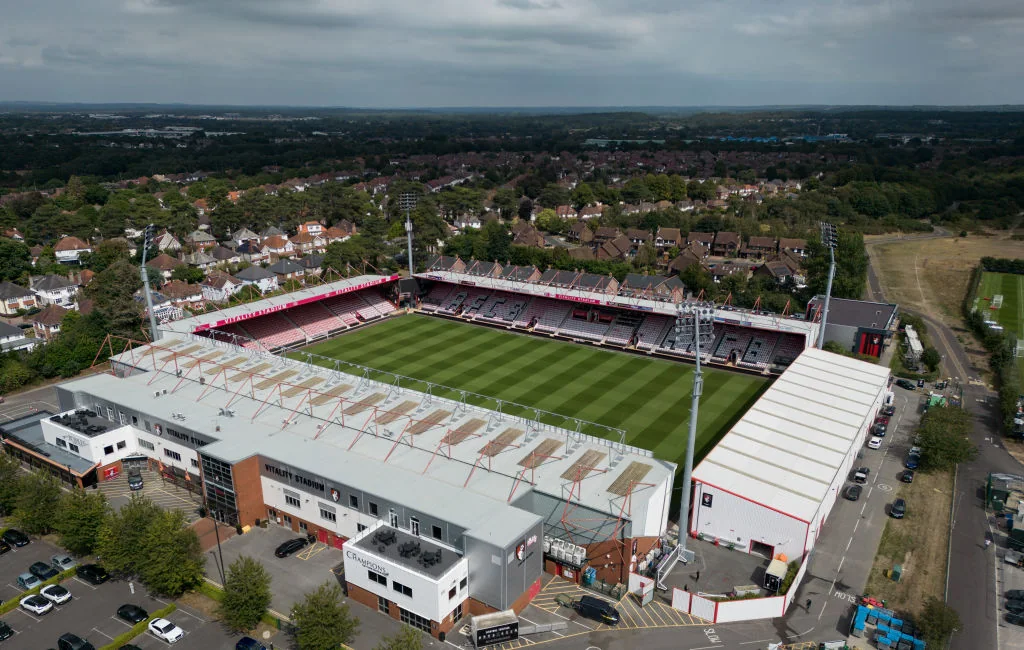
Dean Court and Vitality Stadium refer to the same ground, with Vitality Stadium the sponsored name. Dean Court preserves the connection to the Cooper-Dean benefactor described in the club's ground history. This explains why an older match report and a more recent fixture listing can use different stadium names without indicating that the club moved for that match. Ground names should be checked alongside the address and match date rather than treated as completely separate destinations just because the wording differs.
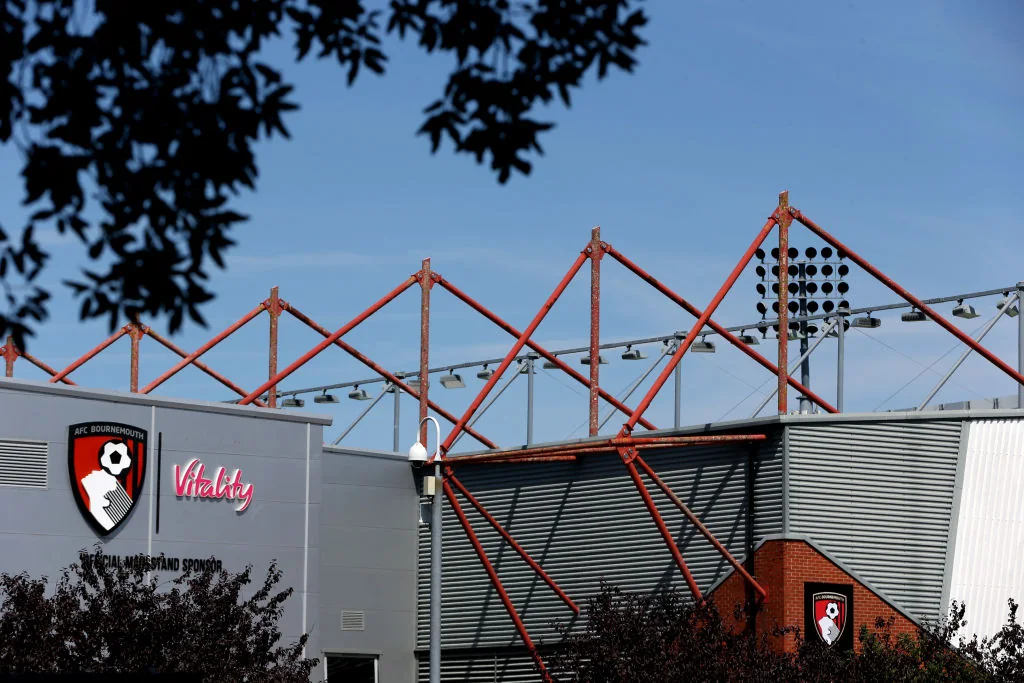
The badge adds another layer. The Beautiful History identifies the head-and-ball silhouette with former striker and commercial manager Dicky Dowsett. That is a badge explanation, not evidence that the nickname came from a pictured cherry: the silhouette, the club colours and the Cherries name do not need to tell the same story. When describing a shirt or programme, distinguish the symbol you can see from the explanation supplied by a historical source. A photograph can show the design; identifying its subject requires additional evidence.
For a visitor, this separation is useful. AFC Bournemouth identifies the institution, the Cherries identifies it informally, and the stadium name identifies its home venue. The exterior photograph here shows the badge and sponsored signage together, making that relationship visible. It is a historical photograph rather than a promise that every sign, entrance or surrounding arrangement will be identical on your visit. Use the club's current match and visitor information for arrival instructions, while using the photograph to understand the identity. That keeps a naming guide useful without asking an older image to answer a travel question it cannot settle.
How Bournemouth reached the Premier League
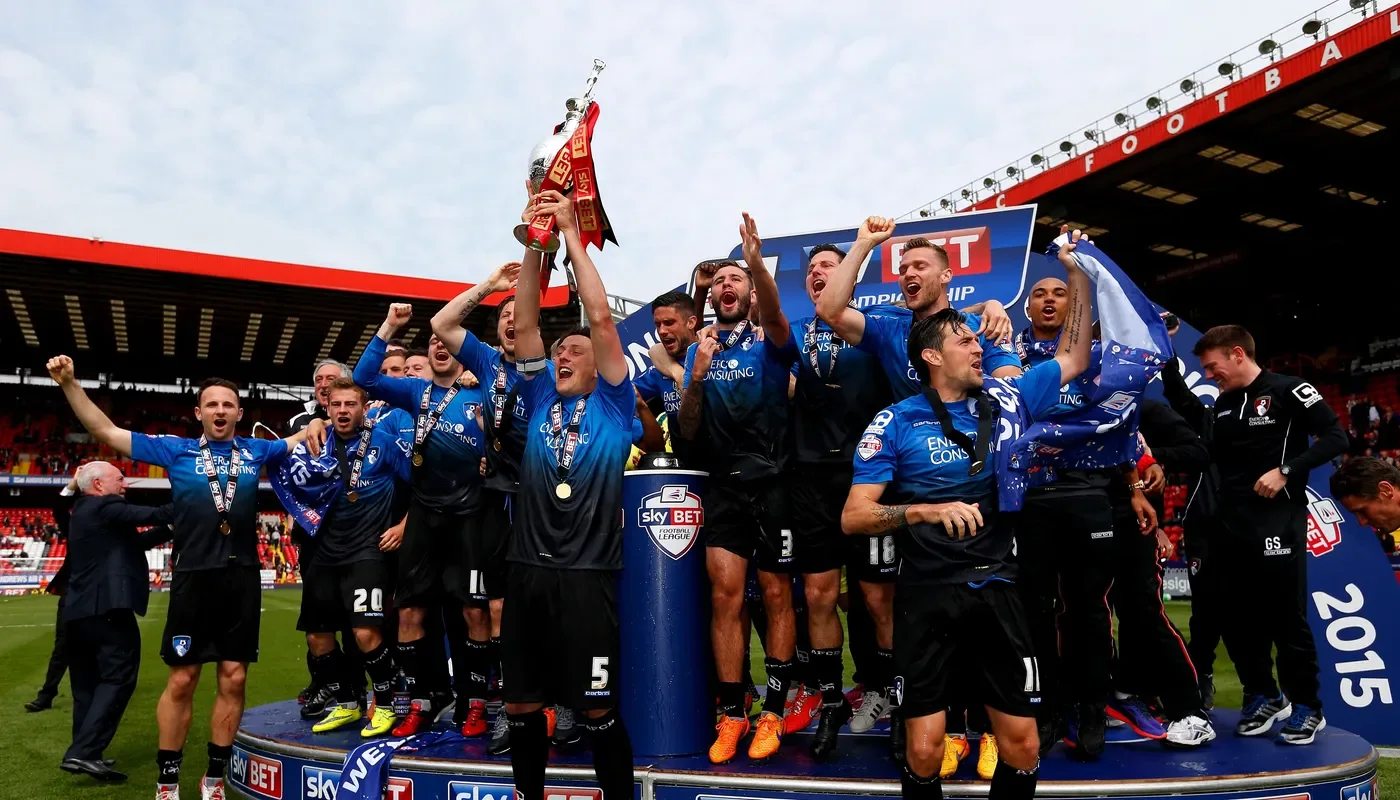
Bournemouth's first Premier League season was 2015/16, following the 2014/15 Championship title. The photograph below records that Championship achievement: the league's Tommy Elphick feature identifies him lifting the 2014/15 Championship trophy. Winning the division below the Premier League and earning promotion into the Premier League are connected achievements, but calling the pictured celebration a Premier League title win would describe a different competition.
| Season | Achievement | Next league level |
|---|---|---|
| 1986/87 | Division Three champions | Old Division Two, the second tier. |
| 2009/10 | League Two runners-up | League One, the third tier. |
| 2012/13 | League One runners-up | Championship, the second tier. |
| 2014/15 | Championship champions | Premier League, the top tier. |
| 2021/22 | Championship runners-up | Return to the Premier League. |
Historical division names need particular care. The database records a Division Three championship in 1986/87 and promotion to Division Two. In that period, Division Two was the second tier. It also records Division Three being redesignated Division Two when the Premier League was formed in 1992. That later change of label did not itself represent Bournemouth winning promotion. Reading only the number in a division's title can therefore give a misleading account of the club's progress. The safer comparison is the tier in the English league system, paired with the season and whether the event was a sporting promotion or a competition-wide renaming.
Arrival in the top flight was followed by a different task: staying there. The official 2015/16 season review confirms that promoted Bournemouth earned safety; the historical results table records a sixteenth-place finish. That result answers how the first Premier League campaign ended. It does not change what the preceding Championship trophy represented. A season spanning two calendar years also makes loose wording such as “Bournemouth won in 2015” unhelpful: specify the competition and season to distinguish promotion celebrations from the opening months at the higher level.
The subsequent record includes relegation in 2020 and promotion back after the 2021/22 Championship season. That interruption is important when an old profile appears to describe Bournemouth as continuously in the Premier League. Club identity persists through a change of division, while competition membership belongs to a particular season. The name AFC Bournemouth, the Cherries nickname and the ground can help you recognize the club across those records, but none substitutes for checking the season's league entry. This is also why a historical guide should preserve its dated milestones instead of presenting an old promotion as the answer to every present-day question about league status.
Follow the right Bournemouth club and the right fixture
There is also a separate Bournemouth FC. Its official website identifies the club as the Poppies and its men's home ground as Victoria Park. That gives you two useful checks against confusing it with AFC Bournemouth, the Cherries at Dean Court. In casual conversation, “Bournemouth” may be enough when everyone knows the context. In a ticket search, archive query or list of local fixtures, the fuller identity matters because two institutions can share the place name without sharing a team or venue.
A useful match lookup starts by checking the club, then the team section and competition. A result for a youth fixture, women's fixture or different local club does not become the men's Premier League fixture because Bournemouth appears in the title. Next compare the opponent, season, date and home-or-away status. Those details are more discriminating than a single keyword. If you are trying to identify an old programme, use the period's club name and the competition together. If you want to attend a match, the current official listing and venue take priority over the historical spelling in an archive.
Even the right fixture can carry an outdated time. The Premier League's fixture guidance explains that broadcast selections and clashes with domestic or European cups can change the date, kickoff time or both. An original fixture-release graphic is therefore useful for the season's pairings, but it may no longer settle a travel plan. Check the latest league or club confirmation before making arrangements, and recheck a match if the listing says it is subject to change. A historical club guide cannot freeze a season's schedule.
For current games, open the Premier League schedule for today and identify Bournemouth's match by its full row. Then use the Premier League TV schedule for the viewing market you need. Confirm the displayed timezone before interpreting “today,” because a calendar date can differ between the UK and your location. Finally, separate kickoff from a broadcaster's programme start: arriving for the match and turning on a pre-match show are different timing decisions. The club's name and history help you recognize the team; the current fixture, venue and viewing assignment supply the details needed to follow it.
Comments
Ask a useful question or share a helpful tip. Comments are reviewed before publication.
Loading comments…